
The AI Advantage: How Artificial Intelligence is Empowering a Smarter Future
From classrooms to hospitals, offices to homes, AI is no longer a distant dream—it’s the quiet force helping humans unlock creativity, efficiency, and innovation

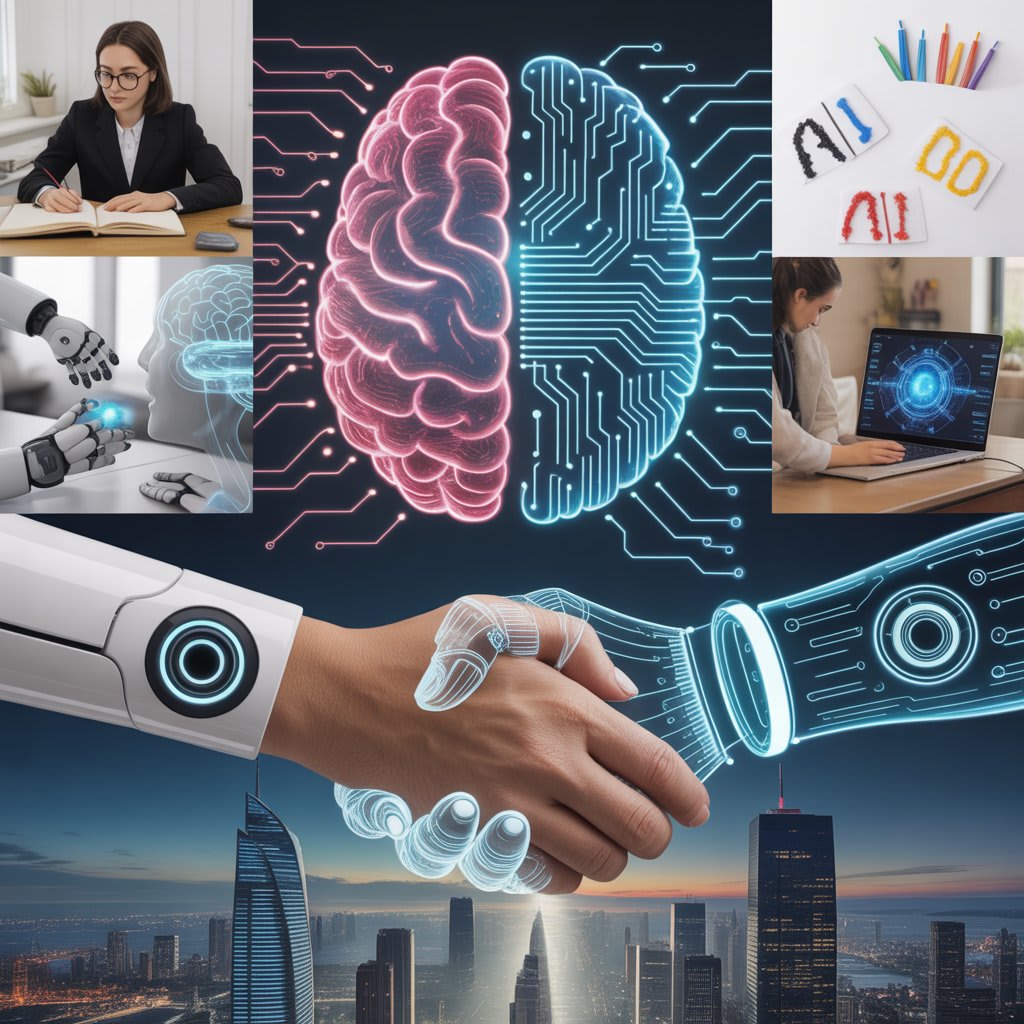
The AI Advantage
Why Artificial Intelligence Isn’t Just About Machines, but About Unlocking Human Potential
The phrase “Artificial Intelligence” often sparks mixed emotions. For some, it sounds like a futuristic dream—machines that can learn, adapt, and work alongside us. For others, it triggers fear of replacement, job loss, or a world where robots overshadow humans. Yet, when we step back and look at how AI is actually being used today, a more balanced picture emerges: AI isn’t here to replace us. It’s here to enhance us. This, in essence, is the AI advantage—the ability to amplify human creativity, productivity, and possibility.
AI in Daily Life: The Invisible Helper
Most of us already live with AI without realizing it. When Google Maps finds the fastest route through traffic, when Netflix suggests the perfect movie for a lazy night, or when your phone corrects a typo mid-text—AI is quietly working in the background.
It doesn’t demand attention. It doesn’t take credit. It simply makes life smoother. This invisible partnership is where AI shines most—helping us make better decisions, saving us time, and reducing frustration in ways that feel almost magical.
Education: Personalized Learning for Everyone
One of the most powerful advantages of AI is how it can transform education. No two students learn in the same way, yet classrooms often expect them to. AI-powered tools are beginning to change that.
Imagine a student struggling with math. Instead of being left behind, an AI tutor can identify their weak points, break down problems step by step, and explain concepts in new ways until they click. At the same time, advanced learners can be challenged with more complex tasks, keeping them engaged instead of bored.
This isn’t about replacing teachers—it’s about empowering them. Teachers can focus on creativity, empathy, and mentorship while AI handles the repetitive practice drills and personalized pacing. The result? A classroom where every student has the chance to succeed.
Healthcare: From Diagnosis to Compassion
In medicine, the AI advantage is already saving lives. Algorithms can scan medical images with astonishing accuracy, catching early signs of diseases like cancer that the human eye might miss. AI doesn’t get tired or distracted, making it a powerful partner for doctors.
But AI in healthcare isn’t just about numbers and scans. Imagine an elderly patient living alone. With AI-powered health monitors, their heart rate, sleep patterns, or blood sugar can be tracked in real-time. If something unusual happens, alerts can be sent instantly to family members or doctors. That kind of quiet vigilance creates peace of mind—not just for the patient but for their loved ones.
And again, this isn’t about replacing doctors or nurses. It’s about giving them sharper tools and more time to focus on what only humans can give—compassion, reassurance, and healing presence.
Work and Productivity: Doing More of What Matters
AI’s role in the workplace is often framed as a threat: “robots taking our jobs.” But the reality is more nuanced. In many industries, AI doesn’t eliminate jobs—it eliminates tasks.
Think of the endless emails, scheduling conflicts, or data entry that drain hours from a workday. AI assistants can handle those in seconds, freeing workers to focus on strategic thinking, creativity, or human connection. Instead of being chained to routine tasks, employees can spend more energy on projects that actually inspire them.
In creative fields, AI acts as a collaborator. Writers can brainstorm with AI tools to overcome blocks. Designers can test dozens of variations of an idea in minutes. Musicians can use AI to generate background sounds and experiment with melodies they might not have discovered on their own. Instead of limiting creativity, AI opens new doors.
Environment and Global Challenges
Beyond personal life and work, AI is proving to be a powerful ally in solving global problems. Climate change, for instance, is too complex for humans to track alone. But AI can analyze vast amounts of environmental data, helping scientists predict weather patterns, monitor endangered species, and design more efficient renewable energy systems.
In agriculture, AI-powered sensors can tell farmers exactly how much water or fertilizer their crops need, reducing waste and protecting the planet. The advantage here is clear: AI allows us to use resources wisely and responsibly, giving us a better chance at sustaining life on Earth.
Facing the Fears
Of course, acknowledging the AI advantage doesn’t mean ignoring the challenges. Ethical questions remain: How do we prevent bias in AI systems? How do we ensure jobs evolve instead of vanish? How do we balance privacy with the benefits of data-driven insights?
These are real concerns, but they are not unsolvable. The key lies in treating AI not as a replacement for human intelligence, but as a partner to it. With responsible development, strong ethics, and transparency, the risks can be managed while the advantages are expanded.
The Human Advantage in the Age of AI
Perhaps the most surprising lesson AI offers us is not about machines at all, but about ourselves. AI forces us to ask: What is uniquely human?
A machine can analyze data faster than we ever could, but it cannot feel empathy. It can generate a poem, but it cannot know heartbreak. It can simulate conversation, but it cannot truly understand what it means to laugh with a friend or cry over a memory.
That’s the real AI advantage—it frees us from the repetitive, the mechanical, the ordinary, so we can spend more of our lives on what is extraordinary: creativity, love, compassion, and connection.
Conclusion: A Partnership, Not a Competition
Artificial Intelligence is not the end of humanity. It is the beginning of a new partnership. Like electricity or the internet, AI is a tool—a powerful one—but still a tool. Its advantage lies not in replacing us, but in helping us become more of who we are.
The AI advantage, then, is really the human advantage. When machines take care of the background noise, we gain the freedom to focus on music, art, relationships, and dreams. And maybe, in this partnership, we’ll finally have the time to create the world we’ve always imagined
About the Creator
Keep reading
More stories from hazrat ali and writers in Futurism and other communities.
The Silent Partner: How AI is Already Changing Our Everyday Lives
The Silent Partner: Everyday Benefits of AI We Don’t Notice When most people hear the words artificial intelligence, their minds leap to futuristic robots, self-driving cars, or even science fiction movies where machines outsmart humanity. But the truth is, AI is not some distant dream or dystopian fear—it is already here, quietly shaping our daily lives. In fact, most of us are using AI dozens of times a day without even realizing it.
By hazrat ali5 months ago in Geeks
About Binding Prometheus
I want to start actively advocating on behalf of my own work, and the most valuable part of my canon is, without a doubt, Binding Prometheus, the play I have been working on since 2019 and only finished in 2023 as part of my MA. The play itself is an amalgamation of a million different inspirations. On one end, it evokes the Ancient Greek myth-play, deriving its own title from the earliest extant work of Western drama we have, Aeschylus’s Prometheus Bound. On the other end, it borrows significantly from the sci-fi bulwarks from over the years, namely Mary Shelley’s Frankenstein and Karel Capek’s Rossum’s Universal Robots. The play could be an episode of Black Mirror, I fear. I don’t know. I’ve only ever seen one episode of Black Mirror.
By Steven Christopher McKnight12 days ago in Futurism
Saudi Arabia Hospitality Market: Tourism Growth, Vision 2030 & Demand Expansion
According to IMARC Group's latest research publication, Saudi Arabia hospitality market size reached USD 53.2 Billion in 2025. The market is projected to reach USD 115.8 Billion by 2034, exhibiting a growth rate (CAGR) of 9.03% during 2026-2034.
By Suhaira Yusufabout 15 hours ago in Futurism


Comments (1)
nice and positive thoughts