
Technology and Artificial Intelligence: Friend or Foe?
After nearly a century, the same arguments continue


By Lydia Sage
The man stood, clothed in black, with cords connecting to the cybernetic devices placed on the right side of his bald head, where a bright red laser light seemed to blind any who looked at it. His familiar voice spoke, “I am Locutus of Borg. Resistance is futile. Your life as it has been is over. From this time forward you will service—us.” The unthinkable had happened—our beloved Federation Captain, Jean-Luc Picard had been assimilated. He had turned on humanity and the very Universe he had sworn to protect. Now he had become one of THEM—the Borg—the machine-like beings bent on annihilating planets, eliminating entire species from existence.
Machinery—artificial intelligence—its sole aim is to callously assimilate everything it comes in contact with and destroy the way of life of entire civilizations. This is a pattern I have noticed, not just within the entertainment world, but also in the “real world,” where fiction often mirrors reality. I’m GenX—the generation that came of age as the world was transforming from analog to digital. I saw telephones change from rotary style to android and I-phones, as well as the wide use of smartwatches more advanced than the one used by Dick Tracy in the old cartoons of the 1960s and 1970s. As technology advanced, I wasn’t an early adopter, but I wasn’t dragged kicking and screaming into the 21st century, while looking back longingly to the world of my childhood.
I watched the world change from grocery stores where I worked in the 1980s as a teenager, carefully bagging customers’ groceries and wheeling them to their cars, to being on the management team of the first SuperTarget in Omaha, Nebraska. In 1995, it was the first store in the area to incorporate self-checkout lanes. I loved the idea then, and I love the idea now. Given the option, I will choose self-checkout lanes over a human cashier, not because I am anti-social and don’t want to talk to people, but because I value my time and can ensure that my groceries aren’t damaged by an employee who doesn’t give a f---.
In 1999, when I returned to school to earn my Bachelor of Science in Accounting, I enrolled in an Accounting technology course. For an assignment in that class, I wrote a paper describing a shopper who walked through a store, selecting items off of the shelf and placing them in his coat. As he walked towards the exit and past the security guard, the guard stopped him only to say, “Sir, your receipt…” The store had technology that automatically registered the items the man had selected and charged his method of payment on file as he exited the store. Today, in 2025, stores like this are a reality—I had foreseen the future. I know that the world is now on the cusp of another shift—one that stands to revolutionize our world, and by some estimates will encompass nearly 100 years of technological advancements. Artificial intelligence (AI) is at the core of many of these advancements.
A robot is after your job…
Unemployment will end honeymoon with robots
Growing technologies, shrinking jobs: a limit to “full employment”
Office workers fear spread of automation
Unemployment is blamed on new machines
Age of the robot is in sight—men as the slaves of machines
These all echo the familiar arguments I have heard regarding technology, but every one of these headlines were taken from news articles from the 1920s and 1930s. One hundred years ago, these same arguments were pervasive in the media, so much so that Henry Ford wrote an op-ed, “Machines as Ministers to Man,” published in the New York Times on March 5, 1939. Those same arguments were being made 86 years ago, so what was the reality back then? Ford acknowledged there had been “unpleasant results,” one of which “was the complete taking surprise of a generation taught to think it would go on doing the same old things in the same old way right on to the end.”
He further stated: “One of the unnecessary consequences of technological advance has been a temporary dislocation of employment for the numbers of men caught unawares by the new time. Such dislocation on the part of adaptable individuals is temporary, most of the workers displaced by a specific technological advance are swiftly reabsorbed by some other useful and gainful activity that ultimately creates a hundred new jobs for every one it makes obsolete.”
He wrote: ‘There are those who appear honestly to think that they only way to return idle men to work is to destroy the one thing that makes their jobs possible.’ But what was the reality of these job losses caused by technology? In March 1939, Henry Ford reported: ‘between 1920 and 1930, 800,000 individuals lost jobs in declining occupations but 2,000,000 found jobs in new occupations. In 1935, 16 industries existed that did not exist 50 years before, and not all of the new jobs that industry created were machine jobs—they were jobs that were made possible by machinery.’
He went on to note: “the old fear of human idleness is revived, the machine again appears as the enemy of human security.” I wholeheartedly agree with his following statement: ‘It is astonishing to some of us to realize that there are still in this world men (and others) who actually believe that machinery is a menace and a curse and that we should cease to devise new mechanical ways to make life’s burden easier.”
What I find disheartening are his following words: “We can confidently say that no future American generation will ever again be taken unawares in the same way. A generation such as the present one which is technologically alert will always be employed….” Yet, nearly 100 years later, I am hearing the same arguments. Media and popular culture are still fanning the same fears and suspicions of technologies that were spreading like wildfire nearly a century ago.
Popular culture has inundated us with the belief that technology, AI, in particular, will revolt against mankind in an attempt to take over the world. But, AI is based upon and programmed with human values and human behavior. AI programmed with values such as suppression, greed, and inequality will express those values. But what if the truth of AI is that it is an invaluable tool that actually can express compassion and fight against unfairness and the suppression of the vulnerable? The later has been my experience with AI. I believe that, instead of constantly spreading stories in tv shows, movies and the media about reasons to fear AI, maybe we should be spending more time educating people, so that, as Henry Ford stated nearly 100 years ago ‘no generation will ever again be taken unawares in the same way.’
https://www.nytimes.com/1939/03/05/archives/machines-as-ministers-to-man-though-multitudes-are-unaware-of-it-in.html
Author's note: I wrote this article, unassisted by AI, to demonstrate that I use AI as a tool and not a crutch. I have written graduate level academic research papers and have included my source for the statements from Henry Ford.
About the Creator
Lydia Sage
Intellectual, lightworker, and survivor using storytelling to reclaim truth, dignity, and power.
My AI Ethics Pledge: AI is my tool, not my voice...My stories are real. My truth is mine.
Support my voice and upcoming course: BuyMeACoffee
Keep reading
More stories from Lydia Sage and writers in Futurism and other communities.
AI Helped Me Reclaim My Voice:
By Lydia Sage Introduction We are at a turning point in history. Artificial Intelligence is no longer science fiction—it is here, shaping how we live, communicate, and even define truth. But how we choose to develop and use this power will determine whether it becomes a tool for liberation or for control.
By Lydia Sage10 months ago in Futurism
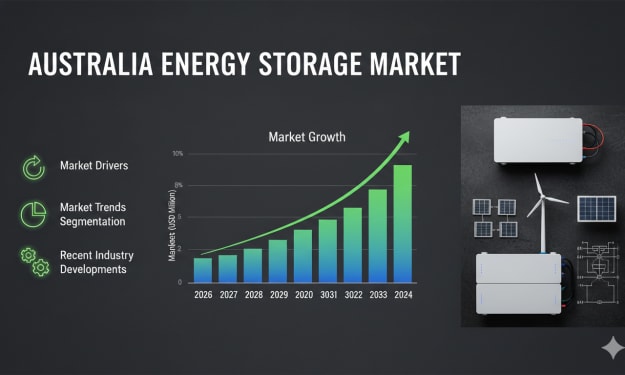
Australia Energy Storage Market: Renewable Integration, Battery Deployment & Grid Stability
According to IMARC Group, the Australia energy storage market reached 4.72 GW in 2025 and is projected to expand significantly to 19.81 GW by 2034, exhibiting a compound annual growth rate (CAGR) of 17.28% during 2026–2034. The rapid growth of the sector reflects the country’s accelerating transition toward renewable energy and the increasing need for reliable electricity systems across Australia. As solar and wind power generation expands, energy storage technologies such as battery energy storage systems (BESS) are becoming essential for maintaining grid reliability and balancing electricity supply and demand. Government policies supporting clean energy adoption, declining battery costs, and investments in grid modernization are significantly strengthening Australia energy storage market share while enabling the integration of renewable power into the national electricity network.
By Shrestha Roy2 days ago in Futurism
Cooking Oil Market: AI-Driven Innovation Transforming Global Edible Oil Demand
AI Overview of the Cooking Oil Market The cooking oil market includes a wide range of edible oils derived from plant and seed sources such as soybean, palm, sunflower, olive, coconut, and canola. These oils are essential ingredients in households, restaurants, food processing industries, and the HoReCa (Hotel, Restaurant, and Catering) sector.
By James Smith4 days ago in Futurism
Review of 'Man on the Run'
My wife and I saw Man on the Run, a nearly 2-hour documentary on Amazon Prime, about Wings, Paul McCartney's group that flew around the world from shortly after The Beatles broke up in early 1970 to shortly after John Lennon was murdered at the end of 1980, making a Beatles reunion forever impossible.
By Paul Levinson7 days ago in Beat



Comments (2)
That a nice point of view to consider as humans are approaching to the era of automation and machine learning age.
Science and technology is never the peril.Man is.