tv review
Reviewing insightful and thought provoking science fiction TV and technology.
Rewatching... Doctor Who: The Moonbase – Part 4
“…we’ve got enough madmen here already.” Saturday 4 March 1967 There are really impressive numbers of Cybermen in this. They march across the lunar landscape and begin to assemble a weapon. I count eleven onscreen at the same time. With others inside their ship you really believe they are a credible threat.
By Nick Brown9 years ago in Futurism
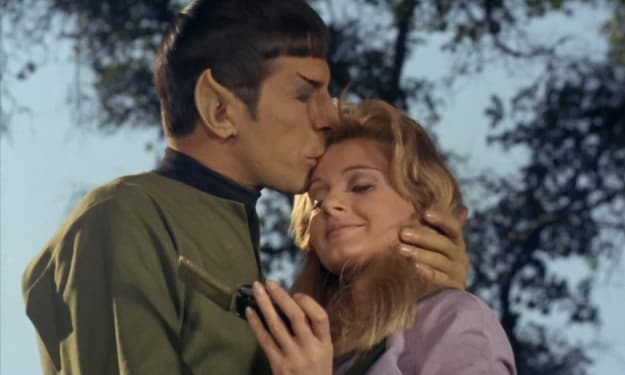
Rewatching... Star Trek: This Side Of Paradise
Thursday 2 March 1967 "Who wants to counteract paradise, Jim boy?" There are two things I especially like in Star Trek. One is when the crew all start going out of their minds, and the other is when it's set on a familiar Earth type planet. So I enjoyed this week's episode.
By Nick Brown9 years ago in Futurism
Rewatching... Doctor Who: The Moonbase – Part 3
Saturday 25 February 1967 "Clever. Clever. Clever." I like the Cybermen’s new voices. Perhaps not as easy to understand as the old ones but much scarier and more emotionless and robotic. Emotionless in tone mind you, but the dialogue still gives away emotional oddities. I’m not sure if “Clever. Clever. Clever.” is sarcasm at Hobson’s realisation of what the drops in air pressure indicated when the Cybermen got in, or self-congratulation. They also come out with words and phrases such as “excellent” and “stupid Earth brains”!
By Nick Brown9 years ago in Futurism
Rewatching... Star Trek: Space Seed
Thursday 16 February 1967 The Enterprise encounters an old 1990s spaceship drifting and sending out a Morse code message. Apparently, in the mid 1990s we had our last World War, a “Eugenics War” where we tried to perfect our race with “selective breeding”. As Spock says, “a strange and violent period” in our history. Thank goodness those days are over, eh?
By Nick Brown9 years ago in Futurism
Re-watching... Doctor Who: The Moonbase – Part 1
Saturday 11 February 1967 The fish-based shenanigans in the Atlantis-set The Underwater Menacewere fun but not really my idea of Doctor Who. Now this is more like it. After the cliffhanger last week the out-of-control TARDIS is buffeted around before hovering above a familiar rocky, crater filled surface before landing. Polly’s all set to congratulate the Doctor for an accurate landing on Mars, except it’s not Mars. They’ve landed on the moon. The moon is a bit of a hot topic here in 1967. NASA has been sending out probes recently, searching for a suitable landing site for the first manned expedition. And just two weeks ago a launch rehearsal ended in tragedy when a cabin fire killed the three crew members of Apollo 1. Tonight though, the moon is positively bustling with activity, with no less than (spoiler alert) three parties at the same landing spot.
By Nick Brown9 years ago in Futurism
Re-watching... Doctor Who: The Underwater Menace – Part 4
Saturday 4 February 1967 “…my ultimate moment of triumph.” So, it's the last episode of this unusual story. It’s a race against time before the whole of the Earth blows up. The Doctor and Ben are separated from Jamie and Polly. The Doctor’s plan is to flood Atlantis but first they have to get past the guard and into the generating station. The Doctor’s confident they’ll get past the guard, Ben less so (“What, in those trousers?”).
By Nick Brown9 years ago in Futurism
28/1/1967: Re-watching... The Underwater Menace – Part 3
My ongoing mission: to watch classic television fifty years after first broadcast... One thing that really strikes me watching this story is the incidental music. Noticing that it sounds exactly like the music used during the Pertwee era (I know, a few years from now!) I hadn’t realised how early Dudley Simpson adopted this purely electronic style. There hasn’t been anything like it before this. I’m not saying it’s good, but it’s undoubtedly striking and unusual.
By Nick Brown9 years ago in Futurism
26/1/1967: Re-watching... Tomorrow Is Yesterday
My ongoing mission: to watch classic television fifty years after first broadcast... This one opens unexpectedly with some grainy stock footage (I presume) of some very modern-looking American military aircraft, so having expected the usual futuristic backdrop I’m hooked instantly. The climactic twist to this pre-titles sequence being the site of the USS Enterprise appearing in the blue sky over an airbase. This does highlight that despite what I have considered pretty decent special effects here in 1967, the model work only looks as good as it does because it’s filmed against a black space background. Putting a silver spaceship against blue sky doesn’t quite work, but I love the juxtaposition so its an effective opening scene nonetheless. And it’s certainly no worse than any similar effect in Doctor Who.
By Nick Brown9 years ago in Futurism
21/1/1967: Re-watching... The Underwater Menace – Part 2
My ongoing mission: to watch classic television fifty years after first broadcast... Back here in 1967 televisions weren’t as reliable as they would become, so despite my repeated thumping on the box I’ve been unable to get a picture since last October. And would you believe it, that coincides with all the episodes of Doctor Who which are missing from the archives in 2017! Cah, typical! So it might not come as a great surprise to you that this week my TV screen has suddenly flickered into life. And look: it’s Patrick Troughton as the new Dr Who! And now I can see Jamie too! Seeing this episode after so many audio only episodes has made me realise how much I must have missed out on, as watching Troughton is a very different experience to hearing a few lines from him. There have not really been any lengthy chunks of dialogue or great speeches from the new Doctor so it’s not easy to get a solid impression of the man. But I’m pleased to say he’s a joy to watch. I should also mention that this is genuinely the first time I’ve seen this episode.
By Nick Brown9 years ago in Futurism
14/1/1967: The Underwater Menace – Part 1
My ongoing mission: to watch classic television fifty years after first broadcast... “You’re not turning me into a fish!” The problem I have with this episode is that Atlantis is presented as if it’s a legend (and indeed referred to as such) when it is in fact a fictional island from a MADE-UP STORY by Plato. The confusion arose when people started to speculate that Plato may have been inspired by a real place. But as far as I’m aware there is no evidence for this, and even if there was such inspiration, that’s all it was. There has never been any such place called Atlantis! So for Doctor Who to have a story set there, well the Doctor might as well visit the ‘legendary’ lands of Narnia or Tatooine or Oz or Pokemon.
By Nick Brown9 years ago in Futurism
12/1/1967: The Squire Of Gothos
My ongoing mission: to watch classic television fifty years after first broadcast... Another week, another red miniskirted yeoman coffee waitress. I didn’t catch her name. Perhaps Kirk knows, perhaps he doesn’t care. Kirk and Sulu suddenly disappear from the Enterprise bridge after a mysterious planet is spotted. Some other crew members beam down to rescue them, and they all end up in this castle, which turns out to be a fake one created by a fake human calling himself Trelane.
By Nick Brown9 years ago in Futurism