space
Space: The Final Frontier. Exploring space developments and theorizing about how humans fit into the universe.
Observatory Guide
There are few pastimes more fascinating, more mysterious, or more peaceful than simply stargazing at a splendid night sky—wondering what it all means. Will we ever travel to any of those other suns? Are there other souls like us on a distant planet, looking up and wondering the same? A special breed of investigator is devoted to finding the answers to some of these questions, by studying everything in the universe from the movement of planets to the nature of such bizarre objects as quasars and black holes, which explode or go beep in the night. That investigator is the astronomer.
By Futurism Staff10 years ago in Futurism
Time's Role in Science Fiction
What is time? In our world, it represents a concept, unit, choice, and even a dimension. In the science fictional universe, it represents all of these concepts elevated into an all encompassing one. Time finds itself as a necessity in that nothing could exist without it––a statement that we cannot fathom because we have never experienced it. Writer Charles Yu claims in his novel, How To Live Safely in a Science Fictional Universe, that “time is an ocean of inertia.”
By Natasha Sydor10 years ago in Futurism
Voyager 2's Expedition
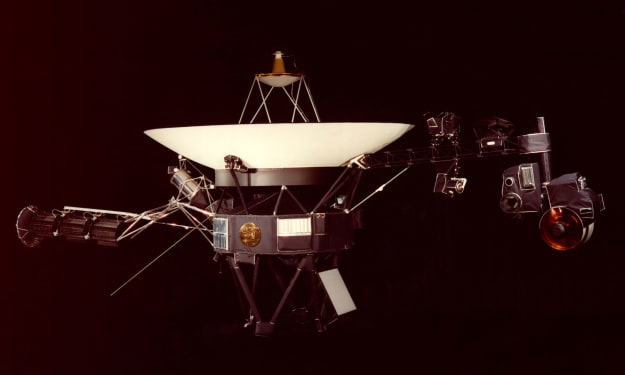
It weighs almost a ton and measures approximately four meters by four meters. Its two television cameras take tens of thousands of pictures of worlds in the outer solar system. A collision with a micrometeoroid could cause it to lose its orientation temporarily, but it wouldn't founder. It is made of millions of parts. If certain components fail, others will take over. We're talking about the fantastic Voyager 2, the semi-intelligent robot that, for nearly 40 years, has explored unknown worlds.
By Futurism Staff10 years ago in Futurism
History of Halley's Comet
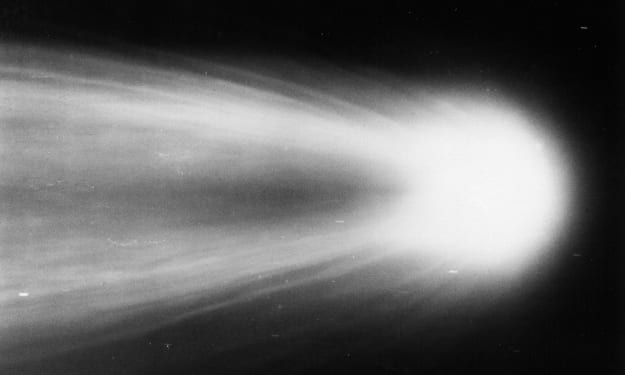
It was August in 1682 when the faint gleam first appeared in the night sky. From one night to the next, it grew slightly brighter and changed position among the background stars. The pioneers of astronomy peered at it through that new-fangled invention, the telescope, and watched it begin to sprout a tail. Among the majority of people, however, the instinctive reaction was fear. “A comet,” they whispered. “A comet has appeared! And plague, famine, and war will surely follow.”
By Futurism Staff10 years ago in Futurism
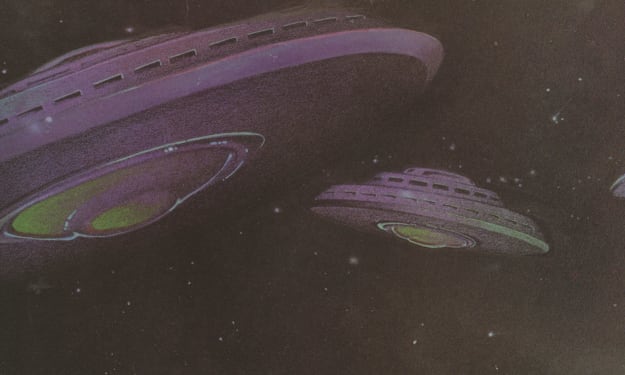
Is the Government Hiding UFOs?
"You ever notice that UFO's never land at places like MIT or UCLA? They always land in some swamp in Arkansas where Billy Hot Dog and his cousin, Weenie, are out hunting. They're real good for reliable reports. It was big and round. Imagine if it landed in Times Square... taxi drivers would honk and scream out 'move that thing!' Bums would come and warm their hands by it and say 'This is nice!' " —Jay Leno
By Futurism Staff10 years ago in Futurism
Impact Craters of North America
The time: June 30, 1908. The place: central Siberia, Imperial Russia. A giant meteorite, blindingly incandescent, streaked across the sky and smashed to Earth near the Tunguska River, devastating a roughly circular region nearly 150 kilometers in diameter. Forests were flattened and several herds of reindeer killed. The earth was pitted by cone-shaped craters up to 50 meters across. Ground vibrations from the impact shattered windows scores of kilometers away. Heat seared the bark from trees, and smoke billowed many kilometers into the atmosphere. Shock waves from the blast were "heard" around the world by delicate microbarographs, instruments that measure pulsations in atmospheric pressure set up by very long sound waves.
By Futurism Staff10 years ago in Futurism
How Apollo 13 Avoided Disaster
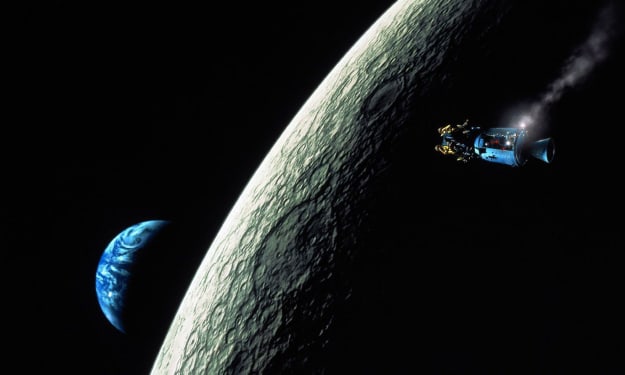
Are you superstitious? Would you fly on ship number 13? Jim Lovell, Fred Haise, and Ken Mattingly didn't think the number 13 would be unlucky for them. They had trained for many months to fly the third lunar landing mission, Apollo 13. Lovell and Haise planned to spend 33 hours exploring the surface of the Moon, while Mattingly circled above them in the command module Odyssey. The story of what happened instead is a tribute to the bravery, ingenuity, and teamwork not only of the astronauts themselves, but also of the hundreds of controllers, technicians, and scientists who brought three men safely home from outer space. You can decide whether or not the number 13 was unlucky for them at the end of the story.
By Futurism Staff10 years ago in Futurism
Life on Jupiter
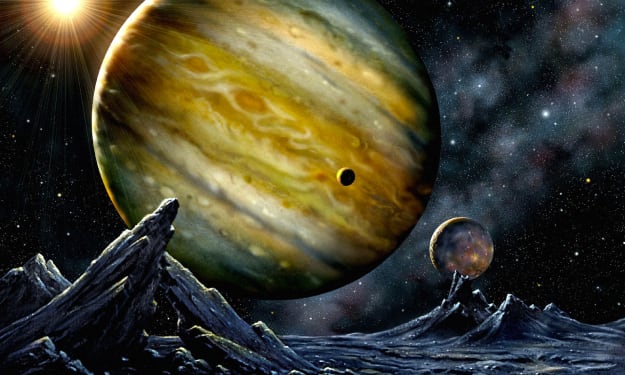
Most people can swim. Even I can, though someone once said unkindly that I give a spirited impression of a baby seal with training flippers. Most animals can also swim, at least passably. And we know that the sea is teeming with life, some of it very intelligent. Dolphins, sea lions, and porpoises are no fools, as we have learned. What, then, are the chances that, somewhere, advanced life forms live in a liquid environment?
By Futurism Staff10 years ago in Futurism