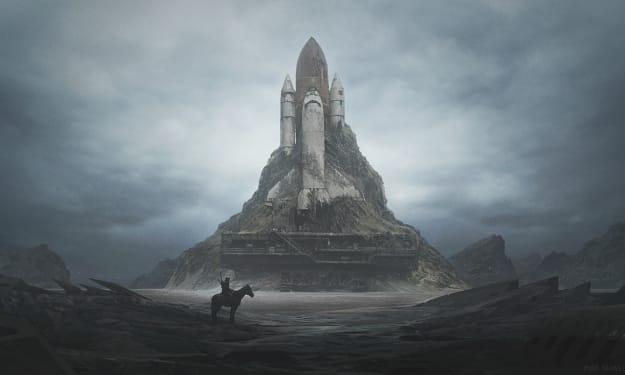
humanity
The evolution of humanity, from one advancement to the next.
The Mind Job
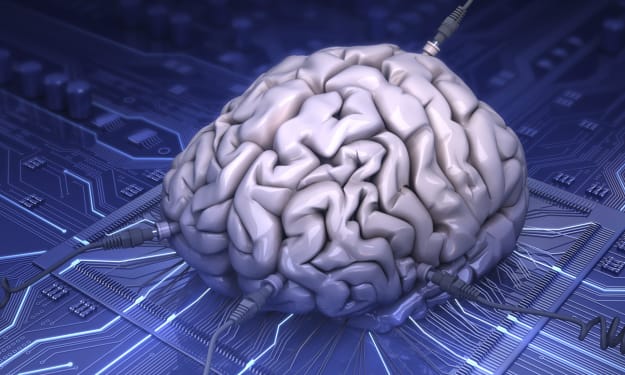
It was past midnight when Detective Jensen received a thought from the Mental Larceny Division. A mind jobber had been busted. The huge cache of stolen memories would have to be read, as well as the jobber's mind. The download would take days, but would likely lead to breakthroughs in several of her cases. She thought about what particular memories, people, and places she was looking for more evidence on, and the computer recorded all faithfully. The systems would let her know when new evidence was available, at the speed of thought.
By David Hallquist9 years ago in Futurism
As You Know Bob - I Don’t Exist
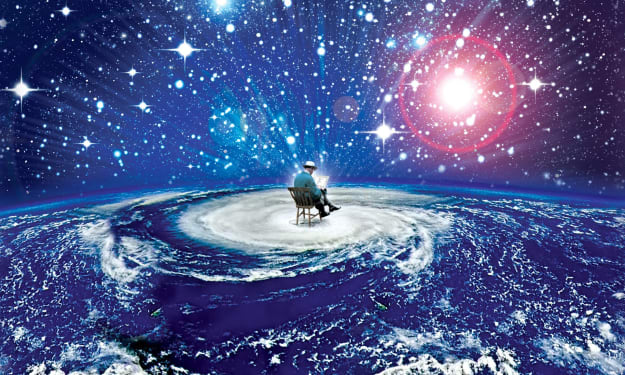
As you know Bob, I don’t exist—but I am, for all intents and purposes, immortal. You must have wondered many times of course just what is meant by the word "self." Certainly there is conscious awareness, but where does that awareness stand? What is its platform? Personality, as we understand it, is a combination of memory and action—declarative memory of the sort that tells you that Paris is the capital of France and it is procedural memory that enables you to ride a bicycle. Personality though? Well then, think of a unit of memory and a single star and personality is a vast and dense constellation of memories in the galaxy of your brain. Stars are born, the age, they flare and they die and as they orbit the center; those constellations change their form and spread… and there can be many constellations in that neural galaxy.
By Brett Davidson9 years ago in Futurism
The Third World War by Sir John Winthrop Hacket
Over 6,200 paperbacks line shelves in my apartment. My wife is an artist, and uses our apartment as her gallery. There was a fight for wall space and I recently lost a skirmish. My solution was logical. Consolidate and toss books that I have read which honestly I think is about 500 - 600. Part of my cathartic process is to write a quick review of the books I remember. Sometimes a quick skim ignites a memory of something particular I liked about the book. The Third World War by Sir John Winthrop Hacket was a sort of alternate reality novel, I remember reading in 1986 as a freshman in college. I must say there are some very detailed sections of, military briefings that can be skimmed through with no real impact. It seems still relevant these days with such uncertainty in American ideology and political stability.
By Arnold Seleskey9 years ago in Futurism
Word-Worlds
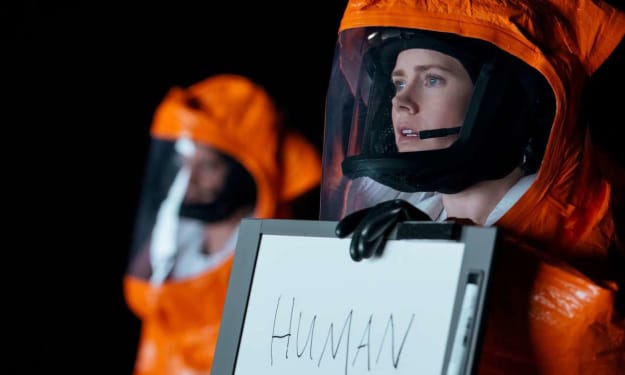
Ted Chiang is among the greatest short story writers in the history of science fiction, and I've been recommending his work to students for years. That said, I was somewhat disappointed by Arrival, Denis Villeneuve's recent film adaptation of Chiang's masterful short story "Story of Your Life." The film, in my view, is too noncommittal genre-wise. It doesn't know what it wants to be—action-adventure or philosophical meditation, Independence Day or Ex Machina. I suppose there's a way to elegantly split that difference, but I don't think it happens here. To be fair, it's a tough story to adapt: high-concept, but cerebral and exposition-y. "Story of Your Life" features none of the fate-of-the-Earth-hangs-in-the-balance testosterone of Arrival; what's most interesting about it is the peculiar linguistics of the alien language, particularly the written script, which Chiang's narrator explores in depth. The film dumbs all this down. We get squiddy aliens ejaculating ideograms, and some montage-like scenes of Amy Adams' character trying to decipher them at her desk, but we're not really privy to her insights, and, though a major plot twist depends on it, we never get the full picture of how the aliens' language is a natural outgrowth and/or determinant (or both?) of their relationship to time, which is, or ought to be, the story's great payoff.
By M. Thomas Gammarino9 years ago in Futurism
Victory Garden
"One may live without bread, not without roses" —Jean Richepin Bernard heard the knock at the door, five weighted raps made by a fist muffled in a glove. He placed both arms on either side of his armchair and pushed himself into a standing position. Pain shot through his large, arthritic frame. Bernard shambled to the front door. He took a few deep breaths to calm his nerves.
By M. Justine Gerard9 years ago in Futurism
Philip K. Dick's VALIS Analyzes Religious Destiny
If you really think about it, the story of Jesus is a work of science fiction. He's a man with superpowers that include turning water to wine, healing others, and coming back from the dead. All jokes aside, religion and science fiction truly go hand in hand although people often try to separate the two. Some of the religious themes that permeate sci-fi stories include the idea of the afterlife, reincarnation, original sin, fictional religions, Messianism, and many other themes that can be found in the works of Philip K. Dick. As a science fiction writer, Dick wrote 44 novels and 121 short stories including Do Androids Dream of Electric Sheep?,A Scanner Darkly, Flow My Tears, the Policeman Said, VALIS, and many others. Some of the films that have been adapted from these stories include Blade Runner, Total Recall, A Scanner Darkly, Minority Report, Paycheck, Next, Screamers, The Adjustment Bureau, and Impostor. Throughout his lifetime, he won several awards including three Hugo Awards, five Nebula Awards, one British Science Fiction Association Award, and many others. There is even a Philip K. Dick Award that was established in 1983 which honors the previous year's best science fiction paperback original published in the US. In 2007, Dick became the first science fiction writer to be included in The Library of America series. The writer died in 1982 after suffering two strokes at the age of 53, but his legacy lives on today in his stories such as VALIS.
By Mackenzie Lu9 years ago in Futurism
Science Fiction Feminist Dorris Lessing
Doris Lessing, made famous by her epic novel of the female experience, The Golden Notebook, was also a prolific writer of science fiction. She was not a fan of genre distinctions. She called science fiction "some of the best social fiction of our time," writing woozy, difficult books about psychic women and fallen paradises.
By Stephanie Gladwell9 years ago in Futurism
Horde
It can’t be amnesia. I know who I am, Caroline concluded. I know where I am. I’m home. Where I belong. Her green eyes scanned a wasteland of musty possessions. Mountains of clothing, books, magazines, newspapers, bottles, toys—collections she’d been meaning to organize, but never got around to, each holding a special indispensable significance.
By Joshua Sky9 years ago in Futurism
The Miracles of Technology Vs. the Dark Side of Human Ambition
On Saturday July 8th 1688, an Irish landowner sat down and composed a letter to an English doctor. The landowner’s name was William Molyneux. Ten years earlier he had married a woman named Lucy. After bearing him three children, she had become ill and was struck blind. But Molyneux’s letter to the doctor wasn't about his wife. The doctor’s name was John Locke and the letter was the first statement of a very profound neurological question. The letter asked the following:
By George Lazenby9 years ago in Futurism
Science Fiction College: Sci-Fi Educates University Level Students
Whether you know it or not, or want to admit it, that little cinematic 1980s romp, Revenge Of The Nerds, has come all too true. Geek culture has risen to prominence, even dominance in our culture. Tech is our global kingdom—and the tech titans like Mark Zuckerberg and Bill Gates are the governing monarchs. The nerd or geek vibe surrounds us on every level imaginable. And it doesn’t stop at the office or in our pockets with our mobile devices. Science fiction is sort of the geek genre of choice, and now all those movies are springboarding courses at the university.
By Will Stape9 years ago in Futurism