future
Exploring the future of science today, while looking back on the achievements from yesterday. Science fiction is science future.
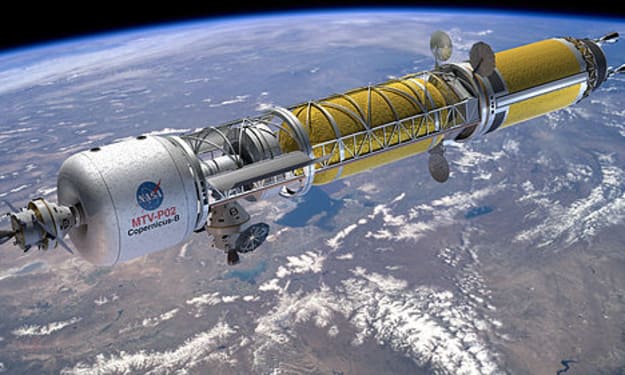
Nuclear Propulsion
“Now I am become Death, destroyer of worlds.” Robert Oppenheimer spoke these words in July of 1945 when asked about his feelings after the Trinity test, the first successful detonation of a nuclear weapon. Oppenheimer’s prophecy rang true on August 6th and August 9th of that same year, after the dropping of those same weapons on Hiroshima and Nagasaki.
By Anthony Pullano9 years ago in Futurism
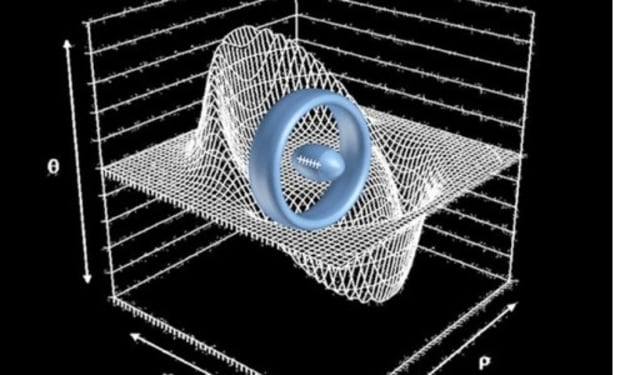
The Warp Drive: A Crash Course In Relativity. Top Story - July 2017.
The estimates from the Hubble Telescope suggest that there are upwards of 100 billion galaxies in the universe. Each with millions upon millions of stars (the Milky Way is a smaller galaxy with around 100 billion stars), each with at least some prospective habitable planets.
By Anthony Pullano9 years ago in Futurism
Elysium
The escape was not difficult. The alarms were broken and the hole in the Fence had grown since I’d last looked. Snatches of cloth caught on the wire, loose strands. More people breaking free from here, running from the hell we’ve realised isn’t normal. Isn’t how we want to live. We never see the Runners again. They might be dead for all we know. Dead or there. Elysium, rumours call it. The light at the end of our tunnel. The beginning of our new lives. It might not even exist. All we know is that anywhere’s better than here.
By Alice Swan9 years ago in Futurism
A History of Gravitational Waves
14th September 2015. A 4 kilometer long arm forming part of the Laser Interferometer Gravitational-Wave Observatory (LIGO) changed its length by one ten-thousandth the width of a proton, due to a distortion in spacetime, disturbing a laser beam housed inside. Computers immediately detected the mind bendingly miniscule change, sending an automatically generated email containing the observed data to a postdoctoral researcher by the name of Marco Drago working in the Max Planck Institute for Gravitational Physics in Hannover, Germany. Marco’s job was to monitor LIGO readings examined the data to rule out any error or “dummy signal” used for testing purposes. Within a few days news of the detection had been leaked to the world astrophysics community and after the observation had been definitively confirmed an official press conference on the 11th of February 2016 revealed to the world the first observation of a gravitational wave on earth by LIGO.
By Devon Keogh9 years ago in Futurism
Alex The Inventor-Chapter 17
Read Chapters 1 - 16 at: Deep Sky Stories Chapter 17 (Part 1) - The First Hello Elizabeth Faraway led Alex into the little kitchen where he saw something resting on the table. It was a little square computer screen on a folding stand and, at first glance, it could easily have been mistaken for a tabletop picture frame."Come sit down," Elizabeth said and she pulled up a chair for him. Sitting down beside her son, Mrs. Faraway brought the small silver screen up close and then lightly touched the glass.There was a momentary blink and flicker as the tiny screen reset itself, then a face appeared behind the glass. The person belonging to the face seemed to be in the middle of talking to someone else but then was interrupted by a faint voice that sounded like Miss Vee‘s. She was talking urgently and there were faint explosions in the background.Alex couldn't understand much of what she said but he thought he heard his name mentioned once. Suddenly the man's face changed drastically and a look of deep sadness and guilt showed clearly in his eyes. He looked away for a few moments, perhaps trying to gather the nerve to continue talking, but finally, he got control of himself and looked up again, straight back through the glass and into Alex's eyes.
By G.F. Brynn9 years ago in Futurism
A Thinking Person's Artificial Intelligence
Over the past decade, artificial intelligence migrated from computer geeks' workshops to something many people encounter in their everyday lives, but not without fears of its effects. Last year, the Pew Research Center assembled a panel of more than 1,300 experts, polled on the impact of increasing our reliance on algorithms—mathematical models underpinning artificial intelligence that aid in making decisions and completing tasks—and whose responses were boiled down into a set of themes.
By Alan Kotok9 years ago in Futurism
Reaper
The Fates don’t play favourites. They play their own cruel game, toying with each thread of existence, ensnaring all who dare to reach out for their own destiny. A lust to exact heinous and petty treachery merely for their pleasure. They seek constant chaos, eternally warring with order. Entropy is their oldest friend. Consequence is what they represent, but never affected by. Curse them. Hear that you demonic beings? Curse them! What profit will you garner from my imprisonment? These chains of black steel around my arms and legs hauled up into the web-like mist high above.
By Nicholas Anthony9 years ago in Futurism
Interview With Dr. Louis Rosenberg, Founder Of Unanimous A.I.
It's rather fitting that Dr. Louis Rosenberg, an individual wholly dedicated to preparing humans for the immediate and distant future, is featured in a project titled Year Million, National Geographic Channel's six-part documentary series that explores and postulates on the future of humanity; on what it will be like to be human one million years into the future.
By Futurism Staff9 years ago in Futurism
Can Better Data Head Off Environmental Disasters?
Do you live within 200 yards of an oil or gas pipe? More than 60% of Americans do, but no one—not public agencies, not commercial customers, and not even the energy companies that own the pipes—could tell you exactly where defects in those pipes are. As that infrastructure ages far beyond its intended lifespan, the costs of maintaining and servicing pipelines pose a $68 billion headache for the industry and a ticking time bomb for the public.
By Rob Salkowitz9 years ago in Futurism
Science Fiction: Science as Craft
Writing is a craft. We talk of crafting a story, and of wordsmiths who forge metaphors from the white heat of their imaginations. The creation of fiction, therefore, involves a process akin to that of making art. This process involves the mind constructing a fabrication which will more clearly define our reality, or even go beyond our understanding of what reality is.
By Nadia Davidson9 years ago in Futurism