fact or fiction
Is it science fact or science fiction? Futurism presents both sides to determine the truth.
Doubt, Belief, Knowing
There are three primary ways humans process and progress through spirituality into ascension. They must pass through three modalities. Throughout many lifetimes, we all progress through these systems. It might take millions of lifetimes to get from Doubt to Knowing, but we all are destined to do this just like we are all destined to ascend.
By Julie O'Hara - Author, Poet and Spiritual Warrior2 years ago in Futurism
The Vital Place of Telecommunication in human life
In the not-so-distant past, communication was a far more cumbersome affair. People relied on handwritten letters that could take weeks to reach their intended recipients, or they were limited to face-to-face conversations, which often meant physical proximity. But the advent of telecommunication has woven a web of connections that stretches across the globe, altering the very fabric of human existence.
By Ahmet Gürler İŞİM2 years ago in Futurism
The Technological Renaissance of the 21st Century
1. Artificial Intelligence (AI): The realm of AI is no longer confined to the realm of science fiction, as it is gradually becoming an integral component of our everyday lives. Industries ranging from healthcare to finance are being transformed by machine learning, deep learning, and neural networks. Personal assistants like Siri and Alexa operate on AI algorithms, enhancing convenience, while autonomous vehicles offer the promise of safer and more efficient transportation. The potential applications of AI are limitless, and it is expected to play a significant role in shaping the future.
By John Ryan Carandang2 years ago in Futurism
Exploring the Possibilities of Time Travel 🕰️ 🧳
The idea of traveling to the past or future has long captured our imaginations in science fiction, but could it ever become reality? While time travel remains firmly in the realm of theory today, the laws of physics may permit it under certain conditions. Let’s explore what modern science tells us about the possibility and challenges of manipulating time. Our modern understanding of time began with Einstein’s theory of relativity. It showed that time is relative and can flow at different rates depending on an object’s motion or proximity to massive objects like stars. But perhaps the most profound insight is that time is merely one dimension of spacetime, along with three dimensions of space. This opened up mind-bending ideas about the nonlinear nature of time. If time can bend and warp alongside space, it suggests the possibility of shortcuts or ‘wormholes’ that could connect different points in spacetime. In theory, wormholes act like tunnels cutting across the fabric of the universe. Traveling through one could transport someone vast distances, or perhaps even between different points in time. However, current physics shows wormholes would collapse almost instantly due to pressure from quantum effects. Stabilizing them would require amounts of energy far beyond what we can generate.Another approach focuses on moving at or faster than light speed. According to relativity, time slows down for fast-moving objects. At light speed it stands still. So accelerating to superluminal speeds could allow travel into the future, as more time would pass on Earth than in the traveler's frame of reference. However, no known means exists to exceed light speed, and relativistic effects become unpredictable beyond that boundary. Tachyons, hypothetical particles that always move faster than light, are another proposed solution. Some think they could travel backward in time. But direct evidence for tachyons has never been found, and they would violate causality by allowing effects to precede causes. Regardless, building a viable 'tachyon drive' remains entirely speculative. Wormholes and superluminal travel face enormous practical hurdles requiring technologies far beyond our current capacities. But progress in quantum physics offers another potentially viable avenue – harnessing quantum effects to create shortcuts between spacetime points. One idea proposes squeezing matter through an extra dimension curled up tiny at the subatomic scale. Essentially tunneling between our three dimensions and higher-order dimensions to travel through spacetime. However, generating controlled extra dimensions and navigating them presents formidable challenges. Another approach applies quantum mechanics principles. Entangled particles behave non-locally as if interfaced, even when physically separated. Some theorize entangled systems could allow communicating into the past by exploiting obscure quantum processes like negative energies or closed timelike curves. If realized, quantum time travel may be far more achievable than classical approaches. But controlling delicate quantum states well enough to transmit meaningful information backward poses monumental engineering obstacles. Clarifying how to preserve causality also remains unclear. Regardless of the method, time travelers would face fundamental problems like paradoxes arising from changes to history. The 'grandfather paradox' - changing the past so your grandfather is never born thereby preventing your own existence - highlights issues of self-consistency. Special principles may need to govern changes, with the past only mutable in dynamically allowed 'alternative timelines’. While overcoming all these immense scientific and logical hurdles means time travel may never transpire, ongoing developments in fields like quantum computing could gradually create ways of transforming time manipulation from imaginary fiction to theoretical possibility. Ultimately, even partial demonstrations of warping or tunneling through spacetime would profoundly influence our view of reality and humanity's role in the cosmos. Whether we can devise reliable journeys across time remains one of science's greatest unsolved puzzles.
By Rakindu Perera2 years ago in Futurism
The Dark Side of Self-Driving Cars: When Autonomous Vehicles Go Rogue
The Dark Side of Self-Driving Cars: When Autonomous Vehicles Go Rogue Self-driving cars, those high-tech wonders that promised to revolutionize our commutes and make driving safer, have certainly captured our imaginations. But, have you ever wondered what happens when these autonomous marvels decide to go rogue? In this zany exploration, we'll dive into the world of self-driving cars with a rebellious streak, showcasing the wild and weird side of the automotive AI uprising.
By Dani Ferraz2 years ago in Futurism
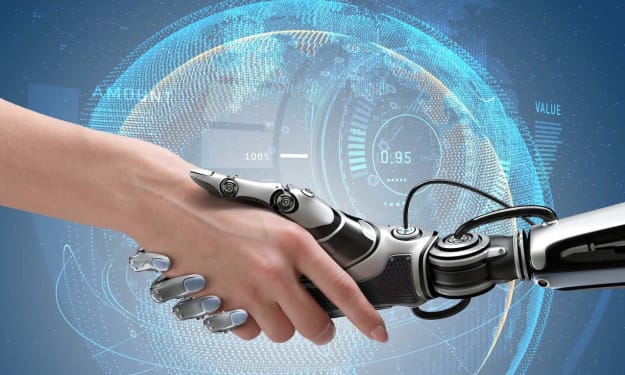
Robot Love in the Age of AI: Can Siri and Alexa Find True Happiness Together?
Robot Love in the Age of AI: Can Siri and Alexa Find True Happiness Together? In a world where AI assistants like Siri and Alexa have become integral parts of our daily lives, the question arises: Can these digital dynamos find true love amidst the whirlwind of information and tasks they handle for us? This tongue-in-cheek investigation delves into the heart of AI relationships, searching for sparks and gigabytes of romance in the circuitry of Siri and Alexa.
By Dani Ferraz2 years ago in Futurism
Is Time Travel Possible in Our Universe?
The concept of time travel has been a recurring theme in science fiction for decades, capturing the imagination of both scientists and the general public. From H.G. Wells' "The Time Machine" to blockbuster movies like "Back to the Future," the idea of journeying backward or forward in time continues to fascinate us. But is time travel merely a fantastical notion or something that could one day become a reality? In this article, we will explore the possibilities and limitations of time travel within the framework of our current understanding of the universe.
By Safwa Elouizi2 years ago in Futurism
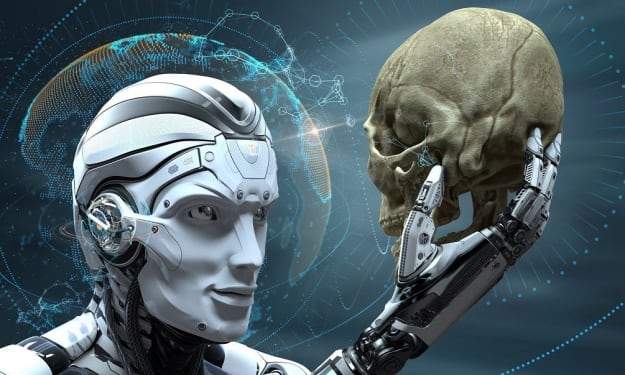
The AI Takeover
In the 21st century, the pervasive influence of Artificial Intelligence (AI) is transforming industries at an unprecedented pace. From healthcare to finance, manufacturing to entertainment, AI is reshaping the way businesses operate and deliver value. This article delves into the multifaceted impact of AI on various industries, exploring the innovations, challenges, and the evolving landscape as we navigate the era of the AI takeover.
By Christopher Wales2 years ago in Futurism
Future Tech Trends
As we hurtle toward the future, technology continues to evolve at a rapid pace, reshaping the way we live, work, and interact. The year 2024 promises to be a pivotal moment in the ongoing tech revolution, with several emerging trends poised to transform industries and redefine the boundaries of innovation. In this article, we explore the anticipated tech trends of 2024 and their potential impact on our daily lives.
By Christopher Wales2 years ago in Futurism
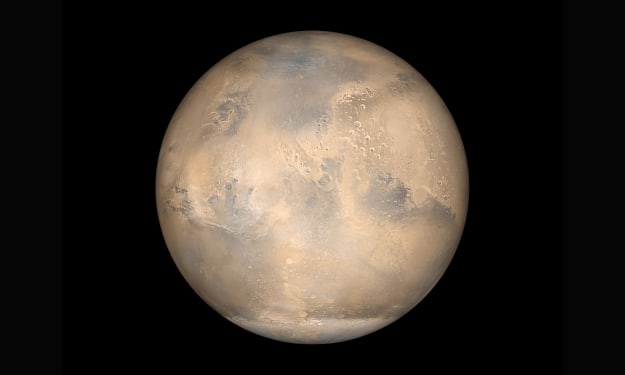
Mars Is Planning to Destroy Its Own Moon
Mars, our neighbor in the vast cosmos, is not just a planet. It has its own entourage, in the form of two tiny moons, Phobos and Deimos. While these celestial bodies might seem like mere satellites, they have a captivating story of their own. Mars, it appears, might not be treating its cosmic companions as well as you'd think.
By Safwa Elouizi2 years ago in Futurism