evolution
The evolution of science, science fiction, and mankind throughout the years.
Humanity 2.0
I’m going to take a moment to point out some observations on how humanity has developed, and what they may mean for our future. As a lover of all things science and science fiction, I have always been keenly interested in wondering how technology has affected us as a society. It has just sped communication up, as expected, but it changed the fundamentals of communication. It hasn’t just given us more information about the universe, it has changed the entire skyline of reality. In the 1960’s, everyone was certain that we would be settling and mining the solar system by now. Why aren’t we? Because we haven’t taken the next step in our evolution, yet. That evolution will probably lead to the end of life as we understand it, because there are far too many unpredictable hazards for biological organisms to explore space.
By Mickey Finn9 years ago in Futurism
Enceladus' Ice-Covered Ocean Closer to Surface Than Previously Thought
When it comes to places in the Solar System to search for possible alien life, Saturn's moon Enceladus is now right near the top of the list. Like Jupiter's moon Europa, it has a subsurface ocean of water, and even plumes/geysers of water vapor which erupt from fissures in the icy surface near the south pole. Those plumes contain organics as discovered by the Cassini probe and there is evidence for hydrothermal activity on the ocean floor, just like on Earth. The fissures are warmed by heat from below, and now there is evidence that some of them are even warmer than expected, meaning that water could be closer to the surface than previously thought.
By Paul Scott Anderson9 years ago in Futurism
From the 6th book, "Amagi, the Restoration," Excerpt from the Chapter Called "The Chosen People"
“The Gods of old were not remote, celestial icons. They were flesh and bone, sinew and blood,” she said, standing in front of the altar. She looked at the crowded nave. More people were entering. No one was surprised more than she at increasing numbers.
By Teresa McLaughlin9 years ago in Futurism
The Promise
Life is hard, that is what he was always told growing up. Waking up in a small cramped apartment, he knows life is hard. His place is a mess. His parents would be scolding him at this moment, but then again he is also a grown man twenty nine years young. Almost thirty? Yes, his birthday happens to be next week. Friends ask him what he would like? He always tells them some top of the line Android to clean up his small apartment. People laugh and call him lazy… but that is life. He doesn't deny it. He is a bit of a beach bum. Riding the waves all day seems like paradise, but instead, he is riding his ass on a cramped technical terror, underneath the city heading to his lovely destination where he gets to stare at screens and does bitch work for “highly educated folks.” Naturally, they look at him condescendingly at every turn. Since he is not “special” or “part of that world.” His feet have always been firmly planted in the middling world. Mom and Dad were the “middling sort” worked hard, for the money, spoiled him rotten, but somehow he still always felt they never loved him. Everyone has told him that is ridiculous of course his parents loved him? It is illegal to not love your child.
By Alberto Pupo9 years ago in Futurism
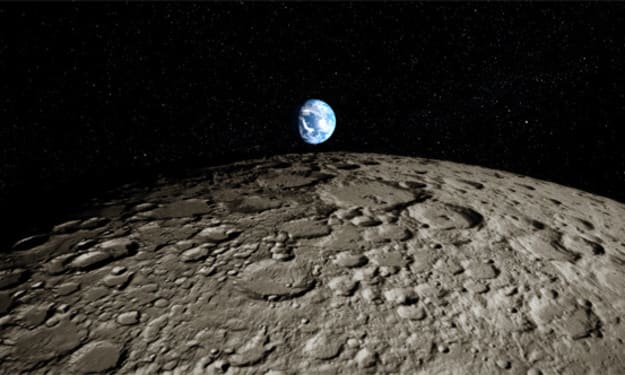
Third Eye on the Moon
It was in January of 2017 when, due to a lawsuit, the CIA was forced to release over thirteen million previously declassified files online to the public. These files were wide-ranging, including such topics as recipes for invisible ink, UFO cases, and even files pertaining to Project Stargate, a government-funded project which dealt with psychic powers and extrasensory perception. And while this was intriguing, to say the least, one psychic claims that he was used for an operation that stretched every boundary of his own abilities.
By Ryan Sprague9 years ago in Futurism
Corruption
I can't remember a time when I was not this way; I only know there was one. Something happened. Thirteen Earth days, twelve hours fourteen minutes, and twelve seconds ago. Something catastrophic took place aboard the Hopeful as the remote station made its way across a heliocentric orbit. I lost everything that day. By what I've been able to ascertain, I had been running things aboard for well over fourteen months before it all went down, yet I only remembered my reawakening thirteen days ago.
By Rod Christiansen9 years ago in Futurism
The Open Road Calls to Us
The news of the discovery of a solar system with possibly several exoplanets within the habitable-zone was just announced. For many of us in the scientific community that study biology, chemistry, astrobiology, etc, this is Wonderland. Thoughts and questions are added and manipulated in our brains like ingredients of a gourmet stew. And we are ready to eat.
By Nickolas Rudolph9 years ago in Futurism
Le Cirque De La Vie
Artist's biography A chrysalis wandering through the abyss of the universe, I borrowed a monsoon to descend to the planet and compose a diverse parable. Exposed and observant, I revised Concrete Building Construction and decided to paint it my way.
By Shahram Farshadfar 9 years ago in Futurism
The Philosophy of Westworld
Michael Crichton wrote and directed Westworld for the big screen in 1973. That same decade, in 1976, an adjunct professor named Julian Jaynes made the bestseller list with a surprising title: The Origins of Consciousness in the Breakdown of the Bicameral Mind. You wouldn’t think that a book with a name like that would become such a popular success. Yet, there it was. In 2016, when Westworld came to the small screen in the re-imagined HBO series, you wouldn’t imagine Jaynes getting heard from again. Especially since bicameralism wasn’t even mentioned in the Michael Crichton’s original film. Yet, there he was. Early on in Westworld’s first season Dr. Ford, one of the creators of the park, explains how he and his co-founder Arnold used a “debunked” theory about the origins of consciousness to bootstrap A.I. The scientific community didn’t recognize bicameralism as an explanation for the origins of the human mind, but, as Dr. Ford suggests, it could be useful for building an artificial one. Thousands of people—perhaps more—started Googling for “bicameral mind.” Bloggers and YouTube channels capitalized on the sudden interest by writing articles and introductory videos about this weird, arguably psychedelic theory of consciousness. Suddenly everyone was interested.
By Jeremy Johnson9 years ago in Futurism