astronomy
Celestial objects and the phenomena that surrounds them. What lies above the earth forever out of reach. From moons, to stars, galaxies, and beyond.
The MeerKAT Telescope
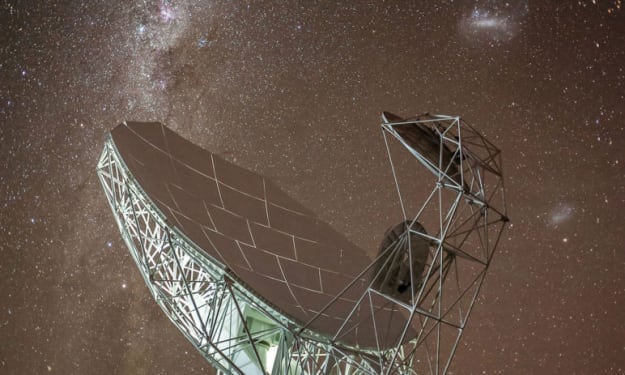
Earth now has the clearest images of the black hole at the center of our galaxy thanks to The MeerKAT Telescope, South Africa’s new super telescope! Originally the Karoo Array Telescope (KAT), the MeerKAT also gets its name from the small carnivorous animal that belongs to the Mongoose family populating South Africa. The observation project of galaxies, dark matter, and the cosmic web also has been gifted the name of the South African Mongoose family the Meerkat is part of: Project MHONGOOSE is a blend for MeerKAT HI Observations of Nearby Galactic Objects: Observing Southern Emitters. Whew! Scientists sure know how to shorten a mouthful, don’t they?
By Lady Sunday8 years ago in Futurism
Pluto Is a Planet
Pluto was declassified as a planet on August 24, 2006. It was reclassified as a dwarf planet. The claim is that there are eight planets now and that Neptune is now the farthest planet from the Sun. The reasons for this change, however, are not founded on correct reasoning.
By Danny Fleming8 years ago in Futurism
Evidence for Life on a Saturn Moon
The search for intelligent life outside of our pale blue dot is a bold one indeed and has been going on for quite some time. Going back as far as we can into human history and even prehistory, people have looked to the stars in search of answers. Where does this all come from? How and why is the existence of our universe as we know it possible? Possibly one of the most eerie questions in this field of thought: are we alone?
By Corey groves8 years ago in Futurism
Telescope Filters
You’ve unpacked your brand-new telescope, lovingly assembled it, and waited like a child on Christmas Eve for the sun to set. Like many first-time sky gazers, you probably pointed the eye of your instrument toward our closest celestial neighbour, the moon. Perhaps your experience was interesting at first, then underwhelming and at worst, disappointing. The moon was a hazy white blur and the craters and mountains appeared to be nothing but grey splotches.
By Rupert Missick8 years ago in Futurism
Pluto in Capricorn
Dante Alighieri, in his 14th Century play The Divine Comedy, immortalized Italian Astronomer Guido Bonatti, who served as advisor to Frederick II, The Holy Roman Emperor. In Dante's Inferno, the 8th circle of Hell is a place where those who would divine the future have their heads turned around. This ironic, eternal punishment forces those damned to the 8th circle, to look always backwards, instead of forwards. Galileo Galilei overturned the old Astrological order during the Renaissance, with his use of Astronomical Observations, and Horoscopes. The 17th Century practice of using Astrology and Astronomy became distinctly separate. Astronomy became a science. Astrology was considered a form of divination, and became an art. The old Astrology used by the Babylonians no longer existed. The separation of the two sciences helped drive the development of Astronomy.
By Lady Sunday8 years ago in Futurism