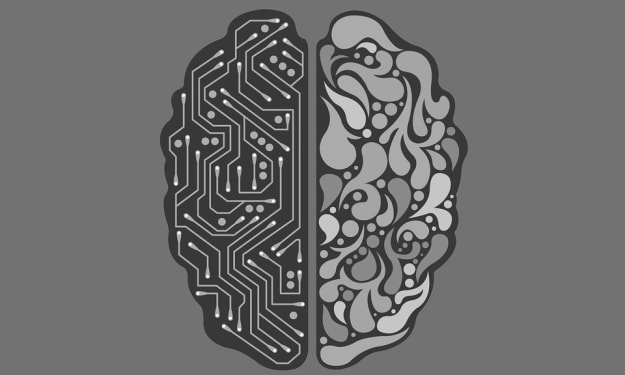
artificial intelligence
The future of artificial intelligence.
The future of Artificial Intelligence
In and of itself, artificial intelligence is just another type of programming. After all, it works in a certain predictable manner that benefits a variety of industries in a variety of predetermined ways. Overall, it is pretty benign as it represents a mere extension of the programmer. The beauty of such programming is how effectively it mimics cognition displayed by humans, and it often does so via a variety of complicated, algorithmic decision trees made up of if-then-else statements. The programming is useful and often amazing in its results, but it is also fairly deterministic and subject to a programmer's understanding at a simple glance of the code. Similarly, such technology is easily reverse-engineered. However, when this type of programming is coupled with machine learning, things become much less straightforward and much more interesting.
By Emmanuel Motelin5 years ago in Futurism
First Responder
Barnes Gearhart shook his head slowly as he looked out of his smart car’s windshield. As he watched the snow outside continue to get worse, he came to the conclusion that people got stupider in direct proportion to weather decline. Although the accident had occurred only a couple minutes ago, both sides of the freeway were already at a standstill.
By Robert Rhoads5 years ago in Futurism
The Golden Mountain
Being an entertainment critic was a somewhat silly move in 2044, but Joss still remembered a time when stories were written by humans; and he had a lot to say about the lack of soul in AI-generated entertainment and art. Famously purist and a previous movie director himself, he used only typewriters and notebooks to write in; there was something about even interfacing with technology that he found less organic and therefore creativity-killing. He also had a loyal base of movie fans and readers that agreed with him.
By Nathan Locke5 years ago in Futurism
Wired that way
His name was Hermann. It was an old-fashioned German name and he disliked it deeply. The fact that he would have preferred another one was extraordinary though, for Hermann was an accumulation of zeros and ones, wrapped in a pile of conductors, processing units and all kinds of circuits inside chunky plastic. There even was a power cable somewhere on his lower back. The whole thing was topped off with a silicone face and two hands, and even though quite sophisticated, their sole purpose was to hold cards and make all kinds of poker-faces, for Hermann was intended to be an artificial poker-player and nothing more than that.
By Zora Kastner5 years ago in Futurism
The Representation
David, both the physical person himself and the network of social, cultural and technological systems he interacted with, was the first human being to be successfully “represented” on July 1st 2030, 10:14 AM, according to Abstract Engineering CEO Solomon Yang in his latest media briefing. After years of careful data collection and processing, occurring parallel to groundbreaking research in robotics, David’s physical body was reconstructed in android form, and his personality faithfully implanted in this machine.
By Mac Powers5 years ago in Futurism
Begin Again
We watched one another decay. First, our words disappeared from our tongues and then our memories from our minds, one by one. Decaying. No one could remember why it was happening. How had our world gotten to this point, with starving, broken bodies and dying language? The ones who offered the Reward knew. They knew every detail, never lost any words. They said that if one of us found the Reward, then we could be the same. Everything would come back. We wouldn’t be hungry — for food or language — anymore.
By Meghan Endahl5 years ago in Futurism
Quantum pyramids
Time travel could be possible through pyramid technology And quantum computers I recently explored the work of Joe Parr. While reviewing his research Many new concepts started to emerge. Joe Parr’s research proved the Existence of “pyramid energy” and possibly even time travel. He did many Experiments; He found the Existence of anti gravity properties as the result of an orb that formed when the pyramid shape was spun on a centrifuge type device (a device that spins in a circle; normally used to separate blood samples and for medical procedures.) it was said this orb gave the pyramid the ability to become weightless and was in a quantum state. Mr. Parr also reported that the test pyramid could travel through Other solid objects; like the walls, or table. This all sounds fantastical, but it explained a lot for me.. I became inspired and I started to postulate the creation of a space craft that could operate on this technology and maybe even travel through time. Mr. Parr hypothesized a phenomenon he refers to as a ”pinch off” where the orb became impervious to gravity entirely and was at 100% opacity. While he never had enough energy to create a pinch off with the orb but he concluded the orb could be pushed by gravity depending on how the ions were polarized, therefore allowing an object to be directed, if you could control the ions.. ( I understand the concept of relatively and I am familiar with how speed can assist in traveling through time and with anti gravity capabilities the speeds could reach 1000 mph, which would essentially push you faster through time creating a time traveling situation.) Joe Parr states the existence of both positive and Negative ions that were captured by the orb, that the pyramid created when spun on a centrifuge. His research stated that they weren’t in equal numbers. (I did some research on quantum computing and found out that the state of the ions used could be positively charged or negatively charged or both at the same time. So the amount of positive or negative ions really wouldn’t effect the theory.) most quantum computers these days consist of ions packed together in one space in an ion trap. The use of a lot of ions is required for optimal computing, but the ions aren’t stable in large numbers and they communicate through their vibrations, so the new prototypes of today consist of individual cells or modules of ions communicating with photons instead of their vibrations, making it a more stable system of computing. These modules can be combined to make bigger quantum computers. The point of this paper is to bring a new method of quantum computing to the table and possibly even allowing for accurate time travel through pyramid technology. It occurred to me that a quantum computer or even a space craft probably couldn’t be possible with out proper manipulation of the ions, so I began to look into how we could control ions. I came across a research paper conducted by the national institute of science and technology in 2017. It proposes that scientist can now control ions and essentially tell them what to do by controlling how the ions are charged with the use of lasers guiding their tasks. It was noted that sometimes a qubit Or - charged atoms, can break down due to Interference from their Surrounding environment. Scientists can isolate these ions in an ion trap to stop them from being disrupted, but in my theory the orb that Joe Parr creates could act as a natural barrier or ion trap where the ions could be manipulated. If the ions are essential to the orb and the orb is essential for the anti gravity properties then it may be possible to create a space craft using all of this technology at once. You need the quantum computer to control the ions and the ions need enough inertia created by the spinning pyramid to create anti gravity. If you achieve anti gravity you could manipulate the ions to move in any direction. One problem that Mr. Parr encountered was the amount of inertia needed to create a dense enough orb wasn’t possible. They blew up a number of centrifuge motors due to excessive wear on the brushes inside the motors. If you used new brushless motor technology maybe from a Tesla car… you could exceed Joe Parr’s tests and get a full 2400 rpms consistently to get a full “pinch off”.
By Andrew morrow5 years ago in Futurism
Time Slips On
Annie fidgeted in her hoverchair. The backrest molded to her spine for maximum comfort but that nagging phantom discomfort from her useless legs never really went away. She wondered what was taking her assistant so long to return with the tea she had requested. She blinked, looking down and to the right to check the time. The small glowing numbers floated there in her vision—her wrinkled brow furrowed in confusion at the numbers. Time seemed to be slipping for her lately, more so than usual. Minutes stretched out, feeling impossibly long. Drumming her fingers on the polished surface of her desk she called out to her assistant, “Dash! Fetch me my little black book.”
By Kelsey Reich5 years ago in Futurism
Bearer of Light
Jojo was not about to let anyone steal the few moments she had left of her time on earth. Her first and last visit, she thought to herself knowingly. It was true that aliens of her status could pass through the universe without notice, tiny and unassuming, shape-shifting with the wind as easily as a chameleon did when brushed lightly on its spine.
By Stefanie August5 years ago in Futurism