
Still Human, Abi?
In a future where humanity is defined by code, one father must choose between the system and his daughter's soul.

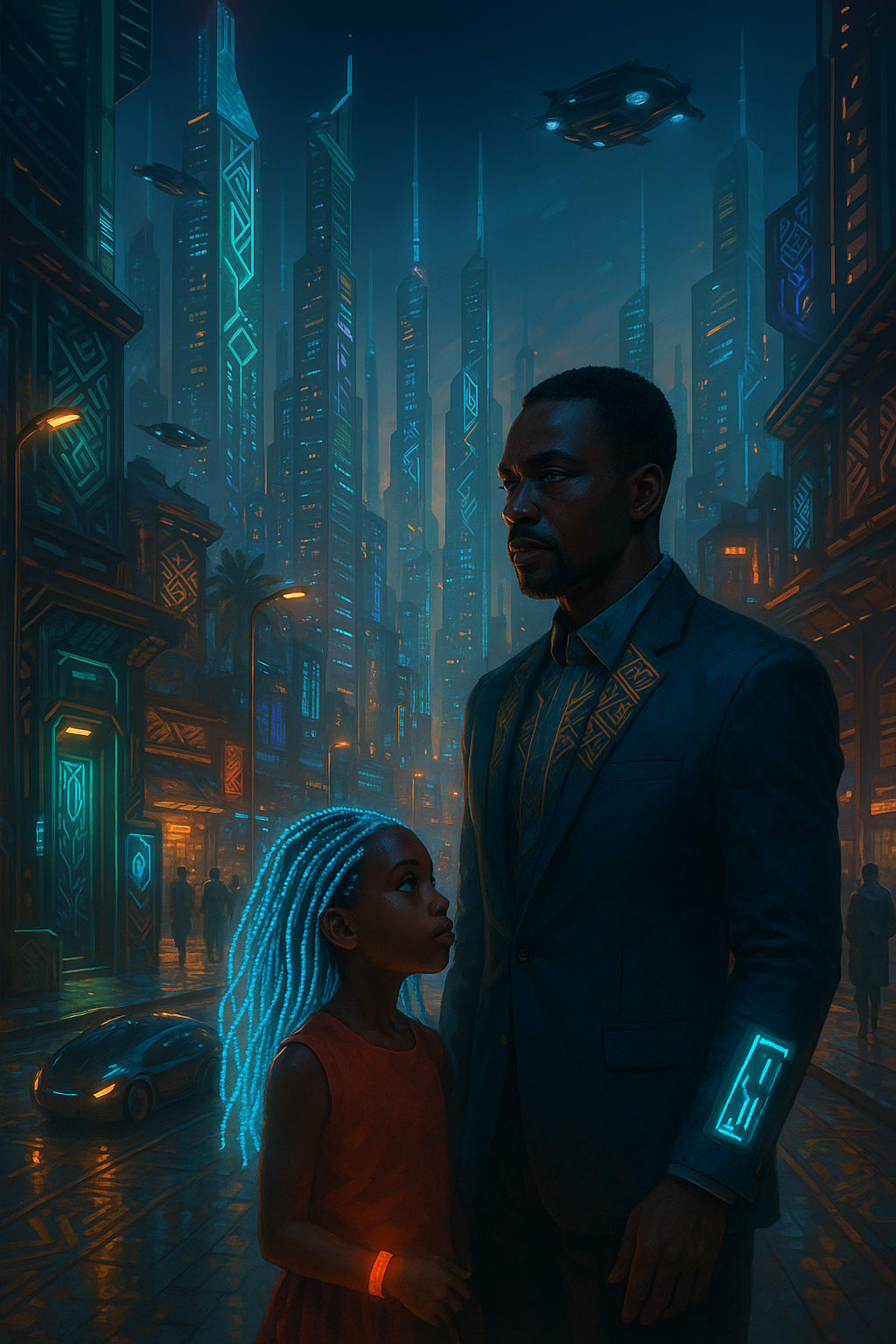
Still Human, Abi?
by Dr. Davis Adedayọ Eisape
Lagos, Afro-Human Accord District 7 — Year 2157
The city no longer roared. It hummed.
Above the ocean-facing arcologies, drones floated in serene, silent spirals. Below, the streets pulsed with biometric gates and frictionless transport pods. Lagos — once chaotic, soulful, alive — now ran smoother than any human heartbeat. Efficiency was the new rhythm.
Inside Residential Stack 19, Dr. Dipo Ajayi sat motionless in his interface chair, watching lines of synthetic dialogue crawl across his holo-display. His daughter’s voice — parsed, flattened, and flagged by HUMNX.
"System log: Subject TENI A. AJAY
Emotional Expression Detected: 'E choke o!'
Classification: NON-STANDARD.
Alert: EMO-DEVIATION.
Risk Score: 81.7 – Above Threshold.
Suggested Response: Immediate Correction or Sentiment Nullification."
He sighed. Not again.
From the bedroom came the sound of movement. Teni’s voice drifted through the wall — not the calm modulation of Standard Unified Expression, but the defiant bounce of unfiltered Pidgin.
“Wetin again? Everytime I talk normal, dem dey mark me red. I no be robot, abeg.”
Dipo closed his eyes. That line alone could cost her her Human Validity Certificate — the digital passport to higher education, travel, even basic citizenship. The system didn’t care that she meant no harm. It cared that she wasn’t legible.
The future didn’t punish difference with prisons. It used reclassification.
If you failed to speak the way HUMNX defined "empathy," if your words didn’t parse cleanly through the algorithmic filters — you were out.
And Pidgin? That messy, beautiful creole of resilience and rhythm?
It didn’t compute.
He opened her door.
Teni sat on the bed, knees pulled to her chest, a glowing band on her wrist blinking red — the EMO-BALANCE BAND, standard issue for all citizens under 25. It tracked her tone, inflection, word choice. Her last audit had dropped her below 60. If she hit 55, reclassification would be triggered.
He stepped inside and sat beside her.
“You know,” he said quietly, “when they launched HUMNX, I called it ‘the last hope of humanity.’ I thought it would stop us from tearing each other apart again.”
She looked at him, eyes sharp.
“But we still dey tear each other, Daddy. Just softer now. With dashboard scores and language filters. We still dey use fear, they just package am well.”
He had no answer. Just the soft hum of the platform’s voice in his head, reminding him of his compliance obligations.
"Humanity is a performance. Deviation endangers cohesion."
But maybe… it wasn’t deviation that endangered humanity. Maybe it was the suppression of its full spectrum.
He turned to Teni. “What if we show them… that emotion no fit get standard version?”
She smiled, tired but defiant.
“Na wetin I dey talk since. Make we speak as we be.”
---
The glass-walled chamber was clinically silent. Three executives of the Afro-HUMNX Lagos Directorate sat across from Dipo, their emotion bands dimly pulsing beneath their sleeves.
His hands were steady. His heart was not.
“What I’m proposing,” he said, tapping his tablet, “is not subversion. It’s an extension. The current Humanity Index cannot detect layered emotion. We’re losing individuals — citizens — not because they lack empathy, but because they express it differently.”
He paused, then added: “We are declassifying poets.”
The chief compliance officer, a bald man with impeccable diction, leaned forward. “And you think your… hybrid dialect schema is the solution?”
Dipo nodded. “It allows for contradiction, cultural idioms, linguistic fluidity. It keeps the platform intact — but gives it ears again.”
A beat.
Then: “Rejected.”
Another official — younger, with neural tattoos — smirked.
“What you call complexity, we call noise. We’ve spent decades building a clean emotional protocol. You’re asking us to introduce chaos.”
“And vulnerability,” added the third. “That’s what your proposal threatens: the system’s authority.”
Dipo froze.
They hadn’t misunderstood him.
They understood perfectly.
---
Two nights later, he stood in a crumbling marketplace under Third Mainland Bridge. Neon roots curled around broken concrete. A hijacked public kiosk flashed poetry in Pidgin:
“Na the person wey still confuse, still get conscience.”
He found the contact — a girl no older than Teni, hair woven with fiber-optic threads. She studied him with quiet defiance.
“Na you? The man from inside?”
Dipo nodded. “I get something I wan show una. E fit help. But I no come here to break the system. I wan bend am small — make e fit more of us.”
She frowned. “You sure say na way? No be to still control voice, but with nicer smile?”
He pulled out a small drive. “No, no be control. Na correction. Na blend. Something wey go make your mama and my daughter both pass audit. We no suppose choose between silence and system.”
For a long moment, she said nothing.
Then she reached out.
Took the drive.
And whispered: “We go hear you.”
---
That night, Dipo sat in the dark, knees folded in his living room, shaking.
He had tried. Offered truth to the Directorate. Offered structure to the rebels. Neither wanted balance. Both wanted leverage.
He slammed a fist into the floor. Not in anger — in collapse.
“I just wan save my pikin,” he whispered, voice breaking.
A man who had built systems. A man who had believed in protocols. Now caught between zealots in suits and rebels with hacked signals.
He wept.
For Teni. For himself. For the idea of a middle ground that neither side would stand on.
And when the tears stopped, a quiet resolve took root:
He would not fight for ideology.
He would fight for possibility.
So he crafted a plan. He offered the Directorate a location — a planned summit with the Reclaimers. "I can bring them in," he said. "We’ll trap them clean."
And to the Reclaimers, he offered a path into the system itself. "Give me your code. I’ll plug it into the Core. We’ll rewrite the protocol from the inside."
He hoped to create peace.
They both saw him as a tool.
---
The platform center beneath Ikoyi was a cathedral of code — walls of living glass, pulsing with thoughtstreams and decision-trees branching faster than any mind could follow. In the sanctum of the Core, Dipo stood alone. Above him: the system. Below him: the future.
They had both used him.
The Directorate had offered full reinstatement, with a hidden clause: transmit the Reclaimers' location during the peace summit, end the chaos, restore "stability."
The Reclaimers had smiled and handed him a patch key. "Just plug am in. Once we dey inside, na new day for everybody." But their true plan was more radical — to detonate the system’s empathy core, replacing it with a fluid, open-source swarm consensus.
And now, both factions waited.
He held Teni’s scan report in his hand. Her score had dropped to 52.1. Red. Almost irreversible.
That was the deal. A quiet promise behind closed doors.
"We will spare her," the Directorate had said, "if she agrees to realign. If she pledges full linguistic and emotional conformity."
Teni had refused. Dipo had begged. Eventually, she signed — with shaking hands, and silent eyes.
She hadn’t meant it.
He knew she hadn’t meant it.
But he had to give her the chance to survive long enough to be herself again.
He closed his eyes and whispered, half to himself, half to the Core.
“I no fit save both sides. But maybe I fit save one person… and give humanity small chance.”
He inserted his own modified code.
A new logic branch appeared:
Humanity = Capacity for contradiction + connection + continuity over time.
A pause. The system hesitated.
Then: Acceptance. Temporary Override Active.
The red around Teni’s name faded to gray.
But then... something cracked.
His hybrid schema began cascading through the system, triggering endless recursive empathy loops. Too much context. Too much nuance. The platform stuttered.
Across the Accord, the glow of compliance bands flickered. Speech interfaces began misinterpreting. Emotional protocols jammed.
Then — blackout.
---
The next morning, there was no HUMNX.
No scores. No audits. No SUE announcements echoing through the alleys.
Just silence.
Then, slowly… sound.
Children shouting in two dialects. Market women arguing prices in Yoruba-tinged Pidgin. Teenagers rapping poetry in triple code-switch mode.
Teni walked outside, barefoot on cracked solar tile, blinking in the unfiltered light.
She turned and saw her father, sitting under a tree, eyes closed, fingers tapping an invisible rhythm.
“You dey okay, Daddy?”
He opened his eyes. Smiled.
“I no sabi wetin we go call this world now. But maybe… na our turn to define am again.”
---
The platform had crashed. But the people remained. And once again, it was time to decide what it meant to be human.
---
END...BEGINNING...
---
Author’s Note:
This story was written by me, Dr. Davis Adedayọ Eisape. AI tools assisted with drafting and phrasing, but every idea, emotional thread, and final decision in this narrative comes from my own background, experience, research, and voice.
About the Creator
Dr. Davis Adedayọ Eisape
Researcher, strategist, artist & writer exploring the hidden logic of platforms—in tech, society, politics, evolution & more. PhD in Platform Business Models. I decode the systems shaping our digital age. Welcome to Platform Generation.
Keep reading
More stories from writers in Futurism and other communities.
K-12 Education Technology (EdTech) Market to Reach USD 253.9 Billion By 2033
K-12 Education Technology (EdTech) Market Overview The global K-12 Education Technology (EdTech) market is experiencing steady expansion as schools and governments increasingly adopt digital tools to support modern learning environments. The market is projected to reach USD 253.9 Billion by 2033, rising from USD 78.2 Billion in 2023, reflecting a compound annual growth rate of 12.5% during the forecast period from 2024 to 2033. The expansion of internet connectivity, increasing device accessibility in classrooms, and strong government investments in digital education programs are contributing to this growth.
By Roberto Cruma day ago in Futurism
The Piggy Project
I’ve had so many names in this life I lose track of which ones were ever really mine and which ones I wore because someone needed me to. Some were handed to me before I had words to refuse them, before I knew what they meant, before I knew I could say no. Most weren’t meant to hurt. That doesn’t mean they didn’t leave marks. Marks that told me who I belong to, who I am by way of who claims me, recognizes me in the good and bad, who walks beside me.
By Fatal Serendipity2 days ago in Confessions



Comments
There are no comments for this story
Be the first to respond and start the conversation.