
“Stanford Found an 8-Word Trick That Changes How You Use AI”
A simple 8-word instruction is changing how people interact with AI — and it might make complicated prompt engineering almost unnecessary.


Artificial intelligence tools like ChatGPT, Claude, and Gemini have made one thing clear: the way you ask a question often matters more than the question itself. Over the last few years, an entire skill set called prompt engineering has emerged. People spend hours learning how to write detailed prompts in order to get better answers from AI.
But what if most of that effort isn’t actually necessary?
Researchers studying large language models discovered something surprisingly simple. Instead of writing long and complicated prompts, adding a short instruction of just eight words can dramatically improve the quality of AI responses.
Those eight words are simple:
“Think step by step and explain your reasoning.”
At first, this sounds almost too basic to be powerful. But in practice, this small instruction can completely change how an AI system approaches a question.
Why Prompt Engineering Became So Popular
Prompt engineering became popular because AI models tend to give safe, generic answers when prompts are vague. Users discovered that by carefully structuring prompts — giving context, instructions, and examples — they could guide the AI toward better outputs.
For example, instead of asking:
“Explain climate change.”
A prompt engineer might write:
“Explain climate change in simple terms for a 12-year-old student. Use examples and avoid technical jargon.”
The second prompt produces a far better answer because it provides clear instructions.
Over time, this approach became more complex. Some prompts became paragraphs long, including detailed formatting rules, tone instructions, and step-by-step tasks.
But researchers began noticing something interesting. Many of these improvements came from one key factor: forcing the model to reason before answering.
The Power of Step-by-Step Thinking
When AI systems generate answers quickly, they sometimes rely on the most common or statistically likely response. This can lead to shallow answers or even mistakes.
However, when the model is instructed to think step by step, it behaves differently.
Instead of jumping directly to an answer, the AI begins breaking the problem into smaller pieces. This process encourages deeper reasoning and often leads to more accurate results.
For example, consider this math problem:
“A store sells pencils for $2 each. If someone buys 5 pencils, how much do they pay?”
Without reasoning, the AI might answer correctly — but complex problems can lead to errors.
When asked to think step by step, the model explains the process:
Each pencil costs $2
The customer buys 5 pencils
Multiply 2 × 5
Total cost is $10
This method dramatically improves accuracy.
Why This Works
The reason this technique works has to do with how large language models generate text.
These models predict the most likely next word based on patterns learned during training. When asked simple questions, they sometimes choose the most common response without exploring deeper reasoning paths.
But when the prompt explicitly asks the model to explain its reasoning, it triggers a more structured thinking process. The model effectively “talks through” the problem before delivering the final answer.
Researchers sometimes call this chain-of-thought prompting.
Instead of hiding the reasoning process internally, the model writes it out step by step. This simple change can significantly improve performance in tasks such as:
Logical reasoning
Mathematics
Problem solving
Complex explanations
A Small Trick With Big Results
What makes this discovery fascinating is how small the change is.
You don’t need complicated prompts or special formatting. Just adding a short instruction can unlock better answers.
For example:
Basic prompt:
“Give me a startup idea.”
Improved prompt:
“Think step by step and generate five startup ideas.”
The second version often produces more thoughtful and creative responses.
This trick works because it encourages the AI to explore multiple possibilities rather than immediately jumping to the most common answer.
Does This Mean Prompt Engineering Is Dead?
Not exactly.
Complex prompts can still be useful for specialized tasks. However, this discovery shows that simplicity can sometimes outperform complexity.
Instead of memorizing dozens of prompt formulas, users can focus on clear instructions that guide reasoning.
In many cases, the best prompt might simply be the one that asks the AI to slow down and think.
What This Means for Everyday AI Users
For everyday users, this discovery is empowering. It means you don’t need to be a prompt engineering expert to get good results.
If an AI response seems shallow or incorrect, try adding a reasoning instruction.
For example:
“Explain step by step.”
“Think through the problem carefully.”
“Break this down logically.”
These small changes can dramatically improve the quality of the response.
As AI tools continue evolving, one thing becomes increasingly clear: the most powerful techniques are often the simplest.
And sometimes, just eight words can make all the difference.
About the Creator
Keep reading
More stories from Shahid Zaman and writers in Futurism and other communities.
Preparing for a Future Ruled by Artificial Intelligence
A few months ago, I watched a video of a robot answering customer calls better than a human agent. It spoke clearly, responded instantly, and never sounded tired. For a moment, I felt uneasy. If machines can talk, write, design, and even think faster than us, where do students stand in this new world? That question stayed with me. Artificial Intelligence is no longer a futuristic idea. It’s already part of our daily routines. It recommends what we watch, corrects our grammar, suggests what we should buy, and even helps doctors diagnose diseases. For students, especially those dreaming about stable careers, this rapid change can feel overwhelming. But after thinking deeply about it, I realized something important: The future does not belong to those who fear AI. It belongs to those who prepare for it. The real challenge is not competing with machines — it is learning how to work alongside them.
By Shahid Zaman12 days ago in Futurism
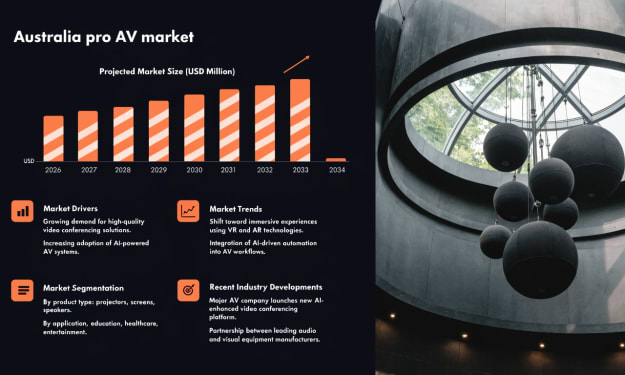
Australia Pro AV Market: Hybrid Work Demand, Digital Signage & Smart AV Technologies
According to IMARC Group, the Australia pro AV market reached a value of USD 93.9 Million in 2025 and is projected to reach USD 133.6 Million by 2034, growing at a compound annual growth rate (CAGR) of 3.88% during 2026–2034. The market is expanding as organizations increasingly adopt advanced audiovisual solutions to support communication, collaboration and digital engagement. Hybrid work environments are encouraging businesses to invest in video conferencing systems, smart displays and integrated collaboration platforms that connect remote and in-office teams. At the same time, industries such as retail, hospitality and tourism are investing in digital signage to improve customer engagement and brand communication. As companies focus on creating interactive and technology-driven environments, professional AV solutions are becoming essential tools for modern workplaces, entertainment venues and commercial spaces across Australia.
By Kevin Cooper3 days ago in Futurism
Agentic AI in Energy Market to Exceed USD 10,700 Million By 2034
Agentic AI in Energy Market Overview The global Agentic AI in Energy Market is projected to reach approximately USD 10,700 Million by 2034, rising from nearly USD 480 Million in 2024. This expansion reflects a strong CAGR of 36.40% during the forecast period from 2025 to 2034. Market growth is being driven by the increasing use of autonomous artificial intelligence systems to manage complex energy operations, including power generation optimization, grid management, predictive maintenance, and energy demand forecasting. Energy companies are integrating agentic AI technologies to automate decision making processes and improve the efficiency of energy infrastructure.
By Roberto Crum3 days ago in Futurism


Comments
There are no comments for this story
Be the first to respond and start the conversation.