
Space as a Sanctuary: Can Humanity Survive Without Earth Forever?
Space

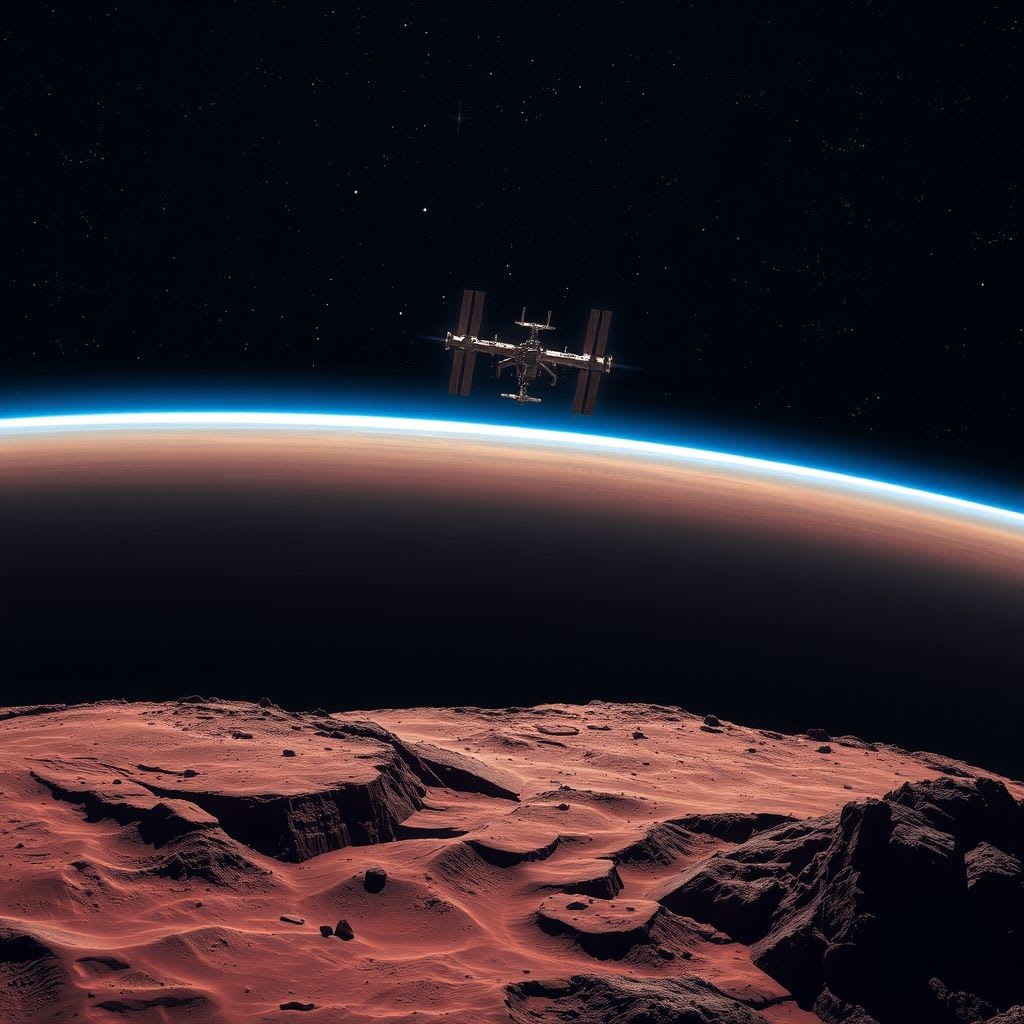
Earth is our cradle — but must it always be our only home? This profound question is no longer confined to science fiction or late-night philosophy. In the face of rising populations, climate change, resource depletion, and the looming threat of global catastrophes, scientists, futurists, and dreamers alike are turning their eyes toward the stars. Could humanity truly survive — and even thrive — away from Earth, permanently?
A Planetary Escape or a One-Way Ticket?
Science fiction paints space colonization as a bold, exhilarating adventure. We see images of glittering cities on Mars, thriving colonies on the moons of Jupiter, and massive orbital habitats filled with greenery and light. These visions inspire hope and awe, but reality is far less forgiving.
Space is harsh. Beyond the protective shield of Earth’s atmosphere, humans face deadly radiation, the vacuum of space, extreme temperatures, and a complete lack of naturally occurring food, water, or breathable air. Despite this, the idea of space as humanity’s "Plan B" refuses to die. Even if it’s not a permanent solution right away, space could offer a lifeline for our species — a backup, should things go irreversibly wrong here on Earth.
Mars: Our First Stop?
Mars stands out as the most plausible candidate for human settlement. It’s relatively close in astronomical terms, has gravity (albeit only 38% of Earth’s), and follows a similar day-night cycle. Yet, the red planet is far from hospitable. Its atmosphere is unbreathable, its soil contains toxic perchlorates, and solar radiation is a serious health risk. Living there would require building enclosed habitats, creating closed-loop life support systems, and recycling everything — from air and water to human waste.
Organizations like SpaceX, NASA, and ESA are actively working on missions that could lay the groundwork for future bases. Elon Musk’s vision of a self-sustaining Martian city might sound grandiose today, but it’s slowly inching from fantasy to possibility. Still, a fully functional colony may be decades — or more likely, centuries — away.
Orbital Cities and Artificial Habitats
Another possibility lies not on planetary surfaces, but in space itself. Instead of terraforming worlds, we might build massive orbital habitats — structures like O’Neill cylinders that rotate to simulate gravity, maintain Earth-like climates, and support self-contained ecosystems. These "space cities" offer flexibility, as they’re not tied to any planetary environment.
In theory, such habitats could become permanent homes for thousands, perhaps millions, of people. In practice, however, constructing and sustaining them would require unprecedented engineering feats, vast resources, and ultra-reliable life support systems. We would need to master space manufacturing, resource harvesting from asteroids, and long-term biological sustainability.
The Human Challenge: Body and Mind
Even if we overcome every technical hurdle, a fundamental issue remains: Can the human body and mind endure life in space long-term?
Microgravity is known to weaken bones, atrophy muscles, and impair circulation. Cosmic radiation increases cancer risk and may cause long-term genetic damage. Mentally, humans are poorly adapted to isolation, confinement, and monotony. Long-duration space missions have already revealed risks of depression, anxiety, and cognitive decline. We are creatures of Earth — shaped by its cycles, nourished by its ecosystems, and stabilized by its gravity. Transplanting ourselves into a sealed metal world is an experiment with unknown psychological consequences.
Could We Leave Earth Forever?
In theory? Yes. In reality? Not yet. Even if we establish colonies on Mars or in orbit, they will remain dependent on Earth for a long time — for technology, for cultural identity, even for raw materials. Earth is not just a place; it’s the foundation of our biology, our civilization, our history.
To truly break free, we would need to replicate Earth’s generosity — to build artificial worlds that can sustain generations without support. That remains one of humanity’s greatest challenges.
Space Is Not an Escape — It’s an Expansion
The ultimate purpose of space exploration shouldn't be to flee Earth but to expand beyond it. Space isn't a refuge from our problems — it’s a frontier for new opportunities, discoveries, and growth. It may become a safety net against extinction, but it won’t absolve us of responsibility for our home planet.
That’s why any roadmap to the stars must go hand in hand with care for Earth. As we develop the technologies and philosophies to live among the stars, we must also heal, protect, and cherish the planet that gave us life.
Earth should always remain part of our future — even as we build new homes beyond the sky.
About the Creator
Keep reading
More stories from Holianyk Ihor and writers in Futurism and other communities.
Apogee and Perigee: Understanding the Cosmic Dance in Simple Terms
The night sky has always captivated humanity — a vast canvas of stars, planets, and mysteries waiting to be understood. Among the many fascinating concepts in astronomy, two terms often come up that sound almost magical: apogee and perigee. Though they may seem like complex jargon, they actually describe something quite simple — and pretty cool.
By Holianyk Ihor8 months ago in Futurism
About Binding Prometheus
I want to start actively advocating on behalf of my own work, and the most valuable part of my canon is, without a doubt, Binding Prometheus, the play I have been working on since 2019 and only finished in 2023 as part of my MA. The play itself is an amalgamation of a million different inspirations. On one end, it evokes the Ancient Greek myth-play, deriving its own title from the earliest extant work of Western drama we have, Aeschylus’s Prometheus Bound. On the other end, it borrows significantly from the sci-fi bulwarks from over the years, namely Mary Shelley’s Frankenstein and Karel Capek’s Rossum’s Universal Robots. The play could be an episode of Black Mirror, I fear. I don’t know. I’ve only ever seen one episode of Black Mirror.
By Steven Christopher McKnight12 days ago in Futurism
The steps to losing a child
Step One: Lose a child. Not what anyone wants to happen and nothing you can do to change it, but you can go through steps to becoming happy again. You can go through steps to loving again. You can go through steps to become a new you because after losing a child you will never be the same person you once were.
By Tabitha Hinkley4 days ago in Fiction




Comments (1)
The idea of space as a backup for humanity is fascinating. Mars seems like a likely first stop, but it's far from easy. We'll need to overcome a lot of challenges to make it work.