
South Africa Automotive Market: Production Capacity, Supply Chain Shifts & Growth Outlook
How changing mobility habits, cost-sensitive consumers, and technology integration are redefining brand positioning in the South Africa automotive market.

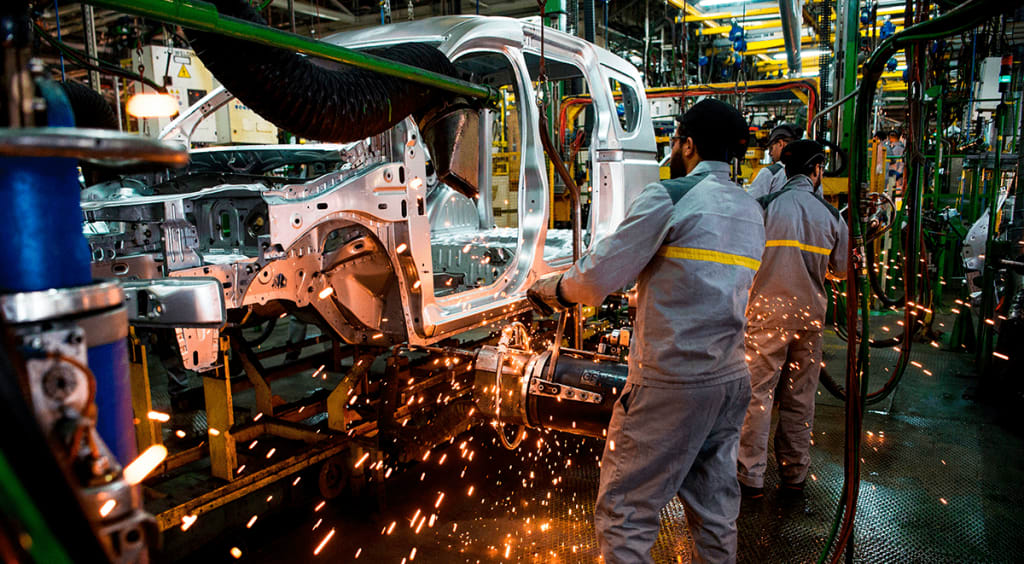
According to IMARC Group's latest research publication, the South Africa automotive market size reached USD 14.47 Billion in 2024. Looking forward, IMARC Group expects the market to reach USD 23.52 Billion by 2033, exhibiting a growth rate (CAGR) of 4.98% during 2025-2033.
How AI is Reshaping the Future of South Africa Automotive Market
- AI-driven supply chain optimization enhances operational efficiency and reduces costs across manufacturing and distribution in the South Africa automotive sector.
- Intelligent vehicle systems powered by AI improve safety and driving experiences, aligning with the growing local interest in electric and hybrid vehicles.
- AI supports the expansion of used vehicle and financing markets by enabling smarter credit risk assessments and personalized financing options.
South Africa Automotive Market Trends & Drivers:
The South African automotive industry has been growing, due to the economy, consumer confidence, as well as pent up demand due to previous years when consumers have deferred purchases. South African new vehicle sales have been increasing as buyers target reliable motoring, with the energy supply being more stable and logistics improving. The prevailing factors of lower vehicle inflation and cheaper finance continue to support strong demand for both new and used passenger and light commercial vehicles, while cheaper imports are reshaping consumer tastes and supporting growth in retail activity. The automotive sector has exceeded pre-pandemic levels for the first time in over a decade and is well positioned to grow in the near term.
The move towards new energy vehicles, hybrids and electric vehicles is accelerating with international sustainability trends influencing local developments and government promotion of cleaner vehicles impacting consumer choice. Conversely, consumers are becoming more receptive to electrification, as variety, technology, and international decarbonization efforts increase. Chinese manufacturers are broadening the range of vehicles and opening dealerships, increasing the availability of high-end features. The sales volume of new energy vehicles in the year to date has already exceeded that of the entire previous year, driven by an increase in charging stations and subsidies for local manufacturing, indicating a structural shift in the domestic market.
Also, cheaper imports from China and India are competing with more advanced technology and longer warranty, but value for money, spurring competition in the market and driving developments and price-cutting between market segments. Export volumes have continued to set records, backed by domestic production, to meet demand at home and abroad. In context where demand is volatile, the continuing pressure to import means manufacturers are encouraged to diversify, localize, and become competitive, leading to a wider choice and South Africa remaining the continent's primary automotive production location.
South Africa Automotive Industry Segmentation:
The report has segmented the market into the following categories:
Type Insights:
- Passenger Vehicles
- Commercial Vehicles
- Two Wheelers
Propulsion Type Insights:
- Gasoline
- Diesel
- Electric
- Others
Sales Channel Insights:
- Dealerships
- Online Sales
- Direct Sales
- Others
Regional Insights:
- Gauteng
- KwaZulu-Natal
- Western Cape
- Mpumalanga
- Eastern Cape
- Others
Competitive Landscape:
The competitive landscape of the industry has also been examined along with the profiles of the key players.
Recent News and Developments in South Africa Automotive Market
- January 2026: Tax incentives for new energy vehicle production take effect from March 2026, allowing manufacturers to claim 150% of qualifying investments in facilities and machinery for hybrids and EVs, accelerating the shift to cleaner technologies and attracting further investment.
- January 2026: Toyota reports its best monthly sales figure in 18 years, driven by strong performance in locally-assembled models like the Hilux, Corolla Cross, and Fortuner, highlighting sustained demand for established internal combustion and hybrid vehicles amid market competition.
- January 2026: Chery SA agrees to acquire Nissan's Rosslyn manufacturing plant, set for completion in mid-2026, securing jobs and supplier networks while enabling expanded local production capacity and new model launches under Chinese ownership.
- 2025: New Energy Vehicle sales surge, with year-to-date figures by November already surpassing full-year 2024 totals, fueled by an influx of affordable imports from China and India alongside growing adoption of hybrids and EVs.
Note: If you require specific details, data, or insights that are not currently included in the scope of this report, we are happy to accommodate your request. As part of our customization service, we will gather and provide the additional information you need, tailored to your specific requirements. Please let us know your exact needs, and we will ensure the report is updated accordingly to meet your expectations.
About the Creator
Fatimah
Market research writer at IMARC Group, turning data into engaging stories. Passionate about trends, insights & real-world impact. Join me on Vocal!
About Binding Prometheus
I want to start actively advocating on behalf of my own work, and the most valuable part of my canon is, without a doubt, Binding Prometheus, the play I have been working on since 2019 and only finished in 2023 as part of my MA. The play itself is an amalgamation of a million different inspirations. On one end, it evokes the Ancient Greek myth-play, deriving its own title from the earliest extant work of Western drama we have, Aeschylus’s Prometheus Bound. On the other end, it borrows significantly from the sci-fi bulwarks from over the years, namely Mary Shelley’s Frankenstein and Karel Capek’s Rossum’s Universal Robots. The play could be an episode of Black Mirror, I fear. I don’t know. I’ve only ever seen one episode of Black Mirror.
By Steven Christopher McKnight28 days ago in Futurism
DC-DC Converter Market: Modular Architectures & Custom Power Solutions
Driven by electric vehicle adoption, renewable energy integration, industrial automation, and rising demand for efficient power management across electronics, telecom, and data center infrastructure worldwide. According to IMARC Group's latest research publication, global DC-DC converter market size reached USD 12.3 Billion in 2024. Looking forward, IMARC Group expects the market to reach USD 22.0 Billion by 2033, exhibiting a growth rate (CAGR) of 6.36% during 2025-2033.
By Andrew Sullivanabout 3 hours ago in Futurism




Comments
There are no comments for this story
Be the first to respond and start the conversation.