
Solar-Powered UAV Market Trends: Sustainable Aviation, Ultra-Light Designs & Industry Forecast to 2033
How sustainable aviation priorities and low-emission technologies are positioning solar-powered UAVs as strategic assets across commercial, defense, and scientific missions.

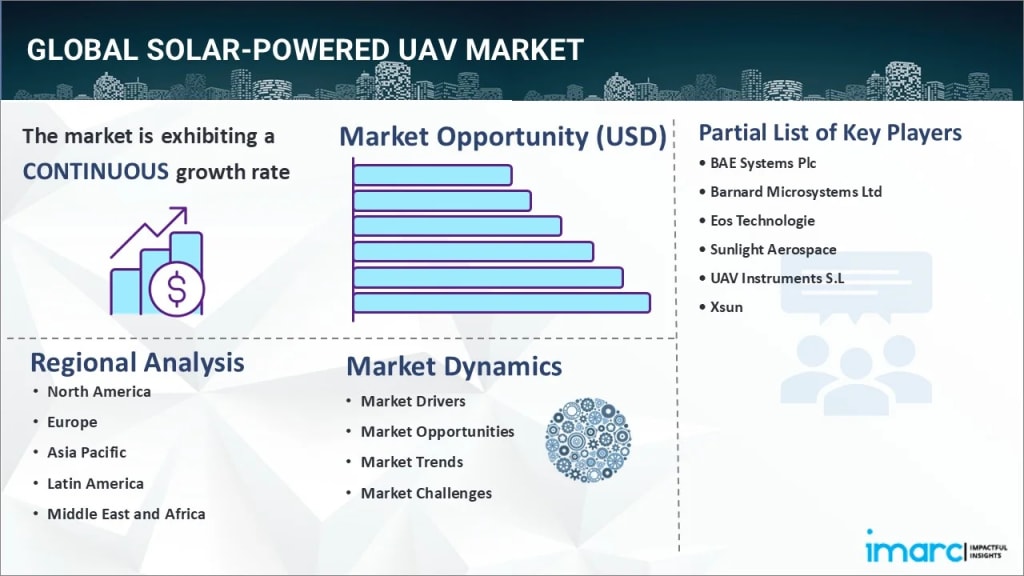
Rising demand for unmanned aerial surveillance, growing defense modernization programs, and the push for sustainable aviation solutions are powering the solar-powered UAV market forward. According to IMARC Group’s latest data, the global solar-powered UAV market size reached USD 401.0 Million in 2024. Looking forward, IMARC Group expects the market to reach USD 867.3 Million by 2033, exhibiting a CAGR of 8.5% during 2025–2033.
Solar-powered UAVs are redefining what long-endurance aerial operations look like. These drones harness solar energy to stay airborne for extended periods sometimes days at a stretch making them ideal for applications where conventional fuel-powered aircraft simply can’t compete on cost or endurance. The market spans a diverse range of segments: fixed-wing drones dominate by type due to their aerodynamic efficiency; missions exceeding 300 km represent the largest range category; and defense remains the single largest application area. Semi-autonomous operation leads the mode-of-operation segment, while propulsion systems and airframes are the core components drawing innovation investment. From crop monitoring in precision agriculture to battlefield surveillance and climate research, solar UAVs are becoming operational necessities across industries.
Solar-Powered UAV Market Growth Drivers:
- Escalating Defense and Military Demand
Defense agencies worldwide are aggressively integrating solar-powered UAVs to support long-range surveillance, intelligence gathering, and communication relay missions without the logistical burden of fuel resupply. The U.S. Department of Defense and NASA have channeled substantial funding into advanced UAV propulsion R&D. A notable example: DARPA’s ANCILLARY program awarded Northrop Grumman a contract in July 2023 to develop autonomous VTOL uncrewed aircraft. With approximately 855,860 drones registered in the U.S. alone—over 316,000 for commercial operations per FAA data—government-led investment continues to be a primary growth engine for this market.
- Surge in Commercial and Agricultural Applications
Farmers, energy operators, and infrastructure managers are increasingly turning to solar UAVs as a cost-effective alternative to traditional surveying methods. These drones monitor crop health, detect pests, spray fertilizers, inspect solar panels, and map large tracts of land—all with minimal operational costs. In January 2024, Sphere Drones launched HubX, a self-sustaining mobile drone platform designed for aerial data collection across remote terrains. Garuda Aerospace’s multi-function agricultural drone, capable of pesticide spraying, pipeline inspection, and delivery operations, is another indicator of how fast commercial use cases are broadening and deepening across sectors.
Claim Your Free "Solar-Powered UAV Market" Analysis Sample Report Here
- Intensifying R&D Investment and Technological Breakthroughs
Research institutions and private firms are pushing the boundaries of how long solar UAVs can stay airborne. India’s National Aerospace Laboratories conducted successful flight trials of a HAPS solar UAV capable of floating in the air for over ten consecutive days—a milestone for stratospheric operations. NewSpace Research and Technologies’ HAPS completed a 21-hour maiden flight in late 2023. IIT Kanpur’s ‘Maral’ solar surveillance drone, developed entirely with indigenous technology, is another example of how government-backed academic research is fueling next-generation capabilities and building the pipeline for commercialization.
Solar-Powered UAV Market Trends:
- High-Altitude Pseudo-Satellite (HAPS) Development
One of the most exciting frontiers in solar UAV technology is the HAPS segment—drones designed to operate in the stratosphere for weeks or months at a time, effectively functioning as low-cost satellite substitutes for communications and Earth observation. India’s government-backed programs, including those led by NewSpace Research and Technologies and DRDO, are investing in indigenous HAPS platforms to reduce dependency on foreign satellite infrastructure. These platforms can provide broadband connectivity to remote regions, border surveillance, and disaster monitoring at a fraction of conventional satellite costs, making HAPS one of the most strategically significant trends shaping this market today.
- Integration of AI and Autonomous Navigation Systems
Semi-autonomous operation currently holds the largest mode-of-operation share in this market, but the direction is clearly toward full autonomy. Leading manufacturers are embedding AI-driven navigation, obstacle avoidance, and real-time data analytics directly into solar UAV platforms. Sentera’s partnership with Freefly Systems, finalized in late 2023, integrated ultra-high-resolution aerial sensors with drone systems to deliver seamless, non-compromised image quality for agricultural analytics. DJI’s April 2024 launch of rapid drone-charging power stations across the U.S., Europe, and Australia—capable of fast-charging in roughly 30 minutes—further signals how the ecosystem is maturing around operationally self-sufficient, intelligent drone fleets.
- Lightweight Material Innovation Improving Endurance
Airframe design is quietly becoming one of the most competitive battlegrounds in the solar UAV space. Manufacturers are adopting advanced carbon fiber composites, aerodynamic wing geometries, and ultra-lightweight structural materials to maximize the energy harvested from solar panels and minimize drag. Fixed-wing drones, which hold the largest type segment share, owe much of their efficiency advantage to these material improvements—allowing them to cover larger areas at higher altitudes during single missions. Paired with more efficient photovoltaic cell arrays and smarter battery management systems, these innovations are steadily extending practical flight durations from hours to days for operational platforms.
Recent News and Developments in Solar-Powered UAV Market
- April 2024: DJI launched its first power stations in the U.S., Europe, and Australia to charge drones when they are far from home. The Power 1000 can fast-charge drones in about 30 minutes, significantly improving operational readiness for commercial and field-deployed solar UAV fleets.
- March 2024: The Indian Institute of Technology (IIT) Kanpur developed ‘Maral,’ a unique surveillance drone powered entirely by solar energy. The indigenously designed UAV promises to revolutionize aerial monitoring capabilities, offering a cost-effective and sustainable solution for long-range defense and civil surveillance applications.
- February 2024: National Aerospace Laboratories (NAL) successfully tested a solar-powered UAV capable of remaining airborne for multiple consecutive days. Scientists in Bengaluru conducted a series of flight trials of a scaled-down HAPS version, marking a significant milestone in India’s push toward indigenous stratospheric drone technology.
Note: If you require specific details, data, or insights that are not currently included in the scope of this report, we are happy to accommodate your request. As part of our customization service, we will gather and provide the additional information you need, tailored to your specific requirements. Please let us know your exact needs, and we will ensure the report is updated accordingly to meet your expectations.
About the Creator
Andrew Sullivan
Hello, I’m Andrew Sullivan. I have over 9+ years of experience as a market research specialist.
Keep reading
More stories from Andrew Sullivan and writers in Futurism and other communities.
Hair Shampoo Market Trends: Ingredient Innovation, Premiumization & Forecast to 2034
Rising environmental pollution, evolving consumer lifestyles, and growing awareness around scalp health are fueling demand for hair shampoos globally, supported by the shift toward herbal and natural formulations, rapid e-commerce expansion, and continuous product innovation targeting specific hair concerns. According to IMARC Group’s latest data, The global hair shampoo market size reached USD 38.0 Billion in 2025. Looking forward, IMARC Group expects the market to reach USD 48.0 Billion by 2034, exhibiting a CAGR of 2.62% during 2026-2034.
By Andrew Sullivanabout 16 hours ago in Futurism
Australia Cyber Insurance Market: Risk Exposure, Digital Adoption & Regulatory Frameworks
According to IMARC Group, the Australia cyber insurance market reached USD 467.1 Million in 2025 and is projected to expand to USD 1,994.3 Million by 2034, exhibiting a strong compound annual growth rate (CAGR) of 17.50% during 2026–2034. This rapid growth reflects escalating cyber risk exposure across businesses and institutions in Australia. As digital transformation accelerates—driven by cloud computing, mobile workforces and data-driven operations—organizations face increasing vulnerability to ransomware, phishing attacks and data breaches. Cyber insurance is emerging as a critical financial risk management tool, providing coverage for business interruption, regulatory fines, forensic investigations and reputational damage.
By Kevin Coopera day ago in Futurism




Comments
There are no comments for this story
Be the first to respond and start the conversation.