
Software Development Market Size and Forecast 2025–2033
AI, Cloud, and Digital Transformation Propel the Global Software Development Industry into a Trillion-Dollar Era

Software Development Market Overview
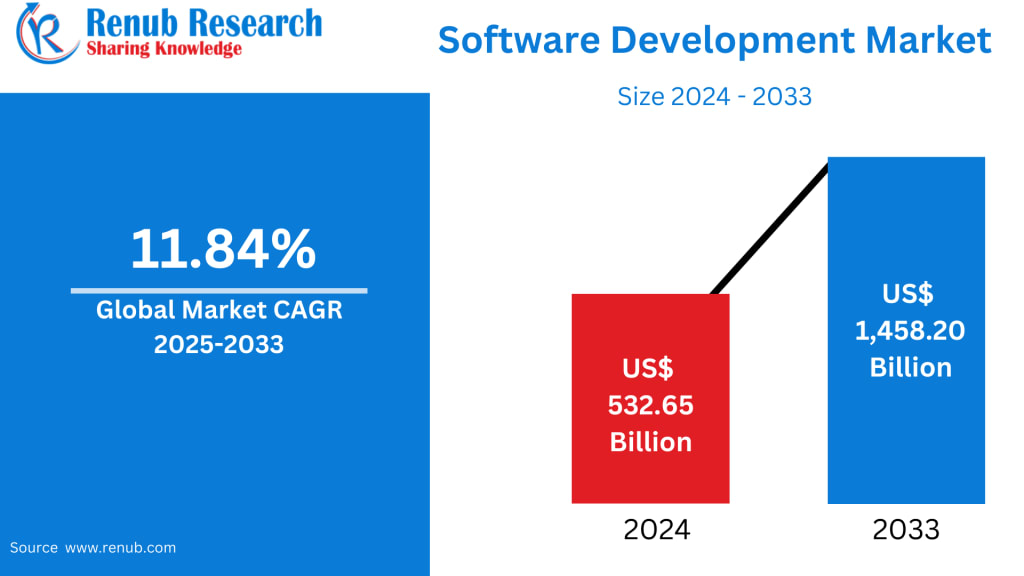
The global software development market has emerged as one of the most influential pillars of the modern digital economy, enabling organizations, governments, and individuals to operate with greater efficiency, intelligence, and agility. According to Renub Research, the Software Development Market is expected to grow from US$ 532.65 billion in 2024 to US$ 1,458.20 billion by 2033, expanding at a robust CAGR of 11.84% from 2025 to 2033.
This rapid growth reflects the accelerating pace of digital transformation across industries worldwide. Software is no longer a support function; it is now a core strategic asset driving innovation, automation, customer experience, and business scalability. From enterprise applications and mobile platforms to AI-driven analytics and cloud-native solutions, software development has become essential to maintaining competitiveness in a data-driven global economy.
Global Software Development Industry Outlook
The software development industry encompasses a broad spectrum of services, including enterprise software, mobile and web application development, artificial intelligence and machine learning platforms, embedded systems, and IoT solutions. Continuous technological advancement, combined with evolving consumer and enterprise demands, has transformed how software is designed, deployed, and maintained.
Modern development practices increasingly rely on agile methodologies, DevOps frameworks, and continuous integration and deployment (CI/CD) pipelines. These approaches allow organizations to accelerate product delivery while maintaining quality and security. The rise of cloud platforms such as Amazon Web Services, Microsoft Azure, and Google Cloud has further shortened development cycles by providing scalable infrastructure, pre-built tools, and seamless integration capabilities.
Additionally, the emergence of low-code and no-code platforms is democratizing software development by allowing non-technical users to build functional applications. Open-source ecosystems and global developer communities also play a crucial role in fostering innovation and reducing development costs.
Despite its global reach, the software development industry is heavily concentrated in North America, Europe, and Asia-Pacific. North America leads in innovation and investment, while Asia-Pacific benefits from a vast talent pool and cost-effective services. Europe remains a strong market driven by regulatory compliance, industrial automation, and enterprise digitalization.
Key Factors Driving Software Development Market Growth
Industry-Wide Digital Transformation
Digital transformation remains the single most powerful growth driver for the software development market. Organizations across manufacturing, retail, BFSI, healthcare, logistics, and government sectors are investing heavily in digital solutions to streamline operations, enhance customer engagement, and improve decision-making.
Custom software applications enable automation of complex workflows, real-time analytics, and omnichannel user experiences. Enterprises are increasingly adopting agile and DevOps practices to accelerate development cycles and respond rapidly to changing market conditions. As digital agility becomes a competitive necessity, demand for reliable and scalable software solutions continues to surge.
Growing Adoption of Cloud Computing and SaaS
Cloud computing and Software-as-a-Service (SaaS) models have fundamentally reshaped the software development landscape. Cloud platforms provide on-demand access to computing power, storage, and development tools, eliminating the need for heavy upfront infrastructure investments.
Organizations are increasingly favoring cloud-native applications for their flexibility, scalability, and cost efficiency. SaaS solutions allow businesses to deploy sophisticated software with minimal IT complexity while supporting remote collaboration and global operations. This shift has significantly increased demand for cloud-based software development, microservices architecture, and API-driven ecosystems.
Integration of Artificial Intelligence and Automation
Artificial intelligence and automation are transforming both the process of software development and the functionality of modern applications. AI-powered development tools help developers write cleaner code, automate testing, identify bugs, and optimize performance, reducing time-to-market and development costs.
At the application level, AI integration enables predictive analytics, personalization, intelligent automation, and natural language processing. Businesses increasingly seek intelligent software solutions that adapt to user behavior and deliver actionable insights. This growing reliance on AI-enabled platforms is accelerating innovation and expanding the scope of the global software development market.
Challenges in the Software Development Market
Talent Shortage and Skill Gaps
Despite strong demand, the software development industry faces a persistent shortage of skilled professionals. Rapid technological evolution requires expertise in areas such as AI, cybersecurity, cloud architecture, and blockchain, skills that remain in short supply globally.
This talent gap leads to higher labor costs, extended project timelines, and increased competition among employers. Continuous learning and upskilling are essential, but many organizations struggle to keep pace with emerging technologies. The shortage of qualified developers remains a key constraint on market scalability.
Rising Complexity and Cybersecurity Risks
As software systems become more complex, managing development lifecycles grows increasingly challenging. Modern applications often integrate multiple platforms, third-party services, and advanced technologies, increasing the risk of bugs and delays.
Cybersecurity threats further complicate development efforts. Developers must incorporate security and compliance requirements throughout the software lifecycle to prevent data breaches and regulatory violations. Balancing speed, innovation, and security remains a critical challenge for software development firms worldwide.
Software Development Market Overview by Region
United States Software Development Market
The United States dominates the global software development market due to its advanced technology ecosystem, strong R&D investments, and deep talent pool. Innovation hubs such as Silicon Valley, Seattle, and Austin drive advancements in AI, cloud computing, cybersecurity, and enterprise software.
The U.S. market places strong emphasis on cloud-native development, agile methodologies, and DevOps practices. While rising labor costs and talent shortages pose challenges, continued innovation and digital transformation initiatives ensure sustained market leadership.
Germany Software Development Market
Germany plays a pivotal role in Europe’s software development landscape, supported by its strong industrial base and engineering expertise. Demand is particularly high for automation, Industry 4.0 solutions, and enterprise software across automotive, manufacturing, and logistics sectors.
Strict data protection regulations under GDPR influence software design, prioritizing security and compliance. Government-backed digitalization initiatives and growing startup ecosystems in cities like Berlin and Munich continue to drive steady market growth.
India Software Development Market
India is one of the fastest-growing software development markets globally, driven by a vast pool of skilled IT professionals and cost-effective service offerings. The country is a global hub for IT outsourcing, custom software development, and product engineering.
Strong demand from BFSI, healthcare, e-commerce, and telecom sectors, combined with government initiatives such as Digital India and Startup India, supports continued expansion. While infrastructure gaps and global competition remain challenges, India’s growing domestic demand and innovation ecosystem position it as a long-term growth leader.
United Arab Emirates Software Development Market
The UAE software development market is expanding rapidly, fueled by national digital transformation strategies and smart city initiatives. Sectors such as finance, healthcare, logistics, and retail are adopting AI, cloud, and IoT solutions at a fast pace.
Dubai and Abu Dhabi have emerged as regional innovation hubs, attracting startups and international investments. Although talent shortages persist, investments in education and favorable business policies are strengthening the UAE’s position as a Middle East technology center.
Recent Developments in the Software Development Industry
Adobe Inc. announced new joint products with AWS and Amazon Ads in March 2025, integrating Adobe Experience Platform with cloud services to enable large-scale customer personalization.
Google Cloud and Salesforce Inc. strengthened their partnership in February 2025 by integrating Gemini language models into AI-driven service workflows.
EPAM Systems expanded its near-shore delivery capabilities in January 2025 by acquiring NEORIS to support digital transformation projects across Latin America.
Market Segmentation
By Application Type
Enterprise Software
Mobile Application Development
Web Application Development
AI/ML and Data Analytics Software
Embedded Systems & IoT Software
By Organization Size
Small and Medium Enterprises (SMEs)
Large Enterprises
By Deployment Mode
Cloud
On-Premise
By Industry Vertical
IT & Telecom
Retail
BFSI
Manufacturing
Healthcare
Government
Others
Key Companies Covered
Major players shaping the global software development market include Microsoft Corporation, Amazon.com Inc. (AWS), Google LLC, IBM Corporation, Accenture plc, Apple Inc., Oracle Corporation, Salesforce Inc., Adobe Inc., and NVIDIA Corporation.
Each company analysis includes business overview, key leadership, recent developments, SWOT analysis, and revenue insights.
Final Thoughts
The global software development market is entering a transformative growth phase, driven by digital transformation, cloud adoption, and the integration of artificial intelligence. As organizations increasingly rely on software to achieve operational excellence and innovation, the industry’s importance will continue to expand.
Despite challenges related to talent shortages and cybersecurity risks, ongoing investments in technology, automation, and skills development are expected to sustain long-term growth. With the market projected to surpass US$ 1.45 trillion by 2033, software development will remain a cornerstone of global economic and technological progress.
About the Creator
Keep reading
More stories from Aaina Oberoi and writers in Futurism and other communities.
Global SEO Market Size & Forecast 2025–2033
Global SEO Market Outlook Search Engine Optimization (SEO) has evolved from a technical niche into a cornerstone of modern digital strategy. In an era where online discovery dictates business success, SEO enables brands to position themselves exactly where consumers begin their journey—on search engines.
By Aaina Oberoi12 days ago in Futurism
About Binding Prometheus
I want to start actively advocating on behalf of my own work, and the most valuable part of my canon is, without a doubt, Binding Prometheus, the play I have been working on since 2019 and only finished in 2023 as part of my MA. The play itself is an amalgamation of a million different inspirations. On one end, it evokes the Ancient Greek myth-play, deriving its own title from the earliest extant work of Western drama we have, Aeschylus’s Prometheus Bound. On the other end, it borrows significantly from the sci-fi bulwarks from over the years, namely Mary Shelley’s Frankenstein and Karel Capek’s Rossum’s Universal Robots. The play could be an episode of Black Mirror, I fear. I don’t know. I’ve only ever seen one episode of Black Mirror.
By Steven Christopher McKnight11 days ago in Futurism
The Food Service Market: How It’s Adapting to Consumer Demands
Overview of the Food Service Market The food service market is a thriving sector that encompasses businesses providing food and beverage services outside of the home. It includes a wide variety of establishments, such as restaurants, cafes, food trucks, catering services, and institutional food providers (e.g., schools, hospitals). The market has expanded dramatically over the years, driven by evolving consumer preferences, technological advancements, and shifts in eating habits.
By James Smith4 days ago in Futurism


Comments
There are no comments for this story
Be the first to respond and start the conversation.