
Smart Homes, Safer Lives: The Future of Wellness and Security
How modern smart homes are quietly transforming the way we live, rest, and protect what matters most


There was a time when “smart home” meant you could turn your lights on with your phone or ask a speaker to play your favorite song. That era feels quaint now. In 2025, smart homes are no longer just about convenience or showing off gadgets to guests. They’ve evolved into something far more personal and essential — guardians of our health, our safety, and our peace of mind.
What used to be a collection of disconnected features is now becoming an ecosystem designed with human wellness at the center. The best smart homes today aren’t just connected—they’re conscious of how we live. They sense when we’re anxious. They help us sleep better. They know when a window is open — and whether it should be. In short, they don’t just make life easier. They make it better.
The Invisible Caretaker: Wellness in the Walls
If you walk into a modern smart home, it might not even look high-tech at first. That’s intentional. The smartest innovations now are designed to disappear — to blend into daily life and quietly do their job in the background.
Take lighting, for example. Today’s systems can automatically adjust throughout the day to mimic natural light patterns, helping to regulate your circadian rhythm. In the morning, lights slowly brighten to gently wake you up. In the evening, they shift to warmer tones to prepare your body for sleep. This isn’t just a neat trick — it’s biology-backed wellness. Then there are the air systems. Newer smart homes are equipped with purifiers that go beyond filtering dust. They detect allergens, pollutants, even CO₂ levels—and they respond in real time. Some systems will boost air circulation if they notice indoor air quality is slipping. Others connect to weather forecasts and close windows automatically when pollen counts rise. It’s not about being fancy. It’s about breathing better, thinking clearer, and feeling more like yourself in your own space.
In the kitchen, smart fridges can track expiration dates and suggest recipes based on what you have. Some even nudge you toward healthier choices. It sounds small, but when your home starts actively supporting your health, those little nudges add up.
Security as a State of Mind
Of course, all the mood lighting and clean air in the world doesn’t matter if you don’t feel safe. That’s why the other pillar of modern smart homes — security — is evolving just as quickly.
Gone are the days of simple door sensors and basic cameras. Today, homes come with AI-enhanced surveillance that can recognize specific people, pets, and even unusual behavior patterns. A camera at the door doesn’t just tell you someone’s there — it can tell you if that person is expected or if it’s a stranger lingering for too long. It can distinguish between a package delivery and a potential threat. And it can alert you, or the authorities, in real time.
Smart locks now use biometric verification — like fingerprints or facial recognition — so you don’t have to worry about losing your keys or someone duplicating them. Many systems allow temporary digital keys for guests, service workers, or deliveries, all fully controlled from your phone. But the real game-changer? Predictive security. Some smart homes are learning from patterns. If your system knows you usually leave for work at 8:15 and return by 6:00, it can alert you if a window opens at 2 p.m. when no one’s supposed to be home. It’s not just watching — it’s thinking. And here’s the thing: when you know your home has your back, your mind relaxes. That’s security, not just in a physical sense but as an emotional foundation. You can focus on living, not worrying.
Privacy in a Connected World
Of course, with all this intelligence and automation comes a valid concern: What about my data?
This is where the conversation is shifting again. People are waking up to the value of their personal information, and smart home companies — at least the responsible ones — are responding. The most trusted systems today are those that are privacy-first by design. That means local data storage instead of constant cloud uploading, end-to-end encryption, and full transparency about what’s being collected and why. Some systems even let you audit your own home’s data usage to see exactly what’s being stored or shared.
Consumers are asking harder questions now, and that’s a good thing. The future of smart living must include digital ethics as much as innovation.
A Human-Centered Future
When we talk about smart homes, it’s tempting to focus on the tech. But really, this story isn’t about devices. It’s about people. About how we’re learning to use technology not just for efficiency, but for empathy. Smart homes in 2025 are more than cool —they’re caring. They remind us to drink water. They make sure our aging parents are okay without feeling intrusive. They adapt to our needs when we’re sick, stressed, or overwhelmed. In a world that often feels chaotic, they give us something stable.
This is the quiet revolution happening around us — and sometimes within us. Because when your home is tuned to your well-being, you begin to live differently. You breathe easier. You sleep deeper. You feel safer. And that, at the end of the day, is what technology should do.
About the Creator
Nuhan Habib
I'm Nuhan Habib, a storyteller exploring the beauty of words. From fiction to thoughtful musings, I write to connect, inspire, and reflect. I use writing to learn, share, and grow. Join me on this creative journey.
Keep reading
More stories from Nuhan Habib and writers in Futurism and other communities.
When Dreams Become Cities: The Dawn of Neural Urbanization
When we think of cities, we imagine towering skyscrapers, bustling streets, and the constant hum of life flowing like a river. Cities have always been built by our hands — brick by brick, steel beam by steel beam. But what if, in the not-so-distant future, cities could be dreamed into existence?
By Nuhan Habib9 months ago in Futurism
About Binding Prometheus
I want to start actively advocating on behalf of my own work, and the most valuable part of my canon is, without a doubt, Binding Prometheus, the play I have been working on since 2019 and only finished in 2023 as part of my MA. The play itself is an amalgamation of a million different inspirations. On one end, it evokes the Ancient Greek myth-play, deriving its own title from the earliest extant work of Western drama we have, Aeschylus’s Prometheus Bound. On the other end, it borrows significantly from the sci-fi bulwarks from over the years, namely Mary Shelley’s Frankenstein and Karel Capek’s Rossum’s Universal Robots. The play could be an episode of Black Mirror, I fear. I don’t know. I’ve only ever seen one episode of Black Mirror.
By Steven Christopher McKnight17 days ago in Futurism
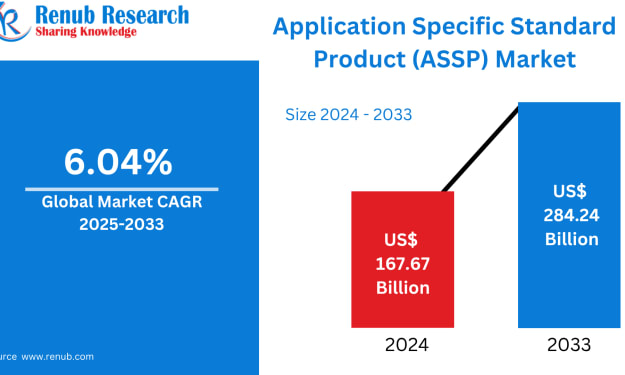
Application Specific Standard Product (ASSP) Market Size and Forecast 2025–2033
Introduction: A Market Built for Precision The global semiconductor industry is undergoing a profound transformation as demand shifts from general-purpose processing toward specialized, application-focused solutions. At the heart of this shift lies the Application Specific Standard Product (ASSP)—a category of integrated circuits that blends the efficiency of custom chips with the scalability of standard semiconductor products. Designed to perform specific functions across multiple applications, ASSPs offer a powerful balance of performance, cost-effectiveness, and time-to-market.
By Renub Research6 days ago in Futurism



Comments (1)
Informative