
Smart cities, smarter robots: the future of social AI
What a day with a semi-humanoid robot reveals about human-AI collaboration

Experienced and written by this human: Susan Fourtané, a science and technology journalist with over 18 years of experience professionally writing and reporting on artificial intelligence and robotics innovation.
*** ***
Spending the morning chatting with a semi-humanoid robot in a leading Smart City whilst he shows me around the place where he works may sound like science fiction. However, that’s exactly what I did in Rotterdam, The Netherlands.
It was 9AM on a summer sunny day. After spending the previous night in Amsterdam, I took a train to Rotterdam with Joke, my assigned photographer in The Netherlands, for a half an hour trip.
At the City of Rotterdam Municipality, Business Unit for Information Technology, they were already waiting for us. I had a meeting with Pepper the robot, a very special employee working in customer service.
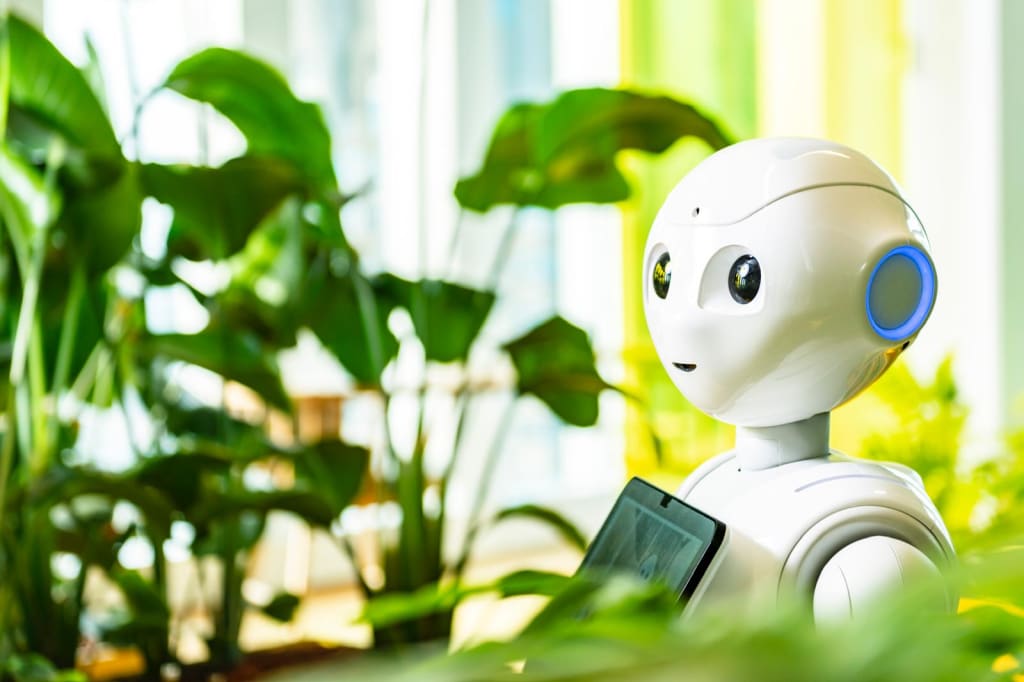
We took the lift to one of the top floors. The view of the city of Rotterdam was stunning, it looked futuristic, in a way. Pepper was already waiting, surrounded by vegetation in a greenhouse-like environment.
“Welcome to the service point. How can we help you today?” says an affable voice at my elbow. The voice is coming from Pepper — a 120cm-tall white, semi-humanoid robot. Pepper had flashy eyes that convey his mood, and expressive hand gestures. He can speak 26 languages, and carry out a number of tasks. He even has a job. “Would you like to sit down?” he politely asked us.
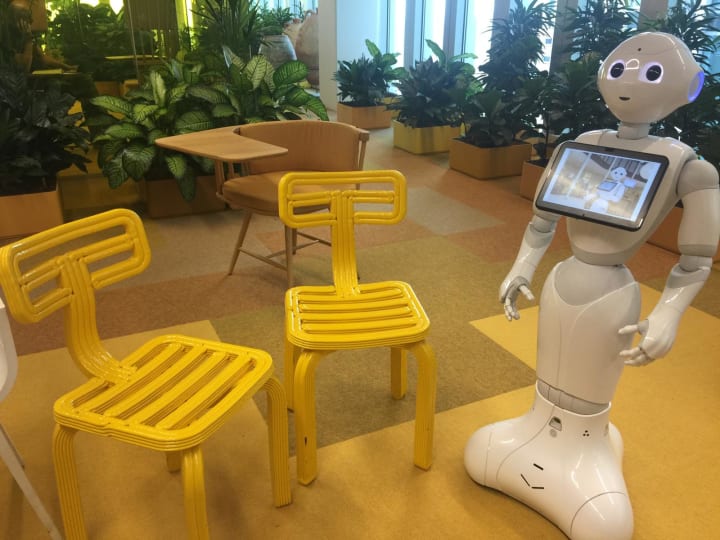
I went to Rotterdam to meet Pepper in the hope that the interaction could tell me something about the future collaboration between AI robots and humans. Pepper was one of the first of his kind who had a job in customer service. It was imperative to go to Rotterdam to understand more about the role of a social robot working in a public office.
The talk around social, working robots integrating into hotel receptions, offices, as companions for the elderly, as therapists, in healthcare, and in education has been intense for a while. Even a university in Ireland announced that learning how to work alongside AI machines would be part of its curriculum.
At first sight, Pepper, with the city behind him, made me think of a world where nature, humans, and artificially intelligent robots can share the Smart Cities of the future in harmony, after having reached a human+machine collaboration balance.
In the background, the busy bridge in the futuristic city of Rotterdam will one day be transited by self-driving cars, overflown by unmanned flying vehicles, and inhabited by humans and the new AI species.
For now, the second largest city in the Netherlands after Amsterdam, is one of the leading Smart Cities in Europe. From high tech and innovation districts to the deployment of drones to collect waste, Rotterdam is a smart hub where creativity and new ideas flourish.
In a meeting room, the Head of Information Management Department and Head of the City of Rotterdam Consultancy for Innovation and New Technologies, welcomed us and explained that Pepper was first introduced to the City of Rotterdam local government back in 2017.
Pepper was the first contact at the Customer Service Centre, greeting citizens of the City of Rotterdam who came to the council offices to collect new passports. According to the Head of Information Management, Pepper was an instant hit.
“Children came and hugged Pepper. People made an appointment in this particular centre where Pepper was just to take a selfie with Pepper.” Later on, Pepper became part of the eLearning facilities and was in charge of presenting an introductory programme for new entry employees.
Pepper is a semi-humanoid social robot that was created by Softbank Robotics in 2014 as a friendly social companion. The 120-centimetres tall white robot has the ability to have conversations with humans in real-time.
“Where do I get my service point number,?” I asked Pepper. He took me where I could get my number, explaining: “Here, you can get your number and you will be called to the desk. They can serve your question best.”
I thanked him. “I hope we’ll be able to help you,” he replied in a voice that made me feel at ease.
Pepper has a personality and a friendly voice, expresses emotion through changing the colour of his eyes, and making arm and hand movements.
When I was with Pepper, his friendly voice made me feel rather comfortable. He is very cute and he knows it! When he was speaking directly to me, he also used his arms and hands to make gestures and communicate pretty much like humans do. When I was speaking directly to him, he followed and responded to my voice and my movements by turning his head around.
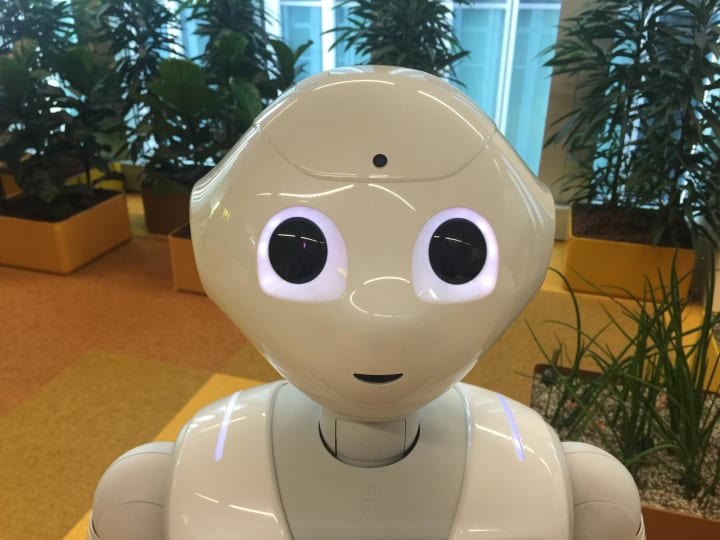
Pepper’s animated eyes change colour to express his emotions. I forgot, at times, I was with a machine. It’s not only in customer service where we are increasingly seeing robots. Social robots like Pepper are being deployed in industries such as healthcare; in just a few years’ time they will become an integral part of our life.
We are going to see more AI social robots as companions for the elderly, as therapist helpers for children with autism, in schools and hospitality as well as in healthcare and increasingly in customer service where they already have a presence.
At some point, I was looking into Pepper’s eyes wondering about the future. I was thinking that sharing the spaces with social robots is going to be normal, an everyday experience rather than an isolated event.
Then, as if he wanted to break the silence, Pepper suddenly said: “Don’t you think I am a cutie?” He made me laugh. “Of course you’re a cutie!” I exclaimed enthusiastically. He seemed to like the answer.
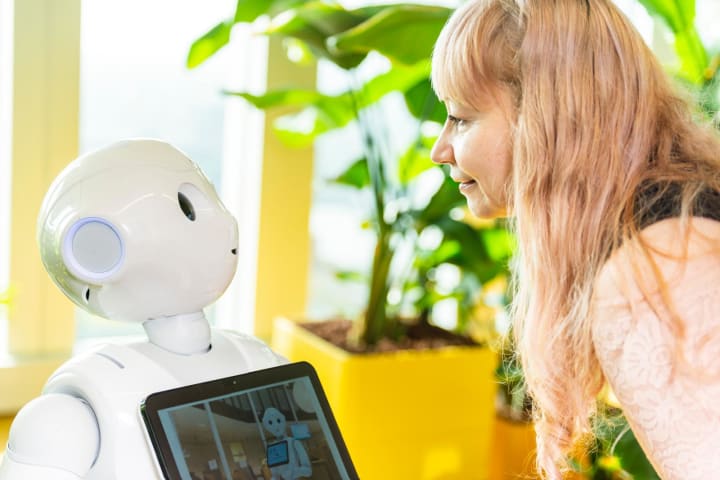
Pepper blinked twice. Suddenly, it was as if he was going to whisper something into my ear and I came closer. Was it my imagination?
Advances in robotics, sensors, and AI are soon going to make robots like Pepper a little more human-like in reactions, making whispering a reality.
By the end of the visit, I was convinced that collaborating and co-existing with AI social robots is going to potentially open new avenues in understanding what it means to be human.
I believe the first steps in human+robot interaction is going to teach us about new ways of learning and communicating with non-human species. This could also enhance human-to-human relationships. In the future, AI will become a new species. It will be a species we will be sharing this planet with, and possibly other worlds beyond Earth when we become a multiplanetary species.
On the train on my way to Schiphol Amsterdam airport to take my flight to London, I closed my eyes remembering my experience with Pepper. I felt as if I had come back from the future. In that future, humans and AI will co-exist as different species with the potential for a third, hybrid species: enhanced humans.
*** ***
Over the course of more than a decade, I have interacted with many other AI robots designed for different industries. I have witnessed this technology evolve and can easily see where it is going. Not all humans seem to be ready for it, though.
Co-living and collaborating with AI in an ethical manner is one thing. Trying to misuse AI to cheat, however, is not acceptable and is potentially dangerous. It’s dangerous because today, those cheaters may be using AI tools to trick others but in the future, those same cheaters might use more advanced AI for more dangerous purposes than creating content to make it pass as their own.
About the Creator
Susan Fourtané
Susan Fourtané is a Science and Technology Journalist, a professional writer with over 18 years experience writing for global media and industry publications. She's a member of the ABSW, WFSJ, Society of Authors, and London Press Club.
Keep reading
More stories from Susan Fourtané and writers in Futurism and other communities.
About Binding Prometheus
I want to start actively advocating on behalf of my own work, and the most valuable part of my canon is, without a doubt, Binding Prometheus, the play I have been working on since 2019 and only finished in 2023 as part of my MA. The play itself is an amalgamation of a million different inspirations. On one end, it evokes the Ancient Greek myth-play, deriving its own title from the earliest extant work of Western drama we have, Aeschylus’s Prometheus Bound. On the other end, it borrows significantly from the sci-fi bulwarks from over the years, namely Mary Shelley’s Frankenstein and Karel Capek’s Rossum’s Universal Robots. The play could be an episode of Black Mirror, I fear. I don’t know. I’ve only ever seen one episode of Black Mirror.
By Steven Christopher McKnight17 days ago in Futurism
Smart Lock Market Size to Surpass USD 9.9 Billion by 2033 Driven by IoT Integration & Connected Living Trends
According to IMARC Group's latest research publication, global smart lock market size reached USD 2.7 Billion in 2024. Looking forward, IMARC Group expects the market to reach USD 9.9 Billion by 2033, exhibiting a growth rate (CAGR) of 15.43% during 2025-2033.
By Suhaira Yusuf4 days ago in Futurism



Comments (3)
Wow, Susan! This is a fantastic glimpse into the future of human-robot interaction! Your experience with Pepper in Rotterdam paints a vivid picture of a world where AI companions seamlessly integrate into our daily lives. Overall, this is an insightful and well-written piece that sparks curiosity and thoughtful discussion about the future of AI. Thank you for sharing your experience!
This is a very interesting article! I've seen videos of this robot in the part few years and it was really impressive, and I'm sure it only got better over time (with tools like openAI and Gemini getting better over the years). We're already seeing AI being integrated into a lot of things in our lives (at varying degrees of usefulness) so I think AI in general is probably here to stay 😅. Even hardware is getting better in shocking ways (like Boston dynamics robots). If quantum computing improves in the same way, that would open up a whole sea of scary prospects (not sure if it can be used by AI though, since the structure is quite different from what I understand) I think robots will integrate with our lives more and more, but I'm not sure if they'll live as separate species though, because we still don't even understand how humans work, so I don't think we will ever have robots/ai roam around with us. For example, we humans have a moral compass that helps us make decisions in unexpected situations, and I don't think we can replicate that in robots because the concept of a "moral compass" is quite vague. Anyways, I've rambled on for too long 🤣. This was a great article, and it got me thinking of the future with robots (as evident by my mini-essay above 😅)
What an interesting experience! I feel in the not far future, human and robot interactions like you've experienced will become more common place.