
Shadows of Society: Unmasking the Social Threats of Our Time
Exploring the Rising Challenges Undermining Trust, Unity, and Human Well-being in the Modern World

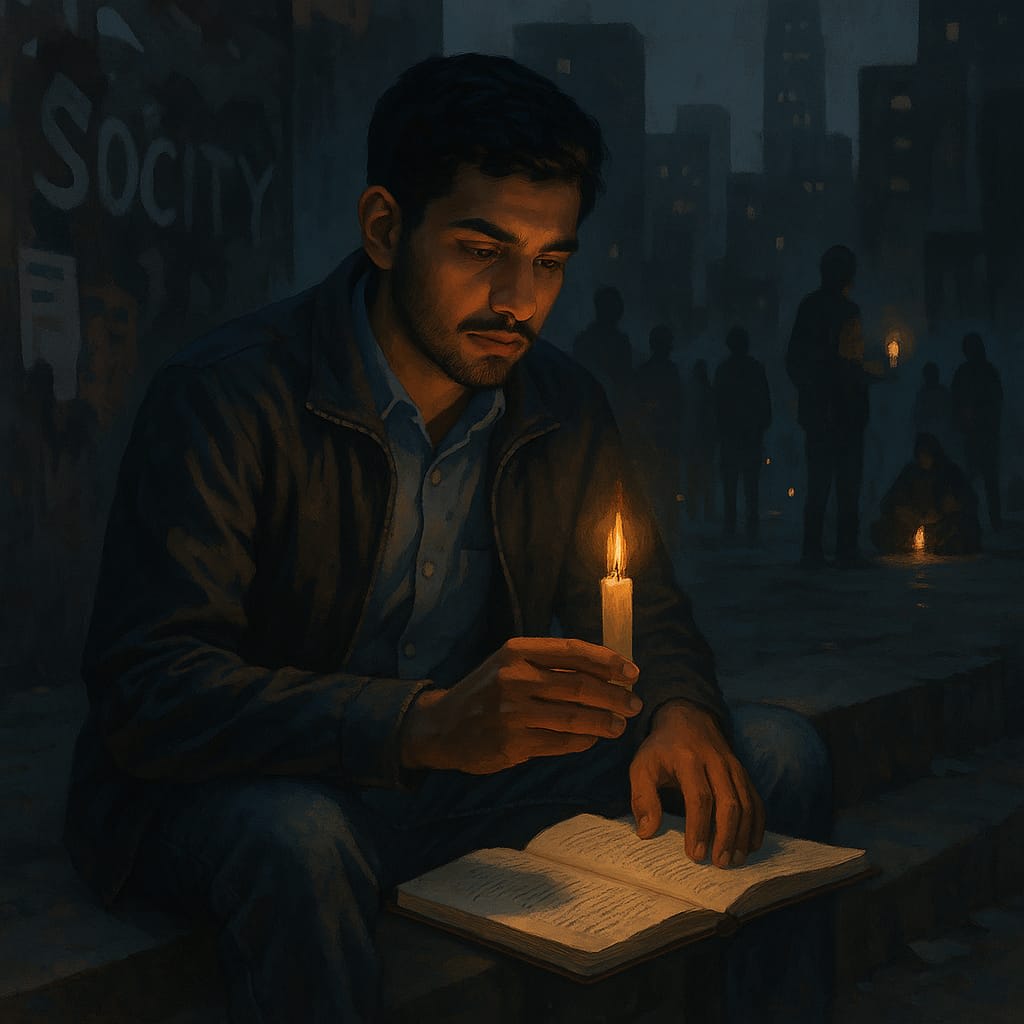
The candle flickered weakly in Faizan’s hand, the tiny flame no match for the shadows that surrounded him.
He sat on a bench in the center of a cracked public square—what was once the heart of his city. Now, skyscrapers loomed like silent giants, screens blared advertisements no one cared for, and people passed by like ghosts, heads down, faces lit only by their phones.
Faizan wasn’t old, not yet thirty, but the world around him felt aged, bitter, and fractured. He could still remember when this very square rang with the laughter of children, music from street performers, and conversations between strangers who met like friends. Now, even the pigeons avoided the silence.
The candle he held wasn’t a protest or part of a vigil—it was a symbol from a university project he had joined just weeks earlier called "Shadows of Society." The initiative aimed to shine light, both metaphorical and real, on the silent crises threatening human well-being. It was run by a passionate lecturer, Ali Sir, who believed the first step toward healing was awareness. Faizan wasn’t so sure—but he came anyway.
As part of the project, participants were asked to carry a candle and walk through their neighborhoods, observing. Not judging—just noticing. Faizan had scoffed at first. What good was walking with a candle in the 21st century? But tonight, something had shifted.
He walked past a group of teenagers huddled together on a street corner. Not one spoke. Each thumbed at a glowing screen, faces void of emotion. Digital addiction, Ali Sir had called it. Technology, instead of connecting us, was isolating us. Faizan thought of his younger sister, Areeba, who now spent more time talking to strangers on TikTok than to their parents. She didn’t eat dinner with them anymore. Didn’t laugh like she used to.
Further down the road, an elderly woman sat outside a locked clinic. Her hands trembled. Faizan offered to help, and she told him the story—her pension was delayed again, and she couldn’t afford her medicine. Economic inequality. Faizan sighed. The woman had worked 40 years for the textile industry, yet now she couldn’t get an asthma inhaler. Meanwhile, influencers on social media flaunted designer bags gifted by sponsors.
He lit another candle and left it on a small stone wall near her. One flame for one voice unheard.
At the park, which used to be crowded with families, he found a man sitting alone on a swing. Middle-aged, eyes sunken. Faizan offered him tea from his thermos. They spoke. The man’s son had left for a foreign country five years ago and never called again. “I think I raised him wrong,” the man said. “Maybe I should’ve taught him more about people than ambition.” He paused, his voice cracking, “I talk to the trees now.”
Faizan stayed quiet. Urban loneliness, another shadow.
He remembered something Ali Sir had said in a session:
"It’s not just that we’re becoming disconnected from each other—we're becoming strangers to ourselves."
On the next block, a group gathered around a man on a soapbox. He was shouting conspiracy theories about politics and vaccines. People recorded him, others argued, and some nodded along. Faizan’s stomach turned. Misinformation—yet another shadow. How had truth become a matter of opinion?
He passed a graffiti-covered wall that read, “Don’t trust anyone but yourself.” Below it, another line said, “The world doesn’t care about you. Don’t care about it.”
Hopelessness. Mistrust. Faizan’s heart felt heavy.
He stopped in front of a closed school. Its notice board still had posters about mental health week—months old, curling at the edges. He remembered a student, Hamza, who had ended his life last year. No one had known he was suffering. Faizan had talked to him a week before. He had smiled. But it wasn’t real.
Mental health crisis—the deepest shadow of all.
Faizan sank to the steps outside the school. His candle guttered in the wind, but didn’t die. He looked at it—this fragile, trembling light—and suddenly understood what Ali Sir meant. The flame wasn’t about solving everything. It was about not looking away.
He took out a notebook from his backpack and began to write. Not an essay. Not a plan. Just names. Faces. Stories. The elderly woman. The lonely man in the park. The teenagers. His sister. Hamza. The flickering candlelight reflected in his eyes as he wrote, one name after another, like tiny constellations trying to form a map through the darkness.
He realized he couldn’t fix the system. Not alone. But he could listen, he could witness, and he could speak.
When he returned to campus the next morning, he read aloud what he wrote. Others followed. They lit candles. Told stories. Disagreed, but kindly. Cried, but together.
Weeks later, the project grew. Community circles formed in parks. A helpline was set up with real counselors. Old neighborhoods painted murals of unity. Students helped elders with groceries. People began waving again.
The city was still broken. The shadows were still there. But so were the candles.
And Faizan—once just an observer—became a bearer of light.
About the Creator
Umair Ahmad
My name is Umair Ahmad, passionate teacher from 2022 to till now and courage to students for their bright future. Beside that, I love to read fiction, philosophy which give me inspirational thought for writing.
Keep reading
More stories from Umair Ahmad and writers in Futurism and other communities.
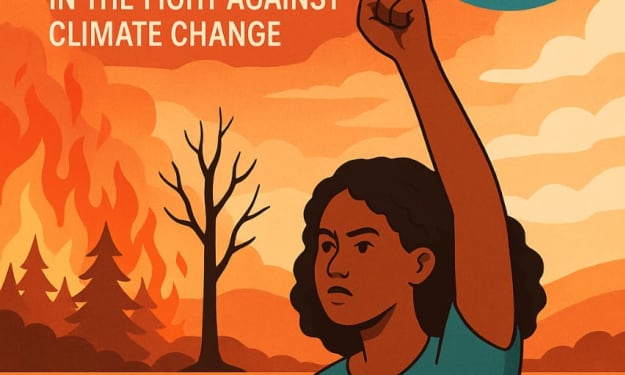
"Facing the Heat: Raising Awareness in the Fight Against Climate Change"
The sun scorched the cracked earth of Elmswood, a small town once known for its lush green meadows and tranquil breeze. Now, heatwaves rolled through like clockwork, dusting the town in a haze of discomfort. Crops failed more often than they succeeded. The river, once teeming with fish, had dwindled into a sluggish stream. And yet, despite the visible changes, many residents remained unaware—or perhaps unconvinced—of what was happening.
By Umair Ahmad8 months ago in Education
Electric Two-Wheeler Market: Urban Mobility Shift, EV Adoption Surge & Industry Growth Outlook
Clean energy priorities, stricter urban emission rules, and rising commuter preference for affordable, efficient transport are pushing electric two-wheeler adoption globally, backed by battery improvements, government incentives, and rapidly expanding charging networks. According to IMARC Group's latest data, the global electric two-wheeler market size was valued at USD 44.5 Billion in 2025. Looking forward, IMARC Group estimates the market to reach USD 114.3 Billion by 2034, exhibiting a CAGR of 11.0% from 2026-2034. Asia Pacific currently dominates the market, holding a market share of over 97.3% in 2024.
By sujeet. imarcgroup4 days ago in Futurism
Galaxy S26 Ultra: Samsung’s Next Flagship Aims to Shift the Smartphone Conversation
What Happened (Facts) Samsung is expected to unveil the Galaxy S26 Ultra alongside the Galaxy S26 and S26+ at a Galaxy Unpacked event scheduled for next week, according to reporting circulating ahead of the launch. The framing around the S26 Ultra is less about chasing the biggest numbers (megapixels, brightness, raw clock speeds) and more about repositioning the phone as a stable, long-life “professional tool” that anchors Samsung’s ecosystem against rivals like Apple’s iPhone 17 Pro and Google’s Pixel 10 Pro.
By Behind the Tech5 days ago in Futurism
A Knight of the Seven Kingdoms Series Review (Season 1)
As one of the biggest properties in fantasy, A Song of Ice and Fire remains immensely popular with audiences. After reaching far into the past with House of the Dragon, a second spin-off was on the cards. A Knight of the Seven Kingdoms serves up a bite-sized slice of action and drama, but it still claims a spot among the best small-screen titles.
By Robert Caina day ago in Geeks


Comments
There are no comments for this story
Be the first to respond and start the conversation.