
Secrets of the Deep: Argentina’s Mar del Plata Canyon Reveals Dozens of Potential New Species
Mar del Plata Canyon,” “new deep-sea species,” and “Argentina ocean discovery

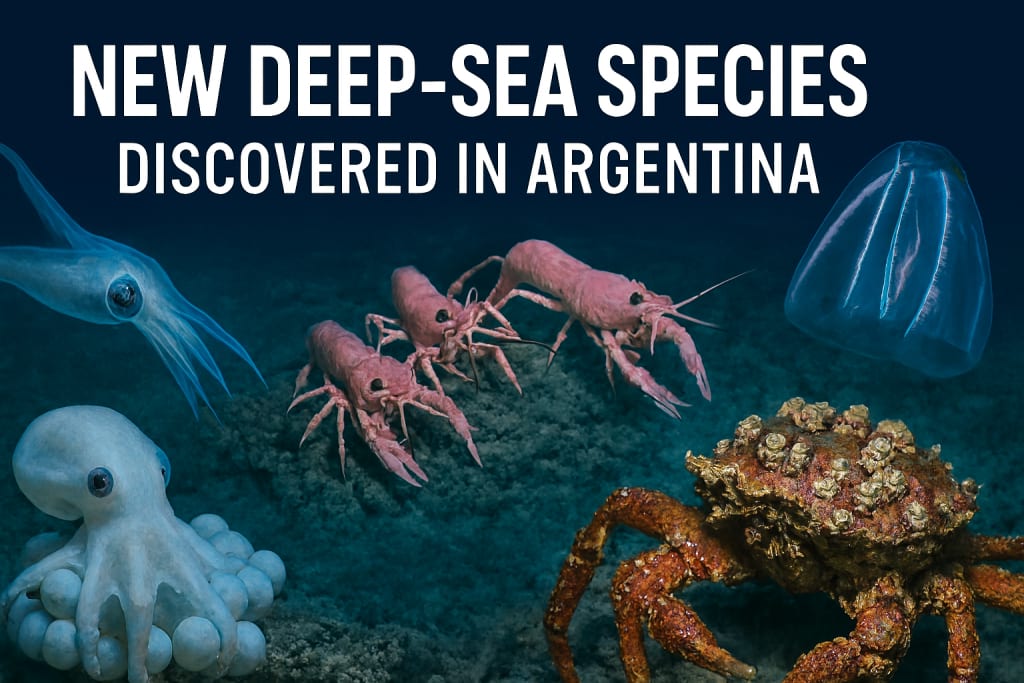
Scientists exploring Argentina’s Mar del Plata Canyon have uncovered over 40 potential new deep-sea species, from glowing jellies to pastel lobsters. Discover how this underwater world could reshape marine science and conservation.
Introduction: A Hidden World Beneath the Waves
When most people think of Argentina, they picture tango, Patagonia, or the bustling streets of Buenos Aires. Few realize that just off its Atlantic coast lies one of the most mysterious and least explored ecosystems on Earth: the Mar del Plata Canyon. Recently, a team of international scientists embarked on a groundbreaking expedition into this abyss — and what they found could rewrite our understanding of life in the deep sea.
From ghostly octopuses guarding their eggs to bioluminescent creatures glowing like stars, the canyon has revealed over 40 potential new species. This discovery is more than just a scientific milestone; it’s a wake-up call about the fragility of our oceans and the urgent need for conservation.
The Mar del Plata Canyon: Twice as Deep as the Grand Canyon
Stretching down to depths of 11,500 feet, the Mar del Plata Canyon is nearly twice as deep as the Grand Canyon. What makes it extraordinary is its location at the meeting point of two powerful ocean currents:
The warm Brazil Current flowing south from the tropics
The cold Malvinas Current sweeping up from Antarctica
This clash of temperatures creates a nutrient-rich environment, fueling a thriving ecosystem of corals, invertebrates, and fish. For scientists, it’s like peering into a natural laboratory where evolution experiments in real time.
Alien-Like Creatures of the Deep
The expedition, led by the Schmidt Ocean Institute, used the ROV SuBastian, a state-of-the-art remotely operated vehicle equipped with HD cameras and robotic arms. What it captured was nothing short of breathtaking:
🦑 Glass squids with hornlike appendages, drifting like translucent phantoms
🦞 Pastel pink lobsters, moving in synchronized groups across the seabed
🐙 Ghostly octopuses, carefully tending to clusters of eggs
🌟 Bioluminescent comb jellies, glowing in rainbow pulses
⭐ Crimson sea stars scattered across coral gardens
🦀 A king crab carrying over 100 barnacles on its shell, a living ecosystem in itself
Each sighting felt like a scene from a science fiction film, yet these creatures are very real — and many may be entirely new to science.
How Scientists Confirm New Species
Discovering a strange-looking animal is only the beginning. To confirm whether it’s truly a new species, researchers:
1. Compare specimens with museum collections worldwide.
2. Analyze environmental DNA (eDNA) — genetic traces left behind in the water.
3. Publish peer-reviewed descriptions, ensuring the species is formally recognized.
This process can take years, but the early signs suggest that dozens of these canyon dwellers are indeed unknown to science.
Technology That Made It Possible
Traditional deep-sea exploration often relied on trawling nets, which damaged fragile habitats. The ROV SuBastian changed the game by allowing scientists to:
Film creatures in their natural environment
Collect coral and sediment samples without destruction
Retrieve sediment cores that revealed not only ancient history but also modern threats like microplastics
This combination of precision and care ensures that discoveries don’t come at the cost of the ecosystem itself.
Conservation Lessons From the Deep
While the expedition revealed wonders, it also exposed troubling realities. Even in this remote canyon, scientists found:
Plastic bags drifting among corals
Lost fishing gear entangled in marine life
Microplastics embedded in sediment layers
These findings highlight a sobering truth: no part of the ocean is untouched by human activity. Protecting deep-sea ecosystems is no longer optional — it’s essential for the planet’s health.
Public Engagement: Science Meets Storytelling
One of the most remarkable aspects of this mission was its public outreach. The dives were live-streamed, attracting over 1.6 million daily viewers in Argentina alone. Viewers could watch in real time as glowing jellies floated past the camera or as scientists gasped at a never-before-seen lobster.
This transparency turned a scientific expedition into a national event, sparking curiosity among students, educators, and everyday citizens. It’s proof that science communication can inspire as much wonder as any blockbuster film.
Why This Discovery Matters
The Mar del Plata Canyon expedition is more than a catalog of strange creatures. It represents:
A leap in biodiversity knowledge: Every new species expands our understanding of evolution.
A conservation alarm: Pollution and climate change threaten even the deepest habitats.
A cultural moment: Millions engaged with marine science in real time, creating momentum for ocean protection.
In short, this canyon is not just a geological feature — it’s a living archive of Earth’s resilience and vulnerability.
Conclusion: A Call to Protect the Unknown
The Mar del Plata Canyon reminds us that Earth still holds secrets waiting to be uncovered. But it also warns us that human impact reaches even the darkest depths. As scientists work to classify these new species, the rest of us face a choice: will we protect these fragile ecosystems, or will they vanish before we even know their names?
The canyon’s story is not just about discovery — it’s about responsibility. And perhaps, in protecting the mysteries of the deep, we’ll rediscover something about ourselves too.
Mar del Plata Canyon discovery
New deep-sea species 2025
Argentina ocean exploration
Schmidt Ocean Institute expedition
Bioluminescent sea creatures
Deep-sea conservation challenges
About the Creator
Tech Horizons
Exploring the future of technology, AI, gadgets, and innovations shaping tomorrow. Stay updated with Tech Horizons!
Keep reading
More stories from Tech Horizons and writers in Futurism and other communities.
About Binding Prometheus
I want to start actively advocating on behalf of my own work, and the most valuable part of my canon is, without a doubt, Binding Prometheus, the play I have been working on since 2019 and only finished in 2023 as part of my MA. The play itself is an amalgamation of a million different inspirations. On one end, it evokes the Ancient Greek myth-play, deriving its own title from the earliest extant work of Western drama we have, Aeschylus’s Prometheus Bound. On the other end, it borrows significantly from the sci-fi bulwarks from over the years, namely Mary Shelley’s Frankenstein and Karel Capek’s Rossum’s Universal Robots. The play could be an episode of Black Mirror, I fear. I don’t know. I’ve only ever seen one episode of Black Mirror.
By Steven Christopher McKnight19 days ago in Futurism
Europe Green Building Market Size and Forecast 2025–2033
Introduction: Europe’s Construction Industry Enters a Green Era Europe’s construction industry is undergoing a profound transformation. Sustainability is no longer a niche preference—it is becoming the new standard. Driven by climate commitments, energy security concerns, and rising awareness among consumers and investors, green building practices are now embedded in the region’s development agenda.
By Marthan Sir5 days ago in Futurism


Comments
There are no comments for this story
Be the first to respond and start the conversation.