
Blue Origin’s New Glenn Rolls Toward Mars: The Beginning of a New Space Age
Inside Blue Origin’s 2025 Mars Launch: New Glenn Rocket Testing, NASA ESCAPADE, and the Next Frontier of Reusable Spaceflight.

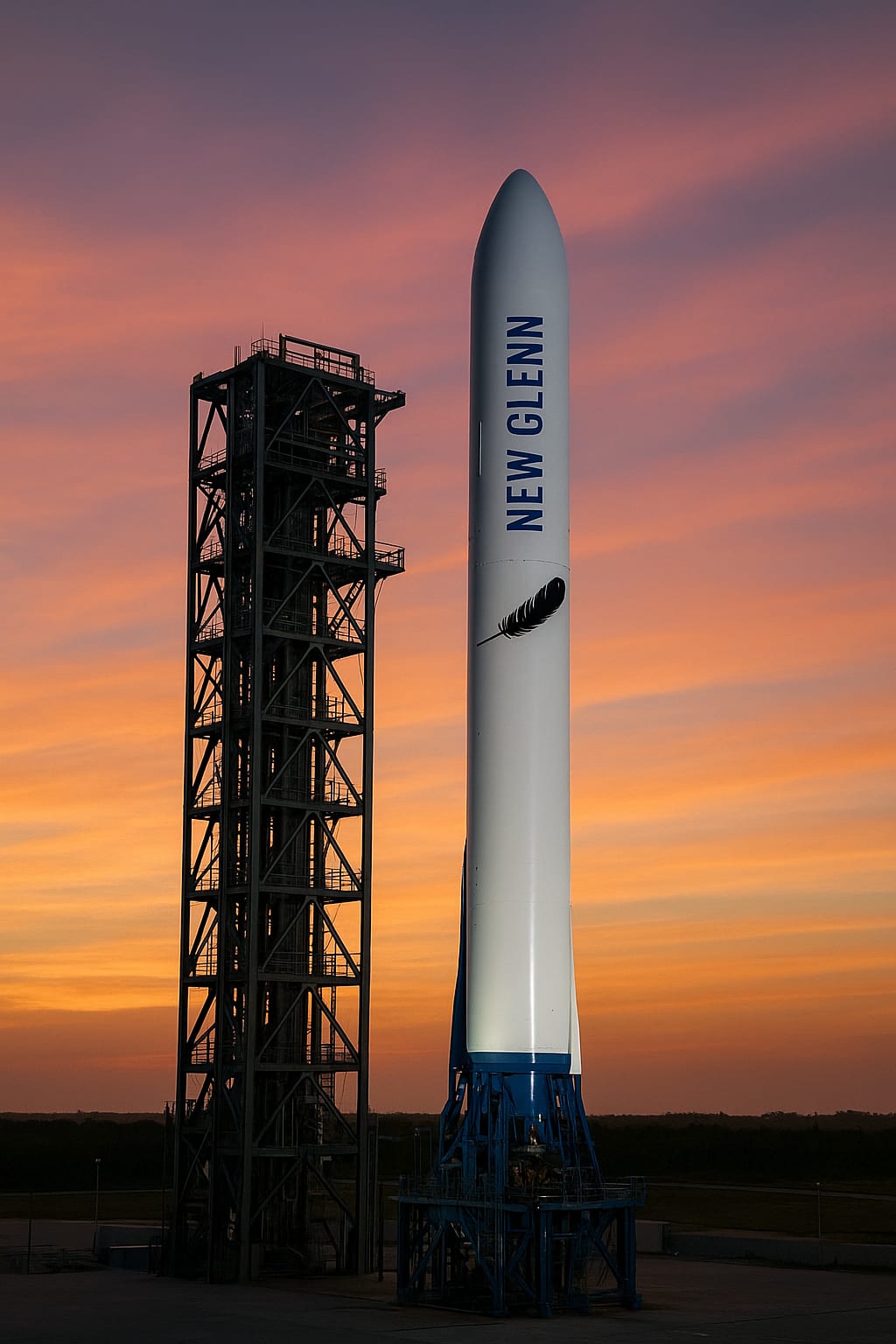
Blue Origin’s New Glenn rocket readies for NASA’s ESCAPADE Mars mission, marking a bold new era in private space exploration and reusable rocketry.
The Florida air shimmered with heat as a massive shadow glided across the concrete at Cape Canaveral. Rising nearly 320 feet into the sky, Blue Origin’s New Glenn rocket began its slow, deliberate roll toward the launch pad — a moment years in the making. This isn’t just another test; it’s a countdown to history. Later in 2025, the rocket is scheduled to carry NASA’s ESCAPADE mission to Mars, marking Blue Origin’s first interplanetary launch and a defining milestone for private space exploration.
Behind the scenes, engineers are preparing the reusable New Glenn booster, fine-tuning every system after its first successful orbital flight earlier this year. If all goes to plan, this next mission will demonstrate that Blue Origin’s vision — a sustainable pathway to the stars — is no longer a distant dream. As Jeff Bezos’s space company steps onto the interplanetary stage, the world watches in anticipation. The journey from Florida’s coast to the Red Planet isn’t just about reaching Mars; it’s about proving that humanity’s future among the stars has already begun.
On a humid Florida morning, as the golden light of dawn spilled across Cape Canaveral, a massive shape began to move. Crawling out of its hangar, gleaming in shades of white and cobalt, the New Glenn rocket—Blue Origin’s crown jewel—slowly made its way toward the launch pad.
It wasn’t just another rocket rollout. It was a declaration. A signal that Jeff Bezos’s Blue Origin is ready to step out of the shadow of its rivals and reach for something truly extraordinary: a mission to Mars.
A New Chapter in Blue Origin’s Story
For years, Blue Origin has been seen as the quiet competitor in the private space race—a company building methodically, sometimes painfully slowly, while SpaceX grabbed the headlines. But this moment marks a turning point.
After the success of New Glenn’s first orbital launch earlier in 2025, Blue Origin is preparing to go even bigger. The company has rolled out the first stage of its second New Glenn rocket for a series of ground tests before its next major flight—one that could send NASA’s ESCAPADE mission to Mars.
If all goes according to plan, that launch could happen as soon as late October or November 2025, opening a new chapter in the story of human space exploration—and proving that Blue Origin’s quiet persistence is finally paying off.
The Rocket That Could Change Everything
Standing at 320 feet (98 meters) tall, New Glenn is a behemoth. Its name honors John Glenn, the first American to orbit Earth, and its mission embodies that same spirit of bold exploration.
This rocket is designed for reusability—the key to making spaceflight more sustainable and affordable. Its first stage is meant to return to Earth and land on a ship in the Atlantic Ocean, ready to fly again after refurbishment.
The first New Glenn reached orbit earlier this year, but its booster failed to land successfully. Despite that hiccup, the launch proved that the rocket’s engines, guidance, and structure performed as expected. Now, Blue Origin is refining every detail for the next attempt.
Inside the vehicle, seven BE-4 engines roar to life with liquid oxygen and methane fuel—a cleaner, more efficient alternative to traditional rocket propellants. The engines are powerful enough to lift 45 metric tons to low Earth orbit, putting New Glenn in the same heavy-lift class as SpaceX’s Falcon Heavy and edging closer to Starship territory.
ESCAPADE: Two Small Spacecraft, One Giant Leap
But this isn’t just about Blue Origin flexing its engineering muscles. The upcoming mission carries real scientific promise.
NASA’s ESCAPADE mission—short for Escape and Plasma Acceleration and Dynamics Explorers—is composed of two small spacecraft, nicknamed “Blue” and “Gold.” Built by Rocket Lab, these twin probes are designed to study how solar wind interacts with Mars’s magnetic field and atmosphere.
It’s a deceptively small mission with big implications. Understanding how Mars loses its atmosphere to space could help scientists learn how the Red Planet evolved—and, eventually, how to protect future human explorers from space weather.
By entrusting Blue Origin to launch ESCAPADE, NASA is signaling confidence in the company’s capabilities. For Blue Origin, it’s more than a contract. It’s a chance to show the world that New Glenn isn’t just a commercial launcher—it’s a gateway to interplanetary exploration.
From Suborbital to Interplanetary
On the same day the New Glenn stage rolled out for testing, another Blue Origin rocket_New Shepard—took six passengers to the edge of space. It marked the company’s 15th human flight and 36th New Shepard mission overall.
This simultaneous activity shows how Blue Origin is scaling up. While New Shepard continues to serve the booming market for space tourism and microgravity research, New Glenn represents the company’s leap into deep space.
For decades, space companies have dreamed of operating like airlines—launching frequently, landing safely, and flying again. Blue Origin’s dual operations hint at that vision becoming real.
Jeff Bezos’s Long Game
If Elon Musk’s SpaceX is known for boldness and rapid iteration, Jeff Bezos’s Blue Origin has built its identity around patience. Its motto—“Gradatim Ferociter,” or “Step by Step, Ferociously”—has defined the company’s slow but deliberate approach.
Many critics once mocked that patience. But now, as New Glenn nears operational maturity, that long game is starting to make sense.
Bezos, who famously said he invests billions from his Amazon fortune into Blue Origin each year, has always played the long view. His ultimate goal isn’t just rockets—it’s an entire space economy where millions of people can live and work beyond Earth.
The rollout of New Glenn isn’t just a milestone—it’s a proof point that Blue Origin’s infrastructure-heavy, sustainability-first philosophy might actually work.
A Quiet Rivalry Ignites
It’s impossible to talk about Blue Origin without mentioning SpaceX. For years, Musk’s company has dominated headlines with its record-setting Falcon 9 launches and its towering Starship project.
But while SpaceX races toward crewed Mars missions, Blue Origin’s strategy is different. It’s slower, quieter, but deeply focused on reliability and reusability.
If New Glenn succeeds with the ESCAPADE mission, Blue Origin will join an elite club of launch providers capable of sending payloads beyond Earth’s orbit—a feat only a handful of companies and nations have achieved.
This quiet rivalry could benefit everyone. As more private companies prove they can handle deep space logistics, NASA gains options, costs go down, and humanity inches closer to a multi-planetary future.
The Symbolism of the Rollout
There’s something poetic about that moment at Cape Canaveral—the massive New Glenn gliding toward the pad under the Florida sun. To the untrained eye, it’s just hardware in motion. But to those who follow space exploration, it’s a symbol of progress.
For years, Blue Origin was the company of tomorrow. Now, it’s finally becoming the company of today.
The rollout isn’t the end of the journey—it’s the beginning of a new phase where Blue Origin moves from promise to performance. And this Mars-bound mission could be the moment when history starts paying attention.
Looking Toward the Red Horizon
When the engines ignite later this year, the roar of New Glenn will echo far beyond Florida. It will carry with it not just a pair of small spacecraft, but the hopes of an entire movement—one that believes space isn’t just the domain of governments and billionaires, but of dreamers, engineers, and everyone who dares to look up.
Blue Origin’s Mars mission might begin as a NASA partnership, but its success could mark something larger: the dawn of a new space age, where private rockets carry humanity’s curiosity across the solar system.
And when that happens, the image of New Glenn rolling toward its first interplanetary launch will be remembered as the moment the quiet contender finally found its voice.
Blue Origin New Glenn
Blue Origin Mars mission 2025
NASA ESCAPADE mission
Jeff Bezos space company
New Glenn rocket specifications
reusable rocket
Cape Canaveral launch
Blue Origin vs SpaceX
New Shepard launch
private space exploration.
About the Creator
Tech Horizons
Exploring the future of technology, AI, gadgets, and innovations shaping tomorrow. Stay updated with Tech Horizons!
Keep reading
More stories from Tech Horizons and writers in Futurism and other communities.
Google VaultGemma: The Future of Privacy-Preserving AI Language Models
With growing concerns around data privacy in artificial intelligence, Google has taken a huge leap forward with VaultGemma, a new privacy-focused language model that is rewriting the rules of AI development.
By Tech Horizons5 months ago in Futurism
Saudi Arabia Robotic Process Automation Industry: AI Integration, Workflow Efficiency & Enterprise Adoption
Rising digital transformation initiatives, increasing demand for efficient automated workflows across sectors, growing adoption in finance, healthcare, and retail, and Vision 2030's digitalization push are driving RPA demand, supported by cost reduction needs, operational productivity goals, and expanding technology infrastructure. According to IMARC Group's latest data, the Saudi Arabia robotic process automation (RPA) market size was valued at USD 0.03 Billion in 2024. Looking forward, IMARC Group estimates the market to reach USD 1.1 Billion by 2033, exhibiting a CAGR of 41.20% from 2025-2033.
By Kishan Kumar5 days ago in Futurism
The Infrastructure Layer Powering the Next Phase of Blockchain Growth
As the blockchain industry matures, attention is steadily shifting from speculative tokens to foundational infrastructure. While early crypto cycles focused heavily on digital currencies and decentralized finance, the current phase emphasizes scalability, interoperability, and developer accessibility. Behind every decentralized application (dApp), smart contract, and Web3 platform lies a robust infrastructure layer that keeps networks running efficiently.
By Muhammad Talha Ahmad3 days ago in Futurism
Boundless
A geographical map could take you there. To the places I've been, to the sights I've seen, to the landscapes I've climbed. But no compass could point you in the direction of my memories. To the experiences I've lived, to the happiness I've felt, to the wonder I've held so close to my heart.
By Alyssa Musso6 days ago in Writers




Comments
There are no comments for this story
Be the first to respond and start the conversation.