
Scientists Discover Over a Million Skate Ray Eggs on an Underwater Volcano Near Vancouver
A newly discovered underwater volcano off Vancouver Island is home to over a million Pacific white skate ray eggs, creating the world’s largest known deep-sea nursery and raising urgent calls for marine conservation.

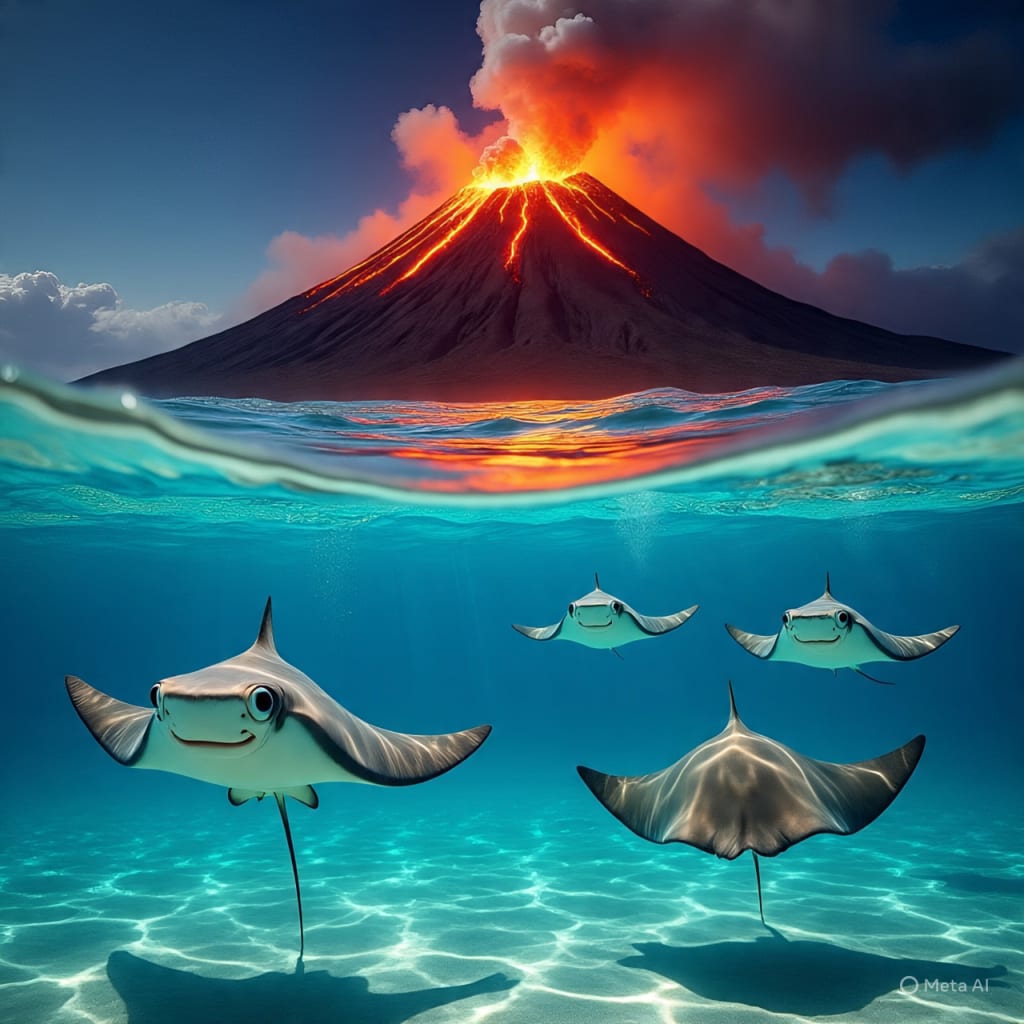
Beneath the cold, dark waters off Canada’s Pacific coast, a discovery has stunned the scientific community. Researchers recently uncovered an active underwater volcano that isn’t just geologically fascinating—it’s also serving as the world’s largest known nursery for deep-sea white skate rays. At a depth of nearly 3,600 feet, scientists estimate the site hosts well over one million egg cases, making it a natural wonder and a reminder of the ocean’s fragile mysteries.
This unprecedented find reveals how marine life adapts to extreme environments and why protecting these habitats is crucial in the face of human threats like deep-sea mining and bottom trawling.
A Hidden World Beneath the Pacific
The discovery took place off the coast of Vancouver Island, where researchers expected to be mapping an extinct seamount. Instead, they encountered evidence of geothermal activity—mineral-rich plumes of hot water rising from the volcanic summit.
For years, marine scientists have studied hydrothermal vents as hotspots for unique life forms. But this volcano is different. Instead of strange bacteria or deep-sea worms, its warm flanks are blanketed with giant egg cases belonging to the Pacific white skate (Bathyraja spinosissima), a rarely observed deep-water species.
The Mystery of the Million Eggs
Nicknamed “mermaid’s purses,” skate eggs are distinctive leathery cases that protect embryos until they hatch. Normally, skate rays lay only a few eggs at a time. Yet here, researchers found egg cases carpeting the seafloor, stretching across the summit like a massive biological garden.
Each case can measure nearly 20 inches long, among the largest egg cases in the world. What makes this discovery even more remarkable is the estimated incubation time. In the cold deep sea, skate embryos may take up to four years to develop—a vulnerable period in which survival rates are low.
But the volcanic warmth may change that equation. Scientists believe the geothermal heat creates a natural incubator, reducing development time and dramatically boosting the chances of survival.
Why Skates Choose a Volcano
The Pacific white skate is considered a rare and vulnerable species. Living at depths of 2,600 to 9,500 feet, they are seldom observed alive in their natural habitat. For these rays, the underwater volcano offers three key advantages:
1. Warmth for Faster Growth
The geothermal energy may accelerate embryonic development, reducing years off the incubation period.
2. Protection From Predators
The deep, volcanic slopes are isolated environments, offering a safer nursery than open seafloors.
3. Food-Rich Ecosystem
Hydrothermal activity often supports microbial life that attracts other species, enriching the food chain around the eggs.
By laying millions of eggs here, white skates may be ensuring their long-term survival in the deep Pacific.
A First in Deep-Sea Reproduction
While other marine animals like deep-sea sharks and rays have been known to use geothermal vents for warmth, this is the first documented case of such large-scale reproductive use of a volcanic environment.
The scale of the nursery is staggering. One scientist compared it to a “forest of life in the deep sea,” where every corner of the volcanic summit contributes to nurturing the next generation of skates.
Why This Discovery Matters
The implications of this discovery extend beyond marine biology. It underscores the delicate balance between geology and ecology, showing how Earth’s natural processes directly shape the survival strategies of ocean life.
Here’s why it matters:
Biodiversity Insight
The find highlights a reproductive strategy never seen before, giving scientists a glimpse into how evolution works in extreme environments.
Conservation Urgency
Deep-sea species like white skates are vulnerable to industrial threats. If these nurseries are damaged, entire populations could collapse.
Climate Connection
Understanding how marine species use geothermal energy could provide insights into resilience strategies in a warming ocean.
The Threats Looming Over Deep-Sea Nurseries
While the underwater volcano provides a sanctuary for skate rays, human activities may put it at risk.
Deep-Sea Mining: The seafloor near hydrothermal vents is rich in minerals like cobalt, nickel, and rare earths—critical for modern technology. Mining operations could devastate habitats before scientists even study them.
Bottom Trawling: Industrial fishing nets dragged across the seafloor destroy fragile ecosystems, including egg nurseries.
Climate Change: Shifts in ocean currents and temperature may disrupt the delicate conditions that make the volcano a safe haven.
Unless stronger protections are enforced, discoveries like this may be lost to exploitation.
Calls for Protection
Marine researchers are now urging international bodies and Canadian authorities to designate the site as a protected marine sanctuary. The nursery represents a unique biological treasure, and its survival could help secure the future of the Pacific white skate population.
“Every egg case on that volcano is a story of survival,” one researcher explained. “Protecting this nursery means protecting an entire species’ future.”
The Bigger Picture
The discovery of a million eggs on a hidden underwater volcano reminds us how little we know about the deep ocean. Less than 20% of the seafloor has been mapped in detail, and with each new expedition, scientists continue to uncover breathtaking surprises.
This find is more than a scientific curiosity—it’s a wake-up call. The deep sea isn’t an empty wasteland. It’s alive, interconnected, and essential to Earth’s health.
Conclusion
The underwater volcano off Vancouver Island has revealed itself as more than a geological wonder. It is a living incubator, hosting the largest known nursery of Pacific white skate rays—an extraordinary example of how life adapts to the planet’s most extreme environments.
Yet this fragile ecosystem faces threats from human exploitation and climate disruption. Protecting it is not only about saving a species but also about safeguarding the ocean’s resilience for generations to come.
As scientists continue to explore the depths, one thing becomes clear: the ocean’s greatest secrets lie far beneath the waves, waiting to remind us just how interconnected our planet truly is.
About the Creator
NextGen Mobile Tech
- I review the latest smartphones, mobile accessories, and tech essentials to help you make smart buying decisions. Explore my curated kits for phones and gear here: [Kit.co link].
Keep reading
More stories from NextGen Mobile Tech and writers in Futurism and other communities.
How Earth’s First Proteins May Have Formed in Water.
For centuries, humanity has asked one of the most profound questions of all time: How did life begin on Earth? While modern biology gives us incredible insights into cells, DNA, and evolution, the earliest steps—how simple molecules transitioned into complex living systems—remain one of science’s greatest mysteries.
By NextGen Mobile Tech5 months ago in Futurism
About Binding Prometheus
I want to start actively advocating on behalf of my own work, and the most valuable part of my canon is, without a doubt, Binding Prometheus, the play I have been working on since 2019 and only finished in 2023 as part of my MA. The play itself is an amalgamation of a million different inspirations. On one end, it evokes the Ancient Greek myth-play, deriving its own title from the earliest extant work of Western drama we have, Aeschylus’s Prometheus Bound. On the other end, it borrows significantly from the sci-fi bulwarks from over the years, namely Mary Shelley’s Frankenstein and Karel Capek’s Rossum’s Universal Robots. The play could be an episode of Black Mirror, I fear. I don’t know. I’ve only ever seen one episode of Black Mirror.
By Steven Christopher McKnight17 days ago in Futurism
UAE Food Service Market: Dining Innovation, Consumer Preferences & Growth Outlook
According to IMARC Group's latest research publication, the UAE food service market size was valued at USD 16.58 Billion in 2024. Looking forward, IMARC Group estimates the market to reach USD 50.21 Billion by 2033, exhibiting a CAGR of 12.20% during 2025-2033.
By Abhay Rajput3 days ago in Futurism
Miss Persephone's Manual to a Seemingly Ordinary Life
Miss Persephone was found at the dining table, her blue eyes swollen, her tears arriving and retreating like the tides of the ocean. Earlier that day, her family had visited her in the retirement home where she had lived for eight years. It was her eightieth birthday.
By Imola Tóth3 days ago in Fiction



Comments
There are no comments for this story
Be the first to respond and start the conversation.