
Science Fiction vs. Reality: Which Space Dreams Have Already Come True?
Space

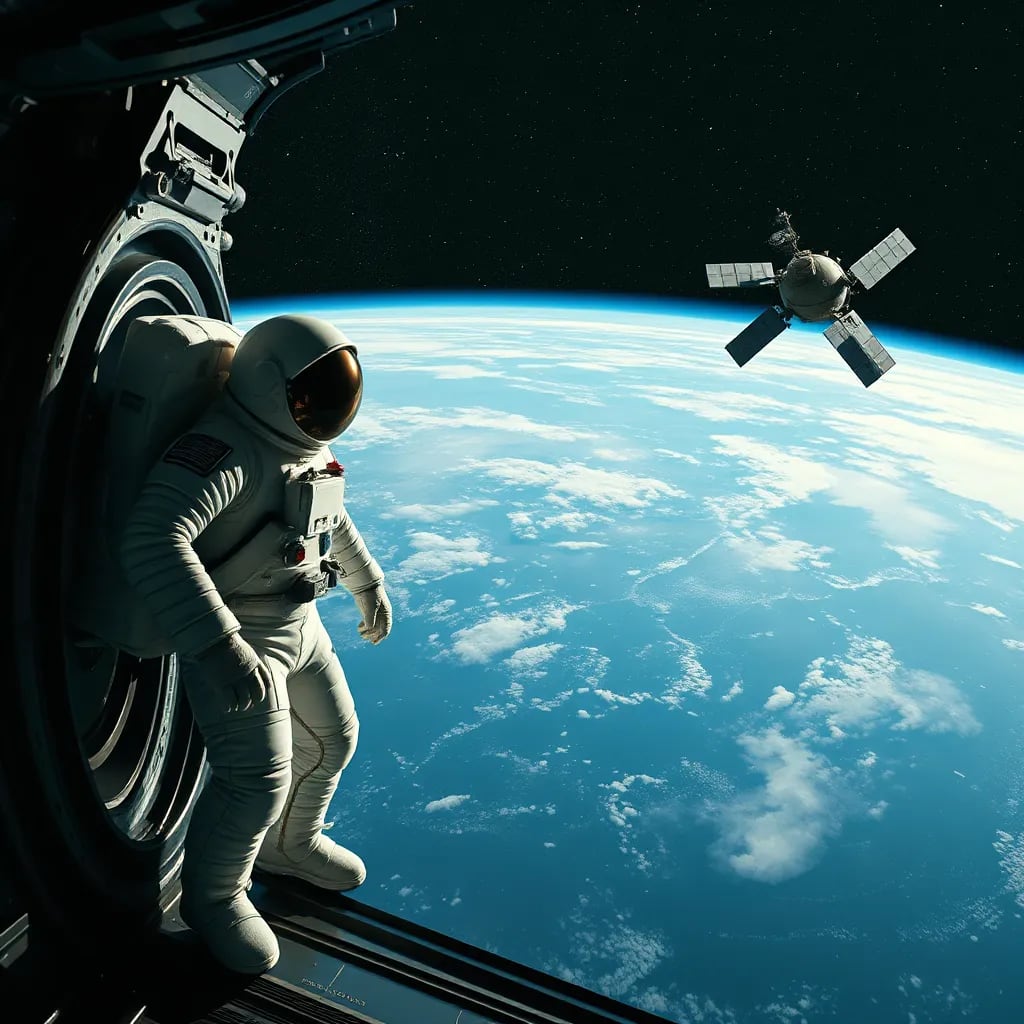
There was a time when reading about space travel, interplanetary missions, and intelligent aliens felt like pure fantasy — thrilling, but impossible. Rockets and moon landings were for the pages of pulp magazines, not front-page headlines. But science has a way of catching up with imagination. In fact, many ideas that once lived only in the realm of science fiction are now part of our everyday reality. It’s as if writers of the past weren’t just dreaming — they were quietly sketching blueprints for the future.
Let’s take a closer look at how fiction became fact.
1. Space Travel: Yesterday’s Fiction, Today’s Routine
In 1865, Jules Verne wrote From the Earth to the Moon, describing a daring mission to our celestial neighbor. His fictional launch site? Florida — the same location NASA uses today. At the time, the concept of rocketry and orbital mechanics was pure speculation. A century later, in 1961, Yuri Gagarin broke the bounds of Earth and entered orbit, turning fiction into history.
Today, astronauts board space capsules with a purpose, not wonder. The International Space Station orbits above us like a cooperative outpost of science, hosting experiments, observations, and humanity’s shared dream of space exploration. What once was science fiction has become standard procedure: launch, orbit, re-entry.
2. Satellites and Global Internet: Arthur C. Clarke’s Legacy
In 1953, Arthur C. Clarke imagined satellites circling the Earth, enabling communication across continents in his novel Childhood’s End. At the time, the idea sounded as fanciful as magic. Now? We rely on that very magic daily.
From GPS navigation to live-streamed calls between continents, satellite communication has reshaped our lives. Elon Musk’s Starlink constellation is beaming internet access to some of the most remote corners of the world — an idea once reserved for visionary fiction. Sci-fi didn’t just predict satellites; it helped make them inevitable.
3. Robots and Rovers on Other Worlds
Many classic sci-fi stories featured autonomous robots exploring alien worlds. Today, we’ve surpassed those pages with real rovers like Curiosity, Perseverance, and China’s Zhurong, which roam Mars, snap selfies, and drill into the red soil in search of ancient microbial life.
These robotic explorers aren’t just wandering — they’re doing serious science. They've survived Martian winters, performed geological analyses, and even delivered sound recordings from another planet. Once a dream, now a data feed from 225 million kilometers away.
4. The Hunt for Exoplanets
For decades, the idea of planets beyond our solar system was mostly speculation. Science fiction often imagined twin Earths or alien paradises circling distant stars, but astronomers had no proof.
That changed in the 1990s with the discovery of the first confirmed exoplanets. Fast forward to today, and we’ve cataloged over 5,000 of them — from gas giants to rocky, Earth-like worlds in the habitable zone. Some even show hints of atmosphere, prompting the question: are we alone? What once was fiction is now a legitimate scientific field.
5. Private Spaceflight: Corporations in the Cosmos
Space travel used to be the sole domain of nations. Yet sci-fi long predicted powerful companies launching their own missions, exploiting space resources, or even ferrying tourists.
That future is here. SpaceX, Blue Origin, and Virgin Galactic are designing reusable rockets, aiming for lunar missions, and offering orbital vacations to the ultra-rich. Elon Musk’s Falcon 9 booster now routinely lands vertically, a feat once dismissed as impossible. Sci-fi imagined it. Engineers made it happen.
6. Space Biotech and Human Adaptation
Stories by Isaac Asimov and movies like Gattaca imagined genetics in space — tweaking DNA, growing organs, and studying how space changes the human body. Onboard the ISS, those concepts are now experiments in progress.
Scientists grow human tissue in microgravity, study how radiation affects DNA, and even grow mini-organs (organoids) in orbit. These breakthroughs could lead to new medical treatments — or future adaptations for life on Mars.
Still Science Fiction... For Now
Of course, not every sci-fi concept has come true. We’re still far from teleportation, warp drives, or meaningful contact with alien civilizations. Black hole tourism and faster-than-light travel remain cinematic fantasies. But with technology advancing at breakneck speed, even those ideas feel like "maybe someday" instead of "never."
Fiction as a Blueprint for Reality
Science fiction doesn’t just dream — it dares. It inspires generations of engineers, astronauts, and thinkers. Many scientists cite sci-fi books and films as the reason they pursued their careers. It plants seeds in the imagination, which eventually grow into blueprints, prototypes, and missions.
In that sense, sci-fi isn’t escapism — it’s ambition in disguise.
Conclusion: The Future Starts with Fiction
Science fiction isn’t prophecy, but it reflects our deepest aspirations. Many of yesterday’s wildest dreams are today’s news headlines. What began as ink on paper has become metal, flame, and orbit. As the line between fiction and reality blurs, one thing becomes clear: the stars may be far, but our reach keeps growing.
Maybe one day, starships will no longer belong to fiction — but to flight schedules.
About the Creator
Keep reading
More stories from Holianyk Ihor and writers in Futurism and other communities.
What If the Universe Is a Hologram? Exploring the Theory of Holographic Reality
The universe feels vast, solid, and deeply real. We touch mountains, observe galaxies, and live our lives under the comforting rules of gravity, matter, and space. But what if this experience — everything we see, feel, and know — is just a grand illusion? Not in a mystical or philosophical sense, but in a profoundly scientific one. Welcome to one of the most mind-bending ideas in modern theoretical physics: the holographic theory of the universe.
By Holianyk Ihor7 months ago in Futurism
About Binding Prometheus
I want to start actively advocating on behalf of my own work, and the most valuable part of my canon is, without a doubt, Binding Prometheus, the play I have been working on since 2019 and only finished in 2023 as part of my MA. The play itself is an amalgamation of a million different inspirations. On one end, it evokes the Ancient Greek myth-play, deriving its own title from the earliest extant work of Western drama we have, Aeschylus’s Prometheus Bound. On the other end, it borrows significantly from the sci-fi bulwarks from over the years, namely Mary Shelley’s Frankenstein and Karel Capek’s Rossum’s Universal Robots. The play could be an episode of Black Mirror, I fear. I don’t know. I’ve only ever seen one episode of Black Mirror.
By Steven Christopher McKnight12 days ago in Futurism
Crowdfunding Market Companies Analysis 2025–2033
Introduction: A New Age of Democratized Capital The global crowdfunding industry has emerged as one of the most transformative forces in modern finance. By enabling individuals, entrepreneurs, and organizations to raise funds directly from a distributed pool of contributors, crowdfunding bypasses traditional intermediaries such as banks, venture capital firms, and institutional lenders. Over the last decade, this model has evolved from small community fundraisers into a multi-billion-dollar ecosystem that supports innovation, social impact, creative ventures, and business growth.
By Marthan Sira day ago in Futurism
Day 4 of Quitting
If this is how sobriety feels, maybe it’s better to go through life a little buzzed… this, along with other hits like, I want to kill myself, I wish I was dead, and I’m going to throw myself off a bridge have been the only thoughts on rotation these past few days. I promise myself that if, in a month, I still feel like this (‘this’ meaning despondent, full of rage, and simultaneously numb) I can go back to smoking. Until mid-February though? Nicotine is off the table.
By sleepy drafts6 days ago in Longevity


Comments
There are no comments for this story
Be the first to respond and start the conversation.