
🚀 Sci-Fi vs. Reality: What the Future Was Supposed to Be
How Science Fiction’s Bold Predictions Got It Right—and Wrong

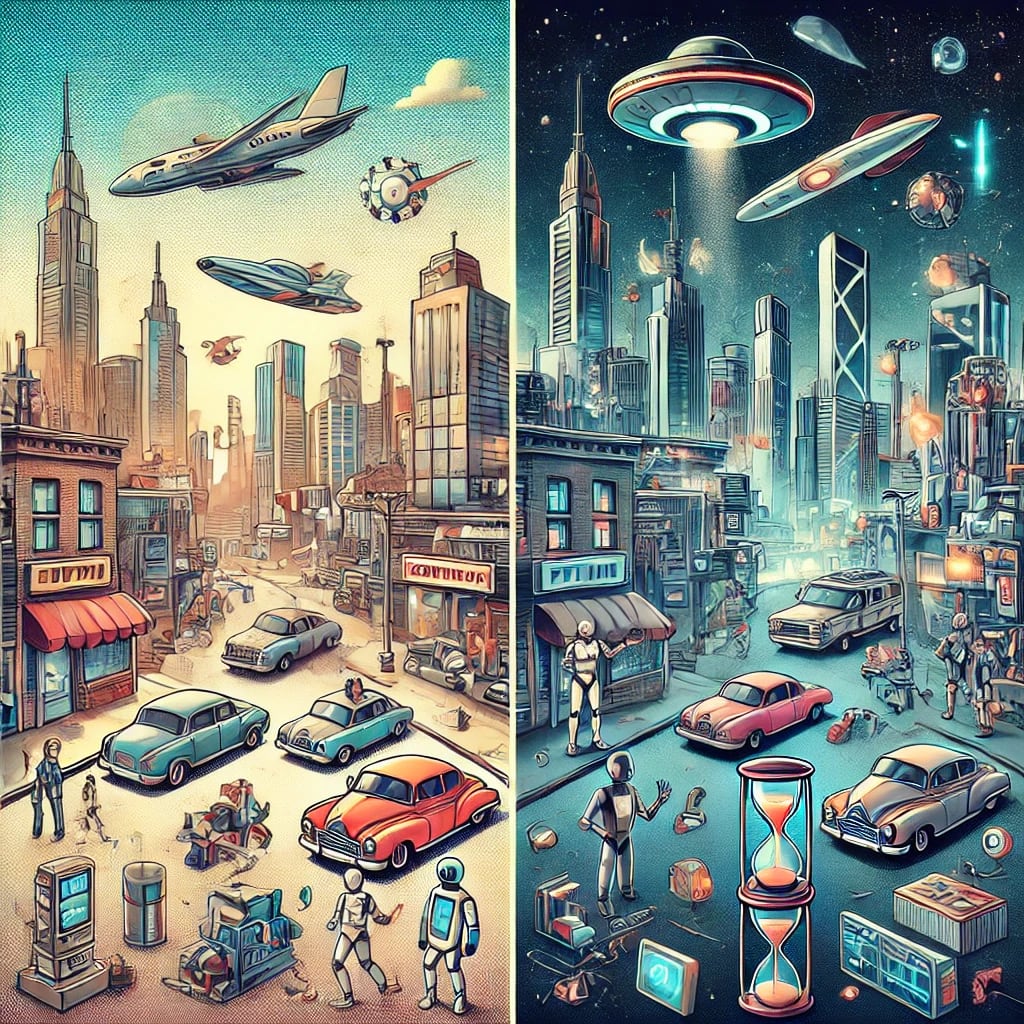
Introduction: Where Is My Flying Car?
Decades ago, science fiction painted a future filled with flying cars, robot assistants, teleportation, and intergalactic travel. Writers, futurists, and filmmakers predicted that by the 21st century, technology would transform our lives in ways unimaginable.
Yet, here we are in 2025—staring at our smartphones, dealing with traffic, and still waiting for someone to invent teleportation. So what happened? Why did some sci-fi visions become real, while others remain distant dreams?
Let’s dive into the boldest predictions from science fiction, explore what came true, what didn’t, and why the future we got looks very different from the one we imagined.
⸻
1. Predictions That Came True
Not everything sci-fi promised was wrong. In fact, some predictions were eerily accurate—just not always in the ways we expected.
1.1 AI and Virtual Assistants
• Sci-Fi Example: 2001: A Space Odyssey (1968) introduced HAL 9000, an AI that could talk, think, and assist humans.
• Reality: Today, we have Siri, Alexa, and ChatGPT, which may not be as sinister as HAL, but they can answer questions, make jokes, and even write essays.
1.2 Video Calls and Smart Devices
• Sci-Fi Example: Star Trek had communication screens and Back to the Future showed video calls.
• Reality: Zoom, FaceTime, and video conferencing have become everyday tools. We even have smart fridges, smartwatches, and smart homes.
1.3 Self-Driving Cars
• Sci-Fi Example: Total Recall (1990) featured a self-driving taxi.
• Reality: Tesla, Waymo, and others have developed autonomous vehicles, although they’re still far from perfect.
Sci-fi got these right because they were logical extensions of existing technology. As computers got smarter, it was only a matter of time before they could assist us in daily life.
⸻
2. The Predictions That Never Happened (Yet)
While some visions of the future became real, others are still science fiction.
2.1 Flying Cars
• Sci-Fi Example: The Jetsons, Blade Runner, Back to the Future Part II.
• Reality: We still drive regular old cars—only now, they come with Bluetooth.
Why didn’t it happen?
• Infrastructure: Cities are not built for flying cars.
• Safety: A car crash on the road is bad, but in the sky? Catastrophic.
• Energy: Flying requires huge amounts of power, and even today’s best batteries don’t cut it.
2.2 Space Colonies
• Sci-Fi Example: 2001: A Space Odyssey predicted a human colony on the Moon by 2001.
• Reality: We haven’t even been back to the Moon since 1972.
Why didn’t it happen?
• Cost: Space travel is insanely expensive.
• Technology: We barely have the ability to survive long-term in space.
• Motivation: There’s no urgent reason to colonize the Moon or Mars—yet.
2.3 Robot Maids and Human-Like AI
• Sci-Fi Example: The Jetsons’ Rosie the Robot, I, Robot’s advanced AI.
• Reality: We have Roombas, but they can’t cook dinner or hold conversations.
Why didn’t it happen?
• True AI is hard: While ChatGPT can generate responses, it doesn’t truly “think”.
• Cost vs. Demand: A human-like robot would be incredibly expensive and not necessarily better than a human.
⸻
3. Why Sci-Fi Gets Some Things Wrong
Sci-fi isn’t just about prediction—it’s about imagination. Some ideas remain fiction because:
• They’re unrealistic: Some predictions ignore real-world physics, costs, and human behavior.
• Technology evolves differently: We got smartphones instead of flying cars because they were more practical and profitable.
• We focus on different problems: Instead of exploring Mars, we’re using AI to solve business problems and optimize social media ads.
The biggest reason? We adapt to new technology quickly. What once seemed futuristic (smartphones, AI, self-driving cars) becomes normal, so it doesn’t feel as exciting as sci-fi made it seem.
⸻
4. The Future That Might Still Happen
Just because some predictions didn’t happen yet, doesn’t mean they won’t.
🔹 Quantum Computing: Could revolutionize AI, cryptography, and problem-solving.
🔹 Brain-Computer Interfaces: Elon Musk’s Neuralink aims to connect human brains to technology.
🔹 Fusion Energy: If scientists crack nuclear fusion, we could have limitless clean energy.
🔹 Mars Colonization: SpaceX is actively working on getting humans to Mars.
We may not have flying cars or robot butlers, but the future is still unfolding—and it might be even stranger than science fiction imagined.
⸻
Final Thoughts: The Future Is Still Unwritten
Science fiction has shaped our expectations, inspired real-world scientists, and given us both dreams and disappointments.
So while you wait for your flying car, remember: The real future is often different from what we expect—but that doesn’t make it any less amazing.
Maybe the next big technological leap is something sci-fi hasn’t even imagined yet. 🚀
About the Creator
Ahmet Kıvanç Demirkıran
As a technology and innovation enthusiast, I aim to bring fresh perspectives to my readers, drawing from my experience.
Keep reading
More stories from Ahmet Kıvanç Demirkıran and writers in Futurism and other communities.
🤖 How AI Thinks in Seconds
Introduction: A World That Answers Instantly Imagine asking a question and receiving an answer within seconds. No searching through endless pages, no waiting—just instant, precise responses. Whether it’s ChatGPT generating text, DALL·E creating images, or an AI assistant setting your reminders, the process feels almost magical. But how does AI work so fast?
By Ahmet Kıvanç Demirkıran11 months ago in Futurism
About Binding Prometheus
I want to start actively advocating on behalf of my own work, and the most valuable part of my canon is, without a doubt, Binding Prometheus, the play I have been working on since 2019 and only finished in 2023 as part of my MA. The play itself is an amalgamation of a million different inspirations. On one end, it evokes the Ancient Greek myth-play, deriving its own title from the earliest extant work of Western drama we have, Aeschylus’s Prometheus Bound. On the other end, it borrows significantly from the sci-fi bulwarks from over the years, namely Mary Shelley’s Frankenstein and Karel Capek’s Rossum’s Universal Robots. The play could be an episode of Black Mirror, I fear. I don’t know. I’ve only ever seen one episode of Black Mirror.
By Steven Christopher McKnight16 days ago in Futurism
Top-12 AI Agents Development Services in the 2026
AI agents are no longer experimental tools. In 2026, they sit at the core of how modern companies automate workflows, support customers, analyze data, and make decisions at scale. Autonomous customer support agents and multi-agent enterprise systems coordinate complex operations. Businesses actively seek partners capable of designing, building, deploying, and maintaining production-ready AI agents.
By CEO A&S Developers5 days ago in Futurism


Comments (2)
very fine written
Love this very well written ✍️🏆🌺🌺