

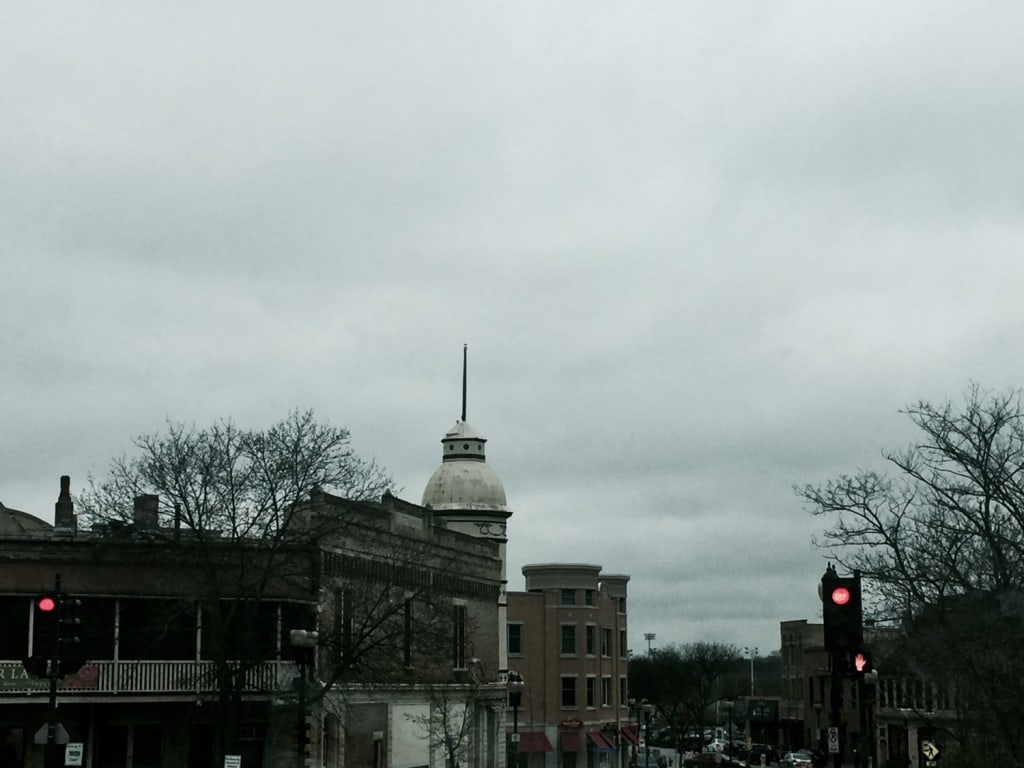
It was sundown; we were almost finished scavenging the block. Square Tudors and period Colonials spanned both sides of Chester Ave, their doors freshly ajar and spray painted red, like the bright blood of cherries in snow.
“Looks like my Grandnurse’s lipstick,” KDee said on the porch swing. She liked to drag her cigarettes through her ring and middle finger, and she liked to parrot murder detectives from old Law & Order seasons. “Our door, I mean. She’d nevah go for that gaudy Fed Red.”
KDee blew her next drag in my nose. I hated her. What was the point of being special? The other Scavengers—how did they break in so quickly?—weren’t trying so hard. They all had normal first names with singular capital letters, and if they smoked, they did so discreetly and with the normal two fingers.
The door to our assignment, 1806 Chester Ave, was charcoal grey—as was most of the three-story house, plus narrow white streaks on the eaves and window frames.
“Your Grandnurse had ugly lips,” I said. “When’s back-up coming?” “You mean the Locksmith?” We weren’t supposed to use words like back-up or Fed Red. Instead, we called “Locksmiths” to “Un-door” the houses, and when the Locksmith finished what the Scavengers couldn’t, we “anointed the property” in vermilion.
“You know who I mean. Did your Grandnurse’s lips have an uncrackable lock system?”
“I wish. Nelly was still talking when they buried her.”
I always wonder how KDee passed the Scavenger’s test. Then again, how did any of us? We had to learn advanced calculus, the histories of European rulers, 5 human languages, 9 coding languages, and the minor details of literature like Great Expectations and The Canterbury Tales. The wealthy will protect their belongings at any cost, which meant locking systems and password protections that only a Renaissance Man could break through.
But KDee is not Renaissance Man potential—in fact, sharing humankind with her is a bit demoralizing.
“Do you know the definition of a saint, KDee?” She shook her head. “A saint is someone who, without a doubt, has secured their place in Heaven. I always thought that Scavengers were like saints to the regime. They chose us; we can’t be purged. We’re guaranteed a spot in Heaven, or at least in this country. We’re their best assets, right? Without us, the New American Front will topple.”
She took another drag. “Sure, you’re kinda like Mother Teresa cuz you brood a lot, and I’m like—”
“You, KDee, are as well-rounded as a thumbtack. How did you become a Scavenger?”
A small hum; a sudden collapse. KDee had more to say, but I focused on the grey door clicking, whirring, and toppling into the porch steps.
The crash alerted several houses; they turned their lights on, cheered, then settled back into the prepubescent evening. It must have been a voice lock, we later concluded, though we’ll never know what the password was.
Why were we breaking down the doors of abandoned properties? It’s complicated. After renegade military forces claimed Baltimore in 1989, they established the New American Front—a cultural revolution that imposed two principles. The N.A.F. 1) renounced wealth and materialism, and 2) renounced the nuclear family.
Naturally, families don’t support giving up their wealth and offspring. I’ll spare the details about bloodshed and mayhem.
Then, the government Grandnursed a new generation of Americans. I am one of those Americans; KDee is another. They educated the brightest of us into Scavengers, a clean-up crew for newly-claimed cities littered with heavily-locked homes. After we gut the properties, new projects are built in place, and the military claims the wealth for itself. So it goes.
Military crackdowns on “biological units” continue today; as the N.A.F. grows, more cities evacuate. The Front had moved West, and we were stationed in a small town just west of Des Moines, IA.
But before the wealthy move West (and the poor are indoctrinated), they often install traps and lock systems to preserve their wealth. These houses, like the ones on Chester, are museums of a different strife, preserving what dignity was found in family life.
The dust settled; KDee and I peered inside. We saw a cozy 3-by-9 antechamber, tiled with white and yellow hexagons. On the left wall, a mirror hung above a stout oak desk, and to the right sat an armchair. We couldn’t tell where the light came from, or where the second lock was. The wall in front of us was bare yellow concrete, and the ceiling reached into a starless night sky.
“So much for the Locksmith,” KDee said. When I turned around, our view of the neighborhood was replaced by an identical grey door. The first of three locks clicked shut.
We were trapped. Our backpacks had drills and stethoscopes and geiger counters, but none of it proved useful. The next hours proved pointless, as the strange yellow antechamber revealed nothing.
“Jonah. Can I tell you a secret?” KDee asked, slumping into the armchair.
“KDee, you’re not very good at the whole ‘surviving under a totalitarian regime’ thing.”
“Hm?”
“Well, if you… trust me, enough, then sure, I’m all ears.”
“I met one of my birth parents.”
“Hm?” I was expecting a secret recipe, or some boring tidbit of yesterday’s lifestyle. But there it was, clean and simple.
“I know. Isn’t that strange? Like, I emerged from you, now let’s have a pleasant little chat.”
“You talked to them?”
“Mhm. Juicy secret, innit?” KDee had swapped the Bronx Cop voice for that of a Brit. Except, every syllable was wrong. “Juicy” was “jew see,” and “innit” was “internet.”
“But, you’re here, anyway. Working for a regime that separates children from parents.”
“And, unlike what the Deputy Minister says, meeting my parents didn’t make me an over-coddled, dysfunctional member of our New American Front.”
I cleared my throat. “KDee, you’re admitting a federal crime, which authorizes me to detain you as an agent of this administration. Do you understand?”
“Sure. But chew won’t, gov’na.”
“But I won’t,” I said, slumping down the ugly yellow wall. “You’d turn me in, too.”
“Jolly right.”
“Was it yer mum ur yer dad?” I said, parrying her Stafford sound with a Darlington drawl. I had met my mom four months ago. It was an accident, as all children meet their parents these days. We had Grandnurses, of course—women were expected to raise a child, just not their own. Women are not of sound judgment with their own blood, the New American Front claimed; besides, too much nurturing softens a child. Much better to raise a machine.
“My mom,” she said. Her voice sounded hollow. “She never told me her name, but we didn’t need names. Something about her, the way we reflected off each other… it’s like, for the first time, the world seemed under control.”
I knew what she meant. My mom and I had only moments, but in them, I was brave enough to hope.
“She couldn’t believe I was a Scavenger.”
“Mine couldn’t, either.”
“You’re either a traitor to the government or a traitor to the people.”
“I hope neither survive.” She laughed at that, but I think I was telling the truth. It doesn’t matter. While we talked, I was staring at our reflection in the mirror, trying to find what felt wrong about the image staring back. From my perch below the armchair, I saw most of KDee and some of my forehead, and I saw the yellow wall behind us, except the mirror reflected a tiny Σ that wasn’t on the real wall.
“KDee, grab a drill,” I said, and we both clicked into Scavenger-mode. We knew mistakes were costly—if the drill was off the mark by even a millimeter, the whole lock system might self-destruct. Or it might not. We wouldn’t know, since they never told us the stories of the people who used to live here. What if we knew them? Saved them a token of antiquity? Still, it’d be nice to know if a billionaire claimed this house; those bloodsuckers always make things harder.
We tried aligning the angle of the mirror with the wall, but in the end, our success was probably luck. KDee’s hands shook like crazy, and I’m not proud of my own spatial awareness. Again, it doesn’t matter. The silent sigma revealed the location of a second lock—a keyhole, rare for a high-security house, and something we learned how to pick on the first day of training. In a matter of minutes, the second lock clicked, and the yellow wall collapsed.
When the dust dissipated, the layout of the antechamber had grown. The yellow wall had fallen inward, revealing a second room built completely of matte-grey stone. On our left was a redbrick fireplace, lit.
In the center: a podium with a clean feather pen and little black book, leather bound with a bronze clasp. Each page was numbered, lined, and unused—we tested for hidden ink, but that proved useless. We couldn’t find a door anywhere. I even stuck my head up the fireplace—it was tall enough, I just had to be quick.
We never figured out what to write in the book. I was disappointed, too. Say what you want about the N.A.F. and its iconoclasm against the rich, but I liked a good puzzle, and I thought with enough time we could crack it. What word on what page would open the entire house to us? We weren’t punished, at least—even our superior said she’d never seen any locks like this one.
We were trying to find more clues, so I was feeling around the chimney bricks for the sixth time, when KDee startled me.
“She told me about my dad, too.”
“Oh?” I didn’t tell her what she already knew: my mom also told me about my dad, and how to find his grave if I escaped.
“Yeah. He’s one of the architects of the regime, apparently. Helped coin “New American Front” and a bunch the government messaging about family.”
“A powerful man. He’d probably keep you as a daughter if he could.”
“He tried, too. That’s what my mom said, but she didn’t tell me how. We bolted when we heard police sirens.”
“Are you… proud to be his daughter?”
That made her choke. “Definitely not, Jonah. I mean, I agree with the N.A.F. about rich people, but we both know the rich run the N.A.F. Besides, we’re the reason they get rich. Every house we crack will be gutted and claimed by them.
“There’s enough money on Chester Avenue to buy an island. How much wealth do you think we’ve given the N.A.F.?”
The Locksmiths arrived an hour later with x-ray equipment and explosives of every intensity. KDee and I repeated our earlier conversation, and the front door opened again; a few minutes later, the room was safe for explosives and they blasted the last wall down. Before the dust disappeared, the Locksmiths had gas masks on and started anointing the property.
While the Locksmiths painted, KDee and I explored the kitchen.
There, on the granite island, was a photo of my mother. Her hair seemed silkier, but otherwise, she looked the same. She held a child her arms—presumably me, though I don’t understand how. I was born after the N.A.F. seized control of my hometown, and my earliest memories are the daycare where they trained us.
The photograph had $20,000 inside. I pocketed the money and the photo before KDee noticed. She still doesn’t know that I have it. It’s dangerous to steal in the N.A.F., but you would have taken the photograph, too.
In a different life, the stout grey Tudor at 1806 Chester Ave would have been home. How lucky was I?
About the Creator
i.t.d.
deleted
Keep reading
More stories from writers in Futurism and other communities.
About Binding Prometheus
I want to start actively advocating on behalf of my own work, and the most valuable part of my canon is, without a doubt, Binding Prometheus, the play I have been working on since 2019 and only finished in 2023 as part of my MA. The play itself is an amalgamation of a million different inspirations. On one end, it evokes the Ancient Greek myth-play, deriving its own title from the earliest extant work of Western drama we have, Aeschylus’s Prometheus Bound. On the other end, it borrows significantly from the sci-fi bulwarks from over the years, namely Mary Shelley’s Frankenstein and Karel Capek’s Rossum’s Universal Robots. The play could be an episode of Black Mirror, I fear. I don’t know. I’ve only ever seen one episode of Black Mirror.
By Steven Christopher McKnight29 days ago in Futurism


Comments
There are no comments for this story
Be the first to respond and start the conversation.