
Scanning the Future: What Lies Ahead for 3D Scanning in the Next Decade
3D Scanning

Over the past decade, 3D scanning technology has expanded from industrial applications to the consumer market, becoming more efficient, convenient, and affordable. With advancements in computer vision, artificial intelligence, materials science, and cloud computing, the future of 3D scanning is filled with limitless possibilities. What will this technology look like in the next ten years? How will it change the way we live and work? This article explores key trends that will shape 3D scanning in the coming decade.
1. The Rise of Intelligent 3D Scanning
Artificial intelligence (AI) and deep learning are becoming key drivers of progress in 3D scanning technology. In the future, 3D scanners will not only be data collection tools but also intelligent systems capable of automatically optimizing, correcting, and analyzing scan results. For example, AI can help remove noise, complete missing parts, optimize mesh models, and even adjust parameters in real-time during scanning to produce higher-quality 3D models. This will significantly lower the technical barrier, enabling more people to use 3D scanning without requiring expertise in modeling or post-processing.
Additionally, AI may enable 3D scanners to automatically recognize different object types and optimize scans accordingly based on materials, lighting conditions, and geometric shapes. For example, when scanning a human body, AI can enhance details in skin and hair, while for mechanical parts, it can sharpen edges and improve geometric accuracy. This advancement will expand the applications of 3D scanning across various fields.
2. Portability and Mobility: Scanning Anytime, Anywhere
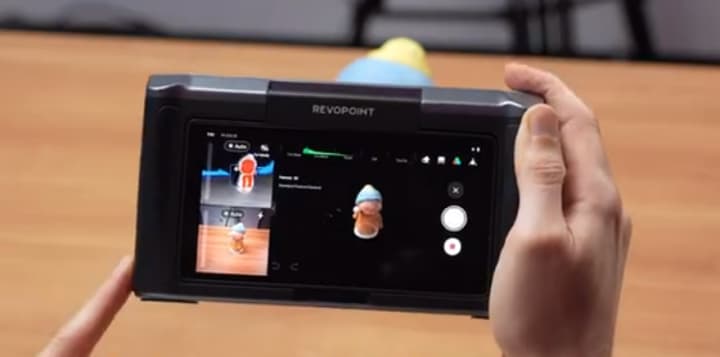
Future 3D scanning devices will become smaller, more portable, and even integrated into smartphones and other everyday devices. In recent years, smartphones have begun incorporating LiDAR and depth-sensing cameras for augmented reality (AR) and photography enhancements. In the next decade, this technology will further evolve, making high-precision 3D scanning a standard smartphone feature.

The rise of portable 3D scanning will make it easier for individuals and small businesses to enter the 3D modeling and printing world. Artists will be able to capture real-world objects anytime for creative projects, designers will scan reference objects on the go, and the medical industry will benefit from on-the-spot patient scans for personalized healthcare solutions. This mobility trend will greatly accelerate the widespread adoption and commercialization of 3D scanning technology.
3. High-Speed Scanning and Real-Time 3D Modeling
In the coming decade, 3D scanning speeds will increase dramatically, reducing scan times from seconds to mere milliseconds and enabling real-time 3D modeling. This will be driven by improvements in computer hardware, faster data transmission rates, and optimized algorithms.
Real-time 3D modeling will have a profound impact on various industries. In gaming and film production, real-time scanning will make motion capture more seamless, creating more lifelike virtual characters. In architecture and engineering, designers will be able to generate precise digital twins of buildings instantly for simulation and optimization. In industrial inspection, real-time scanning will enable manufacturers to detect defects on production lines immediately, improving precision and efficiency.
4. 3D Scanning in AR and VR
With the rapid advancement of AR and VR technologies, 3D scanning will become a crucial bridge between the physical and virtual worlds. In the future, 3D scanning will go beyond static model creation to real-time dynamic capture of objects and environments, enhancing interactive experiences.
In AR shopping, consumers will use 3D scanning to create digital avatars of themselves and try on clothes or test furniture placements in a virtual space. VR game developers will use 3D scanning to create ultra-realistic virtual environments, increasing immersion and interactivity. In education, teachers will use 3D scanning to present historical artifacts, biological specimens, or complex mechanical structures in 3D, allowing students to explore subjects more vividly.
5. Cloud-Based 3D Scanning and Data Sharing
With the expansion of 5G and cloud computing, the storage, processing, and sharing of 3D scan data will become more seamless. Users will be able to upload scans directly to the cloud, where powerful servers will automatically optimize and analyze the data, making it accessible across different devices for further editing.
This trend will facilitate greater collaboration and sharing of 3D content. For example, design teams will be able to work remotely on 3D scan data, modifying product models in real time. Online 3D model libraries will expand, allowing individuals to easily access and use high-quality 3D scan data. Social media platforms may even support 3D content sharing, enabling users to showcase and discuss their 3D creations in virtual communities.
6. Expanded Applications in Healthcare, Cultural Heritage, and Industrial Inspection
The applications of 3D scanning continue to expand, and over the next decade, it will play an even greater role across various specialized fields.
Healthcare
3D scanning will be widely used in personalized medicine, including the creation of custom prosthetics, orthotics, and dental restorations. Additionally, doctors will use 3D scanning for rapid and precise body measurements to develop tailored treatment plans. For example, burn patients can have 3D scans taken to create precise skin graft templates, while surgeons can use 3D models for preoperative planning, improving surgical accuracy.
Cultural Heritage Preservation
3D scanning is already widely applied in the preservation and restoration of cultural artifacts, and this will continue to evolve. High-resolution 3D scans can capture even the smallest details of historical relics, providing accurate data for restoration and replication. Additionally, 3D scanning will enable the creation of virtual museums, allowing people to explore historical artifacts online without having to visit physical exhibitions.
Industrial Quality Control
In manufacturing, 3D scanning will be extensively used for quality inspection. Future 3D scanning systems will become more automated, capable of scanning products during production and detecting defects instantly to ensure quality. This will reduce human error and increase production efficiency.
The Future of 3D Scanning Is Bright
Over the next decade, 3D scanning technology will see major advancements in intelligence, portability, real-time modeling, and cloud-based integration. It will become more embedded in our daily lives and work environments, playing an increasingly vital role in industries such as healthcare, manufacturing, and cultural heritage preservation. As the technology continues to evolve, 3D scanning will no longer be a tool reserved for professionals but will become an accessible innovation for everyone, opening up new possibilities for creativity and technological progress.
About the Creator
Your Galaxy Watch 7 Just Got a Major 2026 Refresh: 4 Things You Need to Know
For many of us, the ping of a software update notification often triggers a brief moment of anxiety—a nagging worry that a new patch might slow down a reliable device or tether us to a charger. However, in the high-stakes tech landscape of early 2026, these updates have evolved into the primary way our hardware actually improves over time. As the new Galaxy S26 series makes its debut, Samsung is ensuring the Galaxy Watch 7 receives the same software dignity as its latest flagships, proving this 2024-era wearable remains a vital, high-performing pillar of the ecosystem. The big news this week? The February 2026 security update has officially moved beyond its initial testing grounds in South Korea and has gone global.
By Tech Horizonsa day ago in Futurism
Australia Aerospace and Defense Market: Sovereign Defense Capability Development, Next-Generation Aerospace Systems & Integrated Security Infrastructure
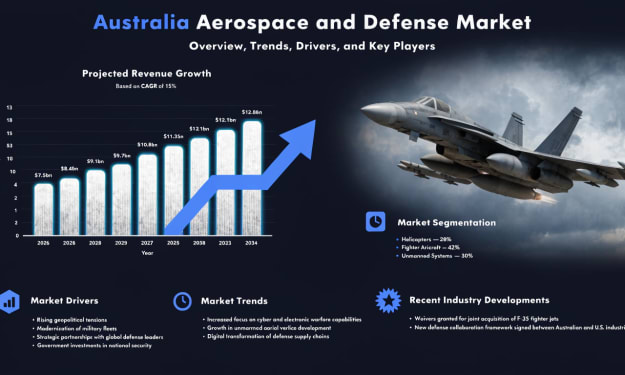
According to IMARC Group, the Australia aerospace and defense market reached a value of USD 13.6 Billion in 2025 and is projected to reach USD 21.4 Billion by 2034, growing at a compound annual growth rate (CAGR) of 5.04% during 2026–2034. The market is expanding as Australia strengthens its national security framework and invests in advanced aerospace technologies and defense capabilities. Rising geopolitical considerations and evolving security challenges are encouraging governments to increase defense budgets and modernize military infrastructure. Programs focused on sovereign defense capability development are encouraging domestic manufacturing of defense equipment, aircraft systems and advanced military technologies. At the same time, collaborations between Australian defense agencies and international contractors are accelerating innovation and enabling technology transfer. Investments in next-generation aerospace systems, cyber defense technologies and satellite communication infrastructure are further supporting the growth of the aerospace and defense sector.
By Kevin Cooper3 days ago in Futurism
The Forsyth House Fire
Since 1851, Forsyth House has stood on the corner of Union Street and Gordon Street in the heart of Glasgow. Its iconic, or was... because on Sunday 8th of March, 2026, a fire broke out in a small, seemingly un-named shop in the building and tore all that history down. As I write, the rubble is still unsettled and the street is still blocked off. Central Station is quiet on the upper level, and around 30 small businesses have quite literally gone up in smoke.
By S. A. Crawford3 days ago in The Swamp


Comments
There are no comments for this story
Be the first to respond and start the conversation.