
Saudi Arabia Automotive Software Market: Connected Vehicles, EV Integration & Growth Outlook
How connected vehicle platforms, advanced driver assistance systems, and over-the-air update capabilities are transforming vehicle intelligence, safety, and digital mobility innovation across the Saudi Arabia automotive software market.


Saudi Arabia is racing toward a software-driven automotive future. Vision 2030 investments in smart cities, electric vehicles, and autonomous technology are transforming how vehicles are designed, manufactured, and operated. The USD 210.6 Million market is expanding rapidly as local automakers integrate advanced driver assistance systems, over-the-air updates, connected vehicle platforms, and AI-powered infotainment. Projects like NEOM, The Line, and King Salman Automotive Cluster are creating testbeds for next-generation mobility software. With government backing, 5G deployment, and partnerships between global tech giants and Saudi manufacturers, automotive software is becoming the backbone of the Kingdom's transportation revolution.
According to IMARC Group's latest data, the The Saudi Arabia automotive software market size reached USD 237.6 Million in 2025. Looking forward, IMARC Group expects the market to reach USD 706.8 Million by 2034, exhibiting a growth rate (CAGR) of 12.88% during 2026-2034.
The Saudi Arabia automotive software market encompasses digital solutions that power modern vehicles, including operating systems, middleware, and application software. These platforms enable critical functions like advanced driver assistance systems, infotainment and navigation, vehicle connectivity, telematics, and autonomous driving capabilities. The market serves diverse vehicle types from conventional internal combustion engine (ICE) passenger vehicles and commercial trucks to battery electric vehicles, hybrid electric vehicles, and emerging autonomous vehicles. Automotive software is essential for safety systems, engine management, powertrain optimization, and creating seamless connectivity between vehicles, infrastructure, and cloud services. As the industry shifts toward software-defined vehicles, these digital solutions are becoming the primary differentiator in vehicle performance and consumer appeal.
Saudi Arabia Automotive Software Market Growth Drivers:
- Rapid ADAS Adoption and Road Safety Priorities
Advanced driver assistance systems are transforming vehicle safety across Saudi Arabia. NEOM's USD 100 million joint venture with Pony.ai is creating testbeds for Level 4 autonomous robo-taxis. Saudi Arabia commands 28.45% of regional ADAS revenue thanks to Vision 2030's explicit autonomous-mobility milestones. Modern systems integrate adaptive cruise control, lane departure warning, automatic emergency braking, and parking assistance to address the Kingdom's road safety priorities. Global EV sales reaching 18 million units drive 20% increases in sensor integration, with premium models featuring over 200 sensing points. These safety technologies require sophisticated software platforms that process real-time data, detect hazards, and enable semi-autonomous capabilities—creating sustained demand for automotive software development.
- Connected Vehicle Ecosystem and 5G Infrastructure Expansion
The Kingdom's rollout of 5G networks is enabling ultra-fast vehicle connectivity and real-time communication. In 2024, General Motors launched OnStar in Saudi Arabia, providing connected mobility services. Consumers increasingly expect over-the-air updates, real-time navigation, voice recognition, smartphone integration, and internet-enabled services. These features require robust software platforms that handle vast data flows while ensuring cybersecurity. Partnerships between automakers, telecom providers like STC and Mobily, and software vendors are creating comprehensive Vehicle-to-Everything ecosystems. The 5G infrastructure supports low-latency communication essential for autonomous driving, traffic management, and smart city integration. Telematics data collection enhances fleet management in commercial sectors, while IoT-enabled mobility drives continuous software innovation across the automotive value chain.
- Vision 2030 Initiatives and Smart Mobility Projects
Government support through Vision 2030 is fundamentally reshaping automotive software demand. The Ministry of Transport and Logistics launched a new Digitalization and Technical Processing Center in 2024, along with the Unified Documents and Records Platform. NEOM, The Line, and Oxagon megaprojects feature AI-driven transportation infrastructure serving as innovation testbeds. The Public Investment Fund makes strategic investments in electric vehicle manufacturers including Lucid Motors and Ceer, Saudi Arabia's first domestic EV brand. The government aims to deploy over 50,000 industrial robots by 2030, with 15% of public transport vehicles operating autonomously. EVIQ is building nationwide fast-charging networks. These initiatives create sustained demand for intelligent transport systems, autonomous testing platforms, and software-centric vehicle architectures.
Saudi Arabia Automotive Software Market Trends:
- Software-Defined Vehicles and Over-the-Air Updates
The automotive industry is shifting from hardware-centric to software-defined architectures. Application software held 47.5% market share in 2024, driven by its core role in infotainment, ADAS, telematics, and human-machine interfaces. Manufacturers are adopting over-the-air update capabilities that allow remote software improvements without dealer visits. This transformation enables automakers to continuously enhance vehicle features, fix bugs, and add functionality post-purchase. Real-time operating systems, autonomous driving algorithms, and cloud-based vehicle management solutions are growing rapidly. The shift allows vehicles to evolve throughout their lifecycle, improving performance and extending value. Saudi Arabia's young, tech-savvy population—with 63% under 30—drives demand for connected, updatable vehicles that integrate seamlessly with digital lifestyles.
- Electric Vehicle Software Integration and Battery Management
Electric vehicle production is accelerating software requirements across the Kingdom. Saudi Arabia targets producing 500,000 EVs annually by 2030 through Lucid, Ceer, and international partnerships. Modern EVs integrate 60% more temperature sensors than conventional vehicles, with premium models featuring over 200 sensing points across battery packs, motor systems, and cabin climate control. Machine learning algorithms continuously monitor temperature variations preventing thermal runaway risks. ZF's TempAI solution utilizes predictive models improving temperature forecasting accuracy by over 15%, unlocking approximately 6% more peak power through precise thermal management. EV software handles charging management, battery optimization, vehicle-to-grid capabilities, and range prediction—creating entirely new software categories beyond traditional automotive applications. The UAE sold over 24,000 electric and plug-in hybrid vehicles in 2024.
- Artificial Intelligence and Autonomous Driving Development
AI-powered systems are becoming fundamental to automotive software platforms. In July 2025, Bosch unveiled SX600 and SX601 system-on-chips designed for advanced ADAS applications up to SAE Level 2+, using AI for improved perception and high-accuracy object detection. The Saudi Road Code, effective in early 2025, provides guidelines for integrating self-driving vehicles into road networks. Initial trials include autonomous buses in NEOM City and semi-autonomous electric buses during Riyadh Season. Machine learning powers predictive thermal management, battery safety monitoring, smart climate control, and hazard detection. AI analyzes sensor data in real-time to enable lane-keeping, automatic braking, and adaptive cruise control. These systems process vehicle data for predictive maintenance, traffic optimization, and personalized driving experiences—positioning Saudi Arabia at the forefront of autonomous mobility innovation.
Recent News and Developments in Saudi Arabia Automotive Software Market:
- 2024: The Ministry of Transport and Logistics opened a new Digitalization and Technical Processing Center, alongside launching the Unified Documents and Records Platform. This digital infrastructure initiative streamlines automotive documentation, licensing, and regulatory processes, creating a foundation for software-driven transportation management and supporting the integration of connected vehicle technologies across Saudi Arabia's mobility sector.
- 2023: Lucid Motors launched the Lucid Air all-electric luxury sedan featuring cutting-edge automotive software including advanced battery management systems, over-the-air update capabilities, and sophisticated driver assistance features. The vehicle's software architecture delivers real-time range optimization, predictive climate control, and seamless smartphone integration, establishing new benchmarks for electric vehicle software performance in the Saudi market.
- July 2025: Bosch unveiled SX600 and SX601 system-on-chips specifically designed for advanced ADAS applications up to SAE Level 2+, operating in the 77 GHz frequency band and using artificial intelligence for improved perception with ability to detect objects with high accuracy. These chips represent a significant advancement in automotive sensor processing, enabling more sophisticated safety features and autonomous driving capabilities for vehicles operating in Saudi Arabia's challenging climate conditions.
- May 2025: Mobileye announced a leading global automaker selected its Mobileye Imaging Radar as a key component for an upcoming Level 3 automated driving system scheduled for production in 2028. This high-definition radar technology requires advanced temperature management and sophisticated software integration, validating the growing importance of autonomous driving software development for vehicles destined for Saudi Arabia and regional markets.
Note: If you require specific details, data, or insights that are not currently included in the scope of this report, we are happy to accommodate your request. As part of our customization service, we will gather and provide the additional information you need, tailored to your specific requirements. Please let us know your exact needs, and we will ensure the report is updated accordingly to meet your expectations.
About the Creator
Faisal Al-Harbi
Market research professional based in Saudi Arabia (KSA), focused on industry trends, market growth, and economic insights.
Writing data-driven articles on Saudi markets, business outlook, and Vision 2030–driven sectors.
Keep reading
More stories from Faisal Al-Harbi and writers in Futurism and other communities.
Saudi Arabia Entertainment Market Insights Youth Demographics & Leisure Spending Expansion
According to IMARC Group's latest research publication, Saudi Arabia entertainment and amusement market size reached USD 5,468.4 Million in 2025. The market is projected to reach USD 11,542.2 Million by 2034, exhibiting a growth rate (CAGR) of 8.65% during 2026-2034.
By Faisal Al-Harbia day ago in Futurism
Indonesia Paper Packaging Market Outlook: Industry Trends & Growth Factors
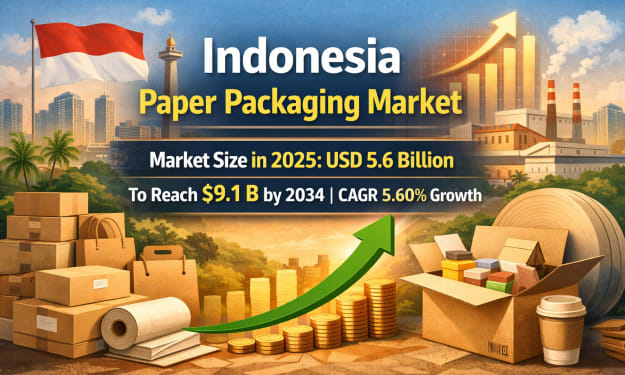
The Indonesia Paper Packaging Market was valued at USD 5.6 Billion in 2025 and is expected to reach USD 9.1 Billion by 2034. The market is forecasted to grow at a CAGR of 5.60% during the period 2026-2034. Key drivers include growing environmental awareness, government regulations aimed at reducing plastic waste, and rising adoption in the food and beverage industry.
By Abhishek Dixitabout 10 hours ago in Futurism
GCC Footwear Market: Insights into Changing Consumer Preferences and Fashion Trends
According to IMARC Group's latest research publication, GCC footwear market size reached USD 4.9 Billion in 2024. The market is projected to reach USD 6.8 Billion by 2033, exhibiting a growth rate of 3.41% during 2025-2033.
By Abhay Rajput6 days ago in Futurism
Super Bowl LX Recap: A Team Called Hawks
Sixty. The Super Bowl turned 60! Still amazes me that this was the sixtieth Super Bowl played in NFL history. It seems like yesterday that I watched Super Bowl XXVII, the first SB I ever watched. The QB who won Super Bowl XXVII has since called a few SBs, and will call next year's game, but that's another story. Super Bowl LX took place at Levi's Stadium in Santa Clara, California, the home stadium of the San Francisco 49ers. However, it was one of their division foes who represented the NFC, as the Seattle Seahawks faced off against the New England Patriots.
By Clyde E. Dawkins3 days ago in Unbalanced



Comments
There are no comments for this story
Be the first to respond and start the conversation.