
Russia Deploys Mach 6 Nuclear Missiles on Fighter Jets Hypersonic First Strike Threat Alarms NATO and the World
Russia equips fighter jets with Mach 6 nuclear missiles, raising fears of unstoppable hypersonic first-strike capabilities and triggering a strong NATO


Russia Deploys Mach 6 Nuclear Missiles on Fighter Jets Hypersonic First Strike Threat Alarms NATO and the World
In a world already teetering on the edge of geopolitical friction a new development from Russia has stirred fresh anxiety in defense circles. The recent equipping of Russian fighter jets with hypersonic nuclear capable missiles capable of reaching speeds up to Mach 6 marks a dramatic escalation in military capability and a profound shift in the global balance of power. This new capability isn’t just a technical upgrade. It’s a seismic move with real human consequences. As tensions build among global powers the haunting possibility of hypersonic first strike nuclear weapons makes the prospect of conflict not just devastating but nearly unstoppable.
A Terrifying Technological Milestone
The R-37M missile also referred to in NATO reports as the Axehead is now believed to be integrated with MiG-31BM interceptor jets. This air to air missile can reportedly strike targets nearly 400 kilometers away (roughly 250 miles) all while traveling at speeds that make interception almost impossible six times the speed of sound. What sets this missile apart isn’t just its speed or range. It's the suspected capability to carry a nuclear payload. While Russia has not officially confirmed this analysts warn that the warhead’s size and design could allow it to be fitted with a miniaturized nuclear bomb turning it from a defensive weapon into a strategic first.strike threat.
The Human Cost of Speed
Mach 6 isn’t just a number it’s a sobering reminder of how little time we would have in the event of an attack. A missile moving at over 7000 kilometers per hour would reach its target within minutes. For civilian populations governments and militaries this leaves virtually no time for detection deliberation or diplomacy. Imagine a city of millions having only a few minutes to respond to a possible incoming nuclear threat. There would be panic miscommunication and unimaginable loss. In this age of instant information and disinformation the margin for error is terrifyingly thin.
A Global Echo of Alarm
The international response has been swift and deeply concerned. NATO officials have flagged the development as destabilizing. Western military strategists are reportedly working overtime to recalibrate defense systems that might counteract such threats but hypersonic speeds make traditional missile defense systems like the U.S Patriot or Israeli Iron Dome nearly obsolete. There is also the issue of trust. Arms treaties and disarmament efforts that once offered a framework for de-escalation are fraying. Russia’s withdrawal from key agreements like the INF Treaty and similar moves from other global powers are fueling a new arms race not in tanks or submarines, but in hypersonic and AI driven warfare.
Cold War Echoes 21st Century Speed
This arms buildup feels eerily reminiscent of the Cold War. But there’s one chilling difference the weapons today are faster more precise and infinitely harder to defend against. The stakes have grown yet the diplomatic frameworks that kept the worst case scenarios at bay have weakened. The Cold War had its near misses Cuba Berlin Able Archer 83. Each was defused in part because leaders had time to think. Hypersonic weapons change that equation. They compress decision making windows from hours to minutes. And when human error algorithmic decisions, and national egos collide in those tight spaces the world becomes a far more dangerous place.
What This Means for Ordinary People
It’s easy to view these developments as distant military maneuvers far removed from daily life. But their consequences could touch every corner of our shared world. A hypersonic arms race diverts resources from education healthcare and environmental efforts. It instills a climate of fear and suspicion and it brings the specter of nuclear conflict back into everyday conversation. For families living in cities that could become targets for soldiers asked to train with these new systems and for diplomats racing to rebuild fragile peace agreements the stakes are painfully real.
A Call for Global Action
Now more than ever the world needs transparency dialogue and renewed arms control efforts. Nations with hypersonic capabilities including the U.S China and Russia must engage in frank discussions not just about deployment but about ethics risks and protocols. New treaties should not only focus on the weapons themselves but also on AI control pre launch verification and communication channels that can prevent escalation.
We need to move from a logic of fear to a doctrine of responsibility.
The equipping of Russian jets with Mach 6 nuclear capable missiles is more than just a leap in technologynit’s a stark warning. As we stand at the threshold of a new era in military power the need for global cooperation and mutual restraint has never been more urgent.
Because at these speeds we won’t get a second chance.
About the Creator
Adnan Rasheed
Author & Creator | Writing News , Science Fiction, and Worldwide Update| Digital Product Designer | Sharing life-changing strategies for success.
Keep reading
More stories from Adnan Rasheed and writers in Futurism and other communities.
Mysterious Metallic Sphere Found in Colombia Ignites UFO Debate and Human Curiosity
Mysterious Metallic Sphere Found in Colombia Ignites UFO Debate and Human Curiosity In early May 2025 a quiet Colombian town became the center of a global mystery. Nestled in the scenic valleys of Buga, a small but historically rich municipality locals stumbled upon a strange metallic object perfectly spherical unusually cold to the touch and eerily smooth. What followed wasn’t just a scientific investigation it was an emotional cultural and philosophical journey into the unknown.
By Adnan Rasheed8 months ago in Futurism
About Binding Prometheus
I want to start actively advocating on behalf of my own work, and the most valuable part of my canon is, without a doubt, Binding Prometheus, the play I have been working on since 2019 and only finished in 2023 as part of my MA. The play itself is an amalgamation of a million different inspirations. On one end, it evokes the Ancient Greek myth-play, deriving its own title from the earliest extant work of Western drama we have, Aeschylus’s Prometheus Bound. On the other end, it borrows significantly from the sci-fi bulwarks from over the years, namely Mary Shelley’s Frankenstein and Karel Capek’s Rossum’s Universal Robots. The play could be an episode of Black Mirror, I fear. I don’t know. I’ve only ever seen one episode of Black Mirror.
By Steven Christopher McKnight18 days ago in Futurism
Solid State Transformer Market: Smart Grid Integration, Electrification & Market Dynamics
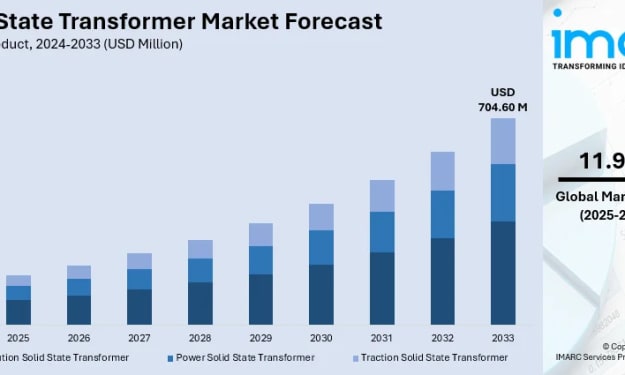
According to IMARC Group's latest research publication, global solid state transformer market size was valued at USD 241.91 Million in 2024. Looking forward, IMARC Group expects the market to reach USD 704.60 Million by 2033, exhibiting a growth rate of 11.98% during 2025-2033.
By Andrew Sullivan4 days ago in Futurism



Comments
There are no comments for this story
Be the first to respond and start the conversation.