
Rubber Market Trends: Circular Economy Adoption, Recycling Innovation & Industry Outlook to 2034
How circular economy adoption, rubber reclaim technologies, and ESG commitments are redefining sustainability benchmarks, operational efficiency, and brand differentiation in the rubber industry.


Rising vehicle production, accelerating healthcare demand, and rapid industrialization across emerging economies are collectively driving the global rubber market forward. According to IMARC Group's latest research, the global rubber market was valued at USD 49.5 Billion in 2025. Looking ahead, the market is expected to reach USD 71.4 Billion by 2034. Asia-Pacific currently dominates the market, holding a significant share of over 37.5% in 2025, owing to its status as the world's largest natural rubber producing region and a rapidly expanding automotive manufacturing base.
The market is divided into two primary types synthetic rubber and natural rubber. Synthetic rubber, led by grades such as styrene-butadiene rubber (SBR) and polybutadiene rubber (PBR), accounts for roughly 58.0% of the market and for good reason. Its consistent quality, superior heat and abrasion resistance, and adaptability to high-performance industrial requirements make it the preferred choice for tire manufacturers, automotive OEMs, and industrial goods producers alike. Natural rubber, on the other hand, retains critical advantages in applications where extreme elasticity and tensile strength are non-negotiable, such as aircraft tires, which are composed of 100% natural rubber.
Rubber Market Growth Drivers
- Surging Automotive Demand
The automotive sector is the single biggest driver of rubber consumption globally, accounting for the majority of both natural and synthetic rubber usage. Tires alone consume around 60% of the world's natural rubber supply. In the United States, with nearly 290 million registered vehicles on the road, tire production and replacement demand create a steady, high-volume market for rubber. The electric vehicle (EV) revolution is adding a new dimension — with over 800,000 EVs sold in the U.S. in a single recent year, specialized rubber compounds designed for higher torque loads and noise reduction are in increasing demand, pushing manufacturers to innovate at pace.
- Healthcare and Medical Applications
The healthcare sector has emerged as one of the fastest-growing consumers of rubber, particularly nitrile and medical-grade silicone rubber. The COVID-19 pandemic supercharged demand for disposable rubber gloves, catheters, and seals used in medical devices. The U.S. alone imported gloves valued at over USD 5 billion from Malaysia, according to the International Labour Organization. Beyond pandemic-driven demand, the aging global population and rising prevalence of chronic diseases are sustaining long-term growth in medical rubber. The market for medical-grade silicone rubber is forecast to reach USD 1.13 Billion in the years ahead.
- Industrialization and Infrastructure Expansion
Rapid urbanization across Asia, Latin America, and Africa is fueling construction activity that relies heavily on rubber-based materials — from flooring and sealants to conveyor belts and vibration-damping components. In Brazil alone, over 4.8 million vehicles are sold annually, and mining operations across the continent depend on rubber hoses and belts to keep operations running. GCC countries are embedding rubber into large-scale infrastructure projects for insulation and sealing applications. Meanwhile, India's government-backed infrastructure push is boosting domestic demand, reinforcing rubber's critical role in industrial economies.
Rubber Market Trends
- Automation and Technology Advances in Manufacturing
Rubber manufacturing is getting smarter. According to the International Federation of Robotics, automated factories can boost production speed by up to 35% while cutting defect rates by nearly 50% compared to manual processes. This is reshaping how synthetic rubber is produced and compounded. In January 2025, Michelin announced trial production of solid SBR blends using renewable feedstocks, targeting a meaningful reduction in carbon footprint without compromising mechanical performance. Advanced polymerization techniques are enabling new rubber formulations that reduce rolling resistance by up to 15% and cut VOC emissions by over 30%.
- Sustainability and Circular Economy Initiatives
Environmental responsibility is rapidly becoming a competitive differentiator in the rubber industry. European Union mandates are pushing tire manufacturers toward recycled rubber use in road surfacing and athletic tracks. Government programs like the European Green Deal are channeling investment into bio-based rubber materials and closed-loop recycling processes. More than 13 million tonnes of waste rubber are generated globally each year, and technologies like devulcanization and pyrolysis are gaining real commercial traction. LANXESS introduced Vulkanox HS Scopeblue in early 2025 — a TMQ antioxidant for tire manufacturing made from over 55% sustainable raw materials, delivering a 30% lower carbon footprint.
- Growth of Electric Vehicles and Specialty Rubber
EV growth is reshaping what rubber needs to do. Heavier battery packs, higher torque delivery, and noise-sensitive cabin environments are requiring entirely new rubber compound specifications for tires, seals, and gaskets. In March 2025, ARLANXEO expanded its solid EPDM production capacity specifically to meet escalating demand for high-quality sealing systems and hoses in the construction and automotive sectors. Bridgestone, in its 2025 Integrated Report, flagged India and the U.S. consumer tire market as priority growth targets, while simultaneously advancing a commercial tire-to-raw-material recycling program in partnership with industry stakeholders.
Recent News and Developments in the Rubber Market
- February 2025: LANXESS launched Vulkanox HS Scopeblue, a sustainable TMQ antioxidant for vulcanised rubber and tire manufacturing. Produced at an ISCC PLUS-certified facility, the product contains over 55% sustainable raw materials and delivers a 30% lower carbon footprint while maintaining full drop-in compatibility for existing production lines — a milestone in sustainable rubber chemistry.
- March 2025: ARLANXEO expanded its solid EPDM (ethylene propylene diene monomer) production capacity to meet rising demand for high-performance sealing systems, hoses, and gaskets. The expansion targets both the automotive and construction sectors, where EPDM's superior weather and thermal resistance are increasingly specified by OEMs.
- June 2025: Bridgestone Corporation released its 2025 Integrated Report, outlining a strategic pivot toward sustainable solutions and key growth markets including the U.S. consumer tire business and India. The company simultaneously advanced its commercial tire-to-raw-material recycling initiative, aiming to 'renew' end-of-life tires back into usable rubber through co-creation with industry partners.
Note: If you require specific details, data, or insights that are not currently included in the scope of this report, IMARC Group is happy to accommodate your request. As part of our customization service, we will gather and provide the additional information you need, tailored to your specific requirements. Please let us know your exact needs, and we will ensure the report is updated accordingly to meet your expectations.
About the Creator
Andrew Sullivan
Hello, I’m Andrew Sullivan. I have over 9+ years of experience as a market research specialist.
Keep reading
More stories from Andrew Sullivan and writers in Futurism and other communities.
Stevia Market Trends: Plant-Based Sweeteners, Health-Driven Consumption & Forecast to 2034
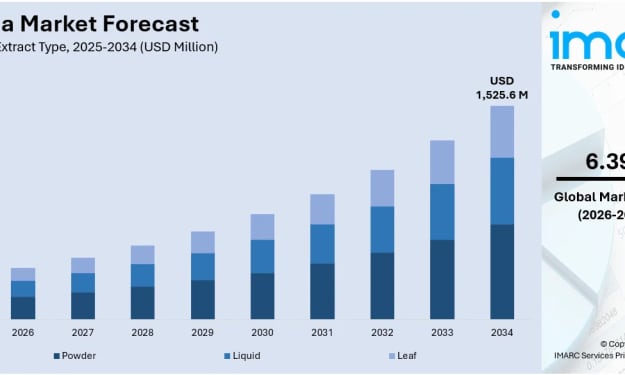
Rising health consciousness, busy lifestyles, and demand for natural alternatives are fueling stevia's momentum, supported by clean-label trends, innovation in taste profiles, and expanding distribution through retail and e-commerce channels. According to IMARC Group's latest data, the global stevia market was valued at USD 873.8 Million in 2025. Looking forward, IMARC Group estimates the market to reach USD 1,525.6 Million by 2034, exhibiting a CAGR of 6.39% from 2026-2034.
By Andrew Sullivanabout 19 hours ago in Futurism
Computer Vision Market Trends: Industrial Inspection, Quality Control & Forecast to 2034
Growing use of AI and deep learning across manufacturing, healthcare, retail, and autonomous systems is driving strong demand for computer vision solutions, backed by hardware improvements, edge computing expansion, and rising industrial automation. According to IMARC Group's latest data, the global computer vision market size was valued at USD 20.5 Billion in 2024. Looking forward, IMARC Group estimates the market to reach USD 34.3 Billion by 2033, exhibiting a CAGR of 5.9% during 2025-2033. Asia Pacific currently dominates the market, holding a significant market share of over 41.0% in 2024.
By Suhaira Yusufabout 14 hours ago in Futurism
Autocatalyst Industry in Saudi Arabia: Stricter Emission Norms, Automotive Production & Market Expansion
According to IMARC Group's latest research publication, Saudi Arabia autocatalyst market size reached USD 131.3 Million in 2025. The market is projected to reach USD 173.4 Million by 2034, exhibiting a growth rate of 3.14% during 2026-2034.
By Kishan Kumar6 days ago in Futurism



Comments
There are no comments for this story
Be the first to respond and start the conversation.