
Rocks from Mars and Bones from the Past: When a Dinosaur Outshined a Martian Treasure
A $5.3 million Martian meteorite made headlines, but it was a juvenile dinosaur skeleton that stole hearts and spotlight at the world's most unexpected auction.
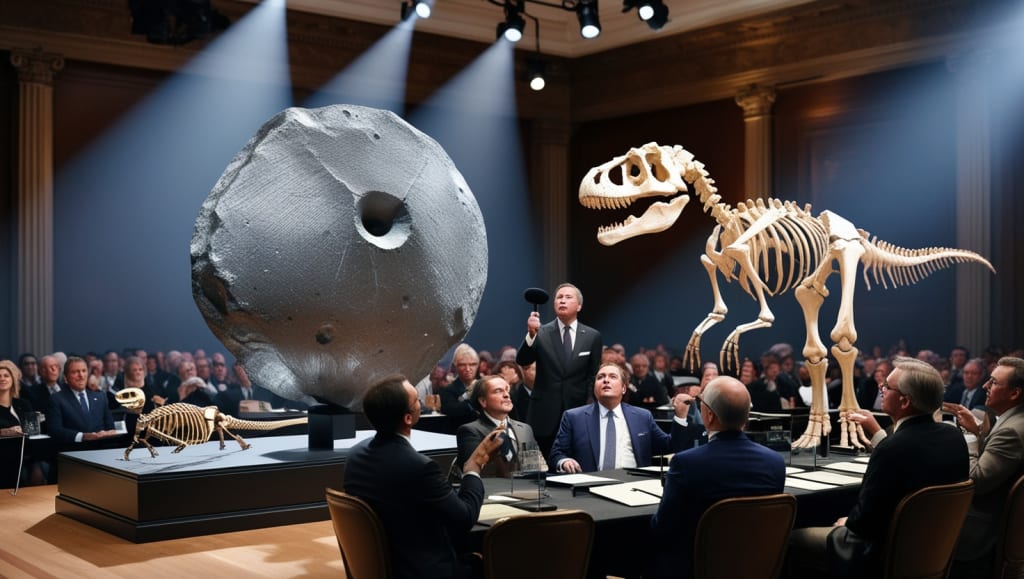
In a universe where wealthy individuals compete to reach Mars and researchers discover mysteries from Earth's distant history, a recent auction seemed to combine these two fascinations perfectly. The largest fragment of Mars ever located on our planet was auctioned off for an astonishing $5.3 million—yet, in an unexpected turn, it wasn't the main attraction.
Rather, the delicate remains of a young dinosaur took center stage. This juvenile fossil attracted less money but garnered far more interest and affection.
This event was anything but typical. It served as an extraordinary tribute to the wonders of time, science, and curiosity, all coming together in one opulent venue.
A Piece of the Red Planet
Known as Black Beauty, the Martian meteorite is more than just another rock found from space. With a weight of more than 32 pounds (14.5 kg), this meteorite is supposed to have been ejected from Mars millions of years ago as a result of an asteroid impact, eventually landing on our planet.
Discovered in the Sahara Desert, its unique nature is remarkable—Martian meteorites comprise only around 0.3% of all those on Earth.
Black Beauty is more than just a scientific specimen; it's a peek into a different world from the past with its deep black glossy surface and striking veins of olivine and pyroxene.
Auctioned for an astounding $5.3 million, it is hardly surprising.
Although Black Beauty was the most costly, another item also drew the attention of everyone in the room…
Enter the Young Star: A Dinosaur in the Spotlight
One side of the auction venue housed the partially finished fossil skeleton of a young theropod, an ancestor of the mighty T. rex.
At a height of more than six feet, this adolescent hunter stood around 75 million years ago during the late Cretaceous period. Expert think among them was the Gorgosaurus, a quick species related to the T. Rex noted for its strong teeth and big eyes.
But beyond its scientific worth, this fossil struck with intense emotional impact. A silent relic from a past age, the little, thin dinosaur was a small, fragile thing. Spectators said its delicate shape gave the impression it had merely rolled up for a rest and never moved again. This is more than a fossil; it's a youngster from a long-gone realm.
According to a paleontologist present, you may feel its past even before grasping the science.
When Science Meets Sentiment
Though the dinosaur wasn't as expensive as the Martian meteorite, which fetched nearly $2 million, it clearly captured many hearts. Rather than pictures of Black Beauty ruling social media, the show was hijacked by the minute specifics of the dinosaur's little claws, fossilized teeth, and beautifully preserved bones.
The auction was more than simply selling; it was about what actually appeals to us.
Mars is far-off, beautiful, and enigmatic. Conversely, the dinosaur resided in our country. It lived with us right here. Our old relationship may explain why we consider it so important.
Why People Are Fascinated by Space Rocks and Dinosaur Bones
There’s something deeply human about wanting to own a piece of the unknown.
Space rocks like Black Beauty give collectors a literal piece of another planet—an object that predates humanity, formed under alien skies. For scientists, they’re crucial for understanding planetary formation and ancient Martian environments. For collectors, they’re ultimate status symbols, rarer than diamonds or gold.
Dinosaur fossils, on the other hand, offer something different. They remind us of what once was. They bring history to life—quite literally—offering a peek into ecosystems that collapsed before our species ever arrived.
Together, these two artifacts—one from deep space, the other from deep time—represent our greatest obsessions: Where did we come from? And what else is out there?
A Deeper Question: Should These Be for Sale?
As stunning as the auction was, not everyone celebrated it.
Some scientists and museum curators expressed concern that important scientific specimens like these should remain in public institutions, not private vaults. When such rare items are bought by wealthy collectors, access to study them can become limited, slowing down scientific progress.
Dr. Alicia Monroe, a planetary geologist, voiced this worry: “Meteorites like Black Beauty can tell us about Martian history—how much of that story are we losing when it becomes a private asset?”
Similarly, paleontologists worry that rare fossils sold to the highest bidder might never be properly studied or displayed.
There’s a growing call for international regulations to ensure such specimens are at least documented, scanned, or digitally preserved before disappearing into private hands.
Conclusion: Awe Has Many Faces
Ultimately, the auction represented more than just a high-stakes affair for the affluent; it illustrated how science connects with our feelings.
The Martian meteorite, valued at $5.3 million, served as a reminder of the immense universe that remains to be discovered. Meanwhile, the young dinosaur highlighted the delicate beauty of life that once existed.
One object originated from a distant world, while the other hailed from a different time. Yet, both shared narratives that went beyond monetary value.
As we gaze at the stars or dig into the earth below us, it becomes clear that our most significant treasures are not merely stones or fossils. They are the tales they convey and the awe they evoke.
About the Creator
Keep reading
More stories from Shahjahan Kabir Khan and writers in Futurism and other communities.
The Future Is Born: Eight Babies, Three Parents, and One Scientific Breakthrough
In a scenario that seems lifted from a science fiction story set in the future, eight healthy infants have come into the world thanks to DNA contributions from a trio—two females and one male—utilizing an advanced IVF method. These are not artificially created super-babies nor are they clones; they are genuine, flourishing newborns made possible by mitochondrial donation, an innovative advancement that may revolutionize our methods for tackling infertility and genetic disorders.
By Shahjahan Kabir Khan6 months ago in Futurism
About Binding Prometheus
I want to start actively advocating on behalf of my own work, and the most valuable part of my canon is, without a doubt, Binding Prometheus, the play I have been working on since 2019 and only finished in 2023 as part of my MA. The play itself is an amalgamation of a million different inspirations. On one end, it evokes the Ancient Greek myth-play, deriving its own title from the earliest extant work of Western drama we have, Aeschylus’s Prometheus Bound. On the other end, it borrows significantly from the sci-fi bulwarks from over the years, namely Mary Shelley’s Frankenstein and Karel Capek’s Rossum’s Universal Robots. The play could be an episode of Black Mirror, I fear. I don’t know. I’ve only ever seen one episode of Black Mirror.
By Steven Christopher McKnight17 days ago in Futurism


Comments
There are no comments for this story
Be the first to respond and start the conversation.