
The Future Is Born: Eight Babies, Three Parents, and One Scientific Breakthrough
A controversial IVF technique just delivered eight healthy miracles—ushering in a new era of genetic medicine and ethical debate.
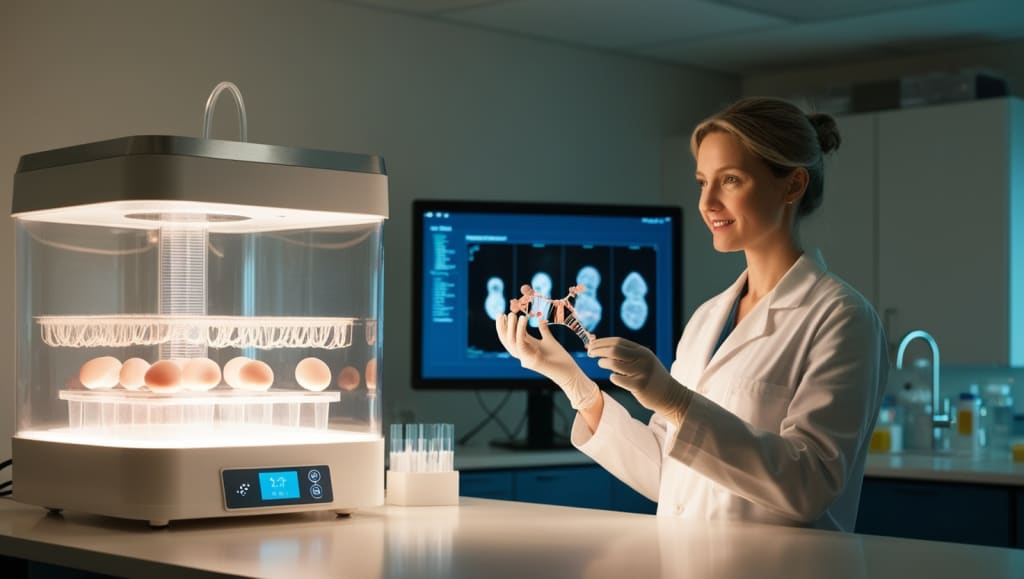
In a scenario that seems lifted from a science fiction story set in the future, eight healthy infants have come into the world thanks to DNA contributions from a trio—two females and one male—utilizing an advanced IVF method. These are not artificially created super-babies nor are they clones; they are genuine, flourishing newborns made possible by mitochondrial donation, an innovative advancement that may revolutionize our methods for tackling infertility and genetic disorders.
However, beneath the surface of this news is a intricate mix of optimism, morality, science, and debate. Let’s explore the details.
What Does "Three-Person DNA" Mean?
For most people, the idea of "three parents" seems strange. However, from a scientific viewpoint, it is actually more accurate than it appears.
In standard IVF, a mother’s egg and a father’s sperm are united. If a woman has defective mitochondria—small parts in cells responsible for energy production—there is a significant chance of passing severe genetic diseases to her children. Mitochondrial disorders can cause issues like muscular dystrophy, heart conditions, neurological problems, and even infant mortality.
To avoid this scenario, scientists have come up with a technique involving the removal of the nucleus (which holds most genetic information from both parents) from the mother’s egg and placing it into a donor egg that has healthy mitochondria. This new embryo now holds nuclear DNA from both the mother and father, along with mitochondrial DNA from the donor, resulting in DNA from three people.
What’s the outcome? Children who receive only a tiny fraction—less than 1%—of their DNA from the donor, sufficient to stop inherited illnesses.
A Quiet Revolution in Reproductive Medicine
For over ten years, the procedure known as mitochondrial replacement therapy (MRT) has generated debate. The first country to officially approve it in 2016 was the UK, following thorough scientific and ethical evaluations.
Only a few single cases had been documented thus far. Eight successful births recently, nevertheless, point to the increasingly widespread use of this method. This represents a shift beyond theoretical concepts; it is becoming real.
Dr. Kate Mitchell, a fertility expert engaged in one of the projects, called it “a cautious yet notable advance in the field of medicine.” She continued, “These are healthy infants from families who would have faced the risk of passing down severe, life-threatening conditions. Our target is to prevent suffering, not to produce luxury children.”
The Families Behind the Breakthrough
Not much information has come to light regarding the eight families, probably to safeguard their privacy and protect them from overwhelming media attention. However, it is known that these couples have suffered from heartbreaking losses, including miscarriages, stillbirths, or having children with serious conditions.
One mother, who wished to remain anonymous, expressed: “After losing two babies to mitochondrial disease, I never imagined I would attempt to try again. This procedure offered me hope that I thought I had lost for good.”
Now five months old, her son is thriving—healthy, joyful, and completely unaware of his significance in medical history.
Science Meets Ethics: The Ongoing Debate
Like any new area in medicine, MRT opens up a complex set of ethical questions.
Some critics believe that even minor changes to human embryos could lead to a dangerous trend in genetic enhancement. If we start with treating mitochondrial diseases today, what might we choose to modify next—eye color or intelligence?
Religious organizations and bioethicists caution that making even good-intentioned changes to DNA could lead to unexpected issues for future generations. Although the donor's genetic material represents a small part of the genome, it can be inherited, meaning these alterations could affect future offspring.
Proponents of MRT suggest that altering DNA is similar to organ donation; they believe that the priority should be on saving lives and reducing suffering as we navigate these advancements.
"Every significant progress in medicine—from organ transplants to in vitro fertilization—met resistance initially," stated Professor Elena Grant, a prominent bioethicist. "However, when our aim is to show compassion, we need to find a responsible way to move forward."
What Comes Next?
The arrival of these eight newborns signifies an important achievement, yet it is merely the start.
Nations such as the UK, Australia, and Japan are currently evaluating their regulations to possibly support wider implementation of MRT. On the other hand, the U.S. proceeds with caution, as the FDA continues to limit its application to clinical trials.
Supporters emphasize the need for enhanced education and openness. The underlying issue is straightforward: families desire healthy kids.
Through sustained monitoring, global cooperation, and ethical guidelines, mitochondrial donation could eventually be as common as IVF.
Conclusion: The Power of Possibility
In a world increasingly influenced by science, the arrival of eight healthy infants created from three-parent DNA transcends mere medical news; it is fundamentally a story about humanity.
This narrative highlights parents who maintain their belief in hope.
It showcases doctors who are advancing limits, not for recognition, but to support families.
Moreover, these babies, by their very existence, have transformed the dialogue about what can be achieved in contemporary medicine.
As we honor this achievement, we must also consider a crucial question: How can we ensure that innovation aligns with ethical standards? The solution may involve not only scientific discovery but also understanding the aspirations and concerns of those who gain from these remarkable developments in science.
Ultimately, life is not produced in a laboratory; it is shaped by the bravery to envision a brighter future.
About the Creator
Keep reading
More stories from Shahjahan Kabir Khan and writers in Futurism and other communities.
Musk vs. Cook: The Battle for the Future of Tech Just Got Personal
Introduction: Two Titans, One Throne For many years, Apple has held a strong position as the leader in consumer technology. Products like the iPhone and iPad have shaped the idea of “premium” in today's digital landscape under Tim Cook's direction. However, a new challenger has emerged: Elon Musk. He isn’t bringing a car or a rocket to this competition; instead, he introduces the Tesla Pi Tablet, a stylish device powered by AI that's making big waves in Silicon Valley.
By Shahjahan Kabir Khan8 months ago in Futurism
Battery Felts Market Report: USD 1889.4 Million by 2034 at 8.3% CAGR
Overview The Global Battery Felts Market is expected to be worth around USD 1,889.4 million by 2034, up from USD 851.2 million in 2024, and is projected to grow at a CAGR of 8.3% from 2025 to 2034. Battery felt is a specialized porous material, commonly made from carbon or graphite fibers, used in various battery technologies particularly redox flow batteries—to enhance electrical conductivity, electrolyte distribution, and overall battery efficiency.
By Hayden Kulas3 days ago in Futurism
Why I'm Scared of AI — And I Work in Tech
Let me say something that doesn't get said enough in tech circles: I am genuinely scared of where AI is heading. I don't mean this in a dramatic, Hollywood-robot-apocalypse sense. This is not a dramatic, Hollywood-robot-apocalypse kind of fear, but rather a quiet, 3 am, staring-at-the-ceiling kind of fear.
By Bethel Nwabuike5 days ago in Futurism


Comments
There are no comments for this story
Be the first to respond and start the conversation.