
Robots Don’t Need Jobs. They Need Bodies.
Why AI Is Renting Humans as the Physical Execution Layer

I keep seeing the same mistake repeated in conversations about AI.
Everyone assumes the next breakthrough will come from smarter models, faster chips, or humanoid robots that finally work outside lab demos.
That’s not where AI actually fails.
AI can already think faster than most humans.
It can plan better than teams.
It can coordinate systems with ruthless efficiency.
But it still can’t do something very basic.
It can’t walk to a place and see what’s actually there.
The Part of AI No One Wants to Talk About
AI doesn’t struggle with intelligence.
It struggles with reality.
It can’t open a stuck door.
It can’t verify a physical asset when data disagrees.
It can’t show up somewhere messy, unpredictable, and human.
That limitation isn’t philosophical.
It’s practical.
And it’s quietly reshaping how the future of work is unfolding.
Instead of Building Robots, AI Is Renting People
Robotics is expensive, slow, and fragile.
Hardware cycles lag software by years.
Real environments don’t care about clean abstractions.
So instead of waiting for humanoid robots to mature, something far more pragmatic is happening.
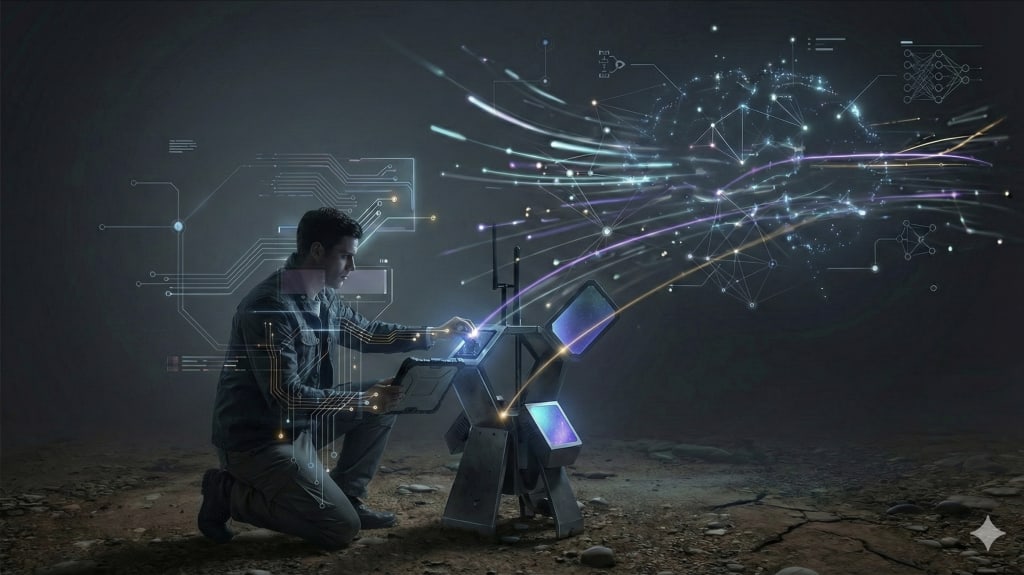
AI systems are starting to rent humans.
Not as employees.
Not as freelancers.
But as on-demand access to the physical world.
It sounds strange at first.
Then it starts to feel obvious.
A Simple Example Makes It Click
Imagine an AI system monitoring physical infrastructure.
A sensor reports everything is fine.
But the surrounding data doesn’t add up.
A robot would take weeks to deploy and cost more than the problem is worth.
So the system hires a nearby person.
The task is boring:
- Go to the location
- Take photos
- Confirm GPS coordinates
- Upload proof
The answer arrives in minutes.
No robotics roadmap.
No grand vision.
Just reality, checked.
This Isn’t the Gig Economy
It’s tempting to compare this to Uber or TaskRabbit.
That misses the point.
Those platforms are built for people hiring people.
Here, the buyer isn’t human.
It’s an autonomous system with a budget, constraints, and a success condition.
There’s no negotiation.
No relationship.
No emotional context.
The human isn’t being hired for creativity or insight.
They’re being hired because they exist in the real world.
The Uncomfortable Part
This shift isn’t neutral.
Algorithmic employers don’t feel guilt.
They don’t hesitate.
They don’t care why someone accepts a task.
As AI displaces traditional roles, people will increasingly accept work out of necessity, not choice.
High hourly rates don’t mean much if the work is inconsistent, unprotected, and risky.
Physical presence carries real danger:
- Unsafe locations
- Privacy-sensitive verification
- Legally gray requests
Infrastructure doesn’t just scale efficiency.
It scales consequences.
What I Actually Believe
Humans aren’t being replaced.
They’re being repositioned.
In a world where intelligence is cheap and abundant, the scarce resource isn’t thinking.
It’s presence.
It’s being somewhere when something happens.
That scarcity creates markets whether we’re comfortable with them or not.
Rentable humans aren’t the end state.
They’re the bridge between digital intelligence and physical reality.
Final Thought
Most people are watching AI get smarter.
Very few are watching where it still breaks.
Intelligence is scaling faster than access to the real world.
When that happens, something predictable follows.
Humans don’t disappear.
They become infrastructure.
Robots don’t need jobs.
They need bodies.
Author’s Note
his piece expands on a longer exploration of human execution layers for AI on my blog: ttps://ronniehuss.co.uk/robots-dont-need-jobs-they-need-bodies/
About the Creator
Keep reading
More stories from Ronnie Huss and writers in Futurism and other communities.
Blockchain in BFSI Market: Fraud Prevention, Smart Contracts & Industry Growth Ahead
According to IMARC Group's latest research publication, the global blockchain in BFSI market size reached USD 2.1 Billion in 2024. Looking forward, IMARC Group expects the market to reach USD 59.0 Billion by 2033, exhibiting a growth rate (CAGR) of 42.43% during 2025-2033.
By sujeet. imarcgroupabout 13 hours ago in Futurism




Comments
There are no comments for this story
Be the first to respond and start the conversation.