
Revolutionizing Context in AI: How the Model Context Protocol is Changing the Game
Model Context Protocol

AI is no longer just about powerful models or larger datasets—it’s about understanding context. In the race to build smarter, more responsive, and safer AI systems, one breakthrough is standing out: the Model Context Protocol (MCP).
This protocol isn’t just another behind-the-scenes tool—it’s redefining how AI systems communicate, think, and act. From personalized digital assistants to complex agent-based ecosystems, MCP is fast becoming the contextual backbone of the AI revolution.
If you are in tech—whether you are coding, designing, or strategizing—this is the shift you need to be paying attention to. Here's why MCP is the upgrade the AI world didn't know it needed… until now.
The Context Problem in AI
Let’s face it: most AI systems today suffer from a short memory. You ask a question, get an answer—and that’s it. No understanding of what came before, what you care about, or what tools are available to assist you. Even advanced large language models (LLMs) operate like goldfish without persistent or structured context.
But real intelligence—human-like intelligence—relies heavily on context.
Context gives AI the ability to:
• Personalize responses.
• Make consistent decisions over time.
• Understand user preferences and constraints.
• Manage goals across multiple interactions.
Without it, AI agents remain reactive, disconnected, and ultimately frustrating.
Enter the Model Context Protocol
The Model Context Protocol (MCP) solves this problem by introducing a structured, standardized way to pass, persist, and interpret context between AI models, tools, and users.
In simpler terms? MCP gives your AI a brain upgrade. Instead of treating each prompt as a clean slate, models can now receive rich context—including user roles, preferences, goals, tools at their disposal, and memory from previous interactions.
MCP is like giving your AI assistant not just a memory, but an operating manual for how to behave, what to prioritize, and how to adapt in real time.
Why MCP Is a Game-Changer
Let’s break down exactly what makes MCP such a big deal.
1. It Gives AI Systems Memory and Purpose
MCP allows developers to define the current goals, past interactions, and system constraints in a structured format. This means AI doesn’t just respond—it responds with intent and continuity.
Example: Imagine a customer support agent that remembers your unresolved issues, preferences, and even your preferred tone of communication. That’s MCP in action.
2. Enables Agent Collaboration
Modern AI is moving toward multi-agent systems—teams of bots working together to solve complex tasks. But coordinating between agents is tricky if each one has its own isolated context.
MCP creates a shared context space where each agent knows:
• Its role in the system.
• What other agents are doing.
• What tools and data are available.
• What the overall goal is.
This turns a group of disjointed bots into a cohesive, collaborative team.
3. Supports Open and Interoperable AI
MCP is model-agnostic and open. Whether you are using GPT, Claude, or an open-source LLM like Mistral, MCP plays well with all of them. That’s huge for developers who want modularity and flexibility in their AI stack.
You can build once and adapt quickly—switching models, tools, or agents without rewriting your entire pipeline.
4. Boosts Safety and Control
With AI safety under the microscope, MCP offers a way to build transparent and controllable systems.
You can:
• Set ethical constraints.
• Define acceptable behavior.
• Limit tool access by agent.
• Create audit logs of contextual decision-making.
MCP doesn't just make AI smarter—it makes it more accountable.
5. Delivers Next-Level Personalization
The future of AI is deeply personalized experiences. MCP enables systems to remember who the user is, what they care about, and how they like to engage.
A health chatbot, for example, can maintain knowledge about your dietary preferences, fitness goals, and medical history without starting over every time.
This isn’t just better UX—it’s radically better AI.
Inside the Model Context Protocol
So, how does MCP work under the hood?
It’s based on a rich JSON schema that includes fields for:
• User and agent roles (who is talking and why).
• Goals and sub-goals (what the model is trying to accomplish).
• Environment state (what tools, data, and APIs are available).
• Memory references (past conversations or knowledge to retain).
• Tool definitions (what actions the model can trigger).
This structure acts like a universal blueprint for context—clear to both machines and developers.
Here’s the best part: MCP is extensible. You can evolve it with your system, adding new capabilities, goals, and roles as your AI grows more complex.
Real-World Applications Already Using MCP
This isn’t theoretical. MCP is already powering the next wave of intelligent systems. Here’s where it’s making an impact:
• Autonomous Coding Assistants: Think AI engineers that not only write code but debug, refactor, and remember project context across tasks.
• Enterprise Chatbots: Bots that understand a user’s history, team structure, and access rights to provide meaningful, secure support.
• AI Research Agents: Assistants that persist knowledge across papers, synthesize results, and cite sources with full contextual awareness.
• Smart Scheduling Tools: Systems that factor in user habits, time zone conflicts, team dynamics, and preferences to optimize calendars.
Each of these examples benefits from the depth, structure, and consistency MCP brings to the table.
Why Tech Leaders Are Paying Attention
If you are building anything AI-powered, ignoring MCP is a risk.
As models get smarter and tasks get more complex, context becomes the differentiator. Those who leverage MCP early will build more capable, safer, and user-friendly systems—and they’ll be better positioned for what's coming next in the AI arms race.
MCP gives you:
• Better user experiences.
• More maintainable systems.
• Increased safety and compliance.
• Faster iteration across models and platforms.
That’s not just a technical edge—it’s a strategic one.
Final Thoughts
We are entering a new era in AI—one where intelligence isn’t just about raw power but contextual understanding. The Model Context Protocol is at the heart of this shift, offering developers a toolset to create systems that are aware, adaptive, and aligned with real human needs.
If you're building the future, MCP needs to be on your radar. Because the next generation of AI won't just respond to prompts—it will understand the moment.
And the ones who master that moment? They will be the ones leading the revolution.
About the Creator
About Binding Prometheus
I want to start actively advocating on behalf of my own work, and the most valuable part of my canon is, without a doubt, Binding Prometheus, the play I have been working on since 2019 and only finished in 2023 as part of my MA. The play itself is an amalgamation of a million different inspirations. On one end, it evokes the Ancient Greek myth-play, deriving its own title from the earliest extant work of Western drama we have, Aeschylus’s Prometheus Bound. On the other end, it borrows significantly from the sci-fi bulwarks from over the years, namely Mary Shelley’s Frankenstein and Karel Capek’s Rossum’s Universal Robots. The play could be an episode of Black Mirror, I fear. I don’t know. I’ve only ever seen one episode of Black Mirror.
By Steven Christopher McKnight26 days ago in Futurism
Advanced Analytics Market: Predictive Insights, Big Data Adoption & Industry Trends
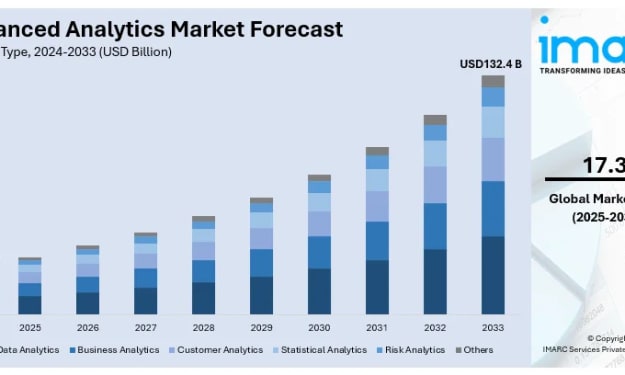
Rapid digital transformation, exponential data generation, cloud adoption, AI and machine learning integration, and rising demand for real-time, data-driven decision-making are accelerating advanced analytics adoption across industries. According to IMARC Group's latest research publication, global advanced analytics market size reached USD 26.9 Billion in 2024. Looking forward, IMARC Group expects the market to reach USD 132.4 Billion by 2033, exhibiting a growth rate (CAGR) of 17.3% during 2025-2033.
By Andrew Sullivan6 days ago in Futurism
Autonomy Is The Real Privilege
Good morning, freedom-seekers! Today we’re gonna be looking at autonomy. A strange word, I know; one many would probably look at blankly and run away from on sight. We’re gonna figure out what it actually means, consider how it’s achieved, and decipher just how deeply most of us are tangled up in dependence without realising it.
By That ‘Freedom’ Guy7 days ago in Humans



Comments
There are no comments for this story
Be the first to respond and start the conversation.