
Revisiting the Alien Saga, Part 2
Prequels and Predators

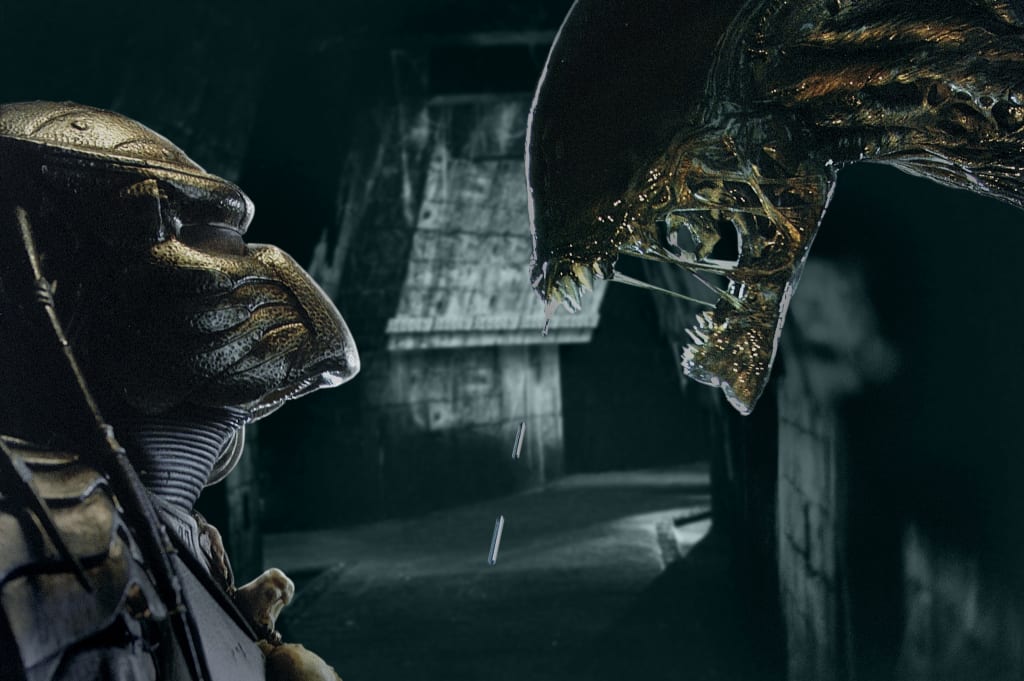
Crossovers, prequels, and wringing the last drop of blood from every bankable IP are now the dominant approaches in big budget cinema. Twenty years ago, the Alien series was already old enough and established enough to warrant its own relaunch, crossing over with another franchise famed for vicious, alien killing machines. This started a run of Alien prequel films, which would eventually lead us to all kinds of strange destinations.

Alien vs Predator
2004 – Paul W. S. Anderson
Setting: Bouvetøya, South Atlantic, 2004
Moviegoers first got a glimpse of the possibility of this crossover in 1990's Predator 2, which famously included an elongated xenomorph skull amongst the Predator's hunting trophies, seeding fan enthusiasm. (Oddly enough, the appearance of a preserved chestburster examined by Colin Baker in a 1986 episode of Doctor Who didn't spark as much excitement.)
The crossover already existed by this point, though, with the Aliens vs Predator comic series that began in 1989, leading to video games and novels throughout the nineties. After some time in development hell, the movie crossover materialised. While the original plan for a direct adaptation of the comics was scrapped, Alien vs Predator is still a comicbook movie, through and through. Approached like that, it's really not bad – an all-out monsterfest blessed with more intelligence than we might have feared from such a crossover.
Paul Anderson was born to make comicbook and video game movies, and brings exactly the right level of deference and defiance to the source material. Basing the action in the frozen wastes of an Antarctic island, and beneath it in an endlessly shifting, Lovecraftian temple, provides a setting and visual style new to both franchises. While Anderson's script leans heavily on the already cliched “ancient astronauts” nonsense of Erich von Daniken, it does give the events greater weight, integrating both species into the history of humanity. It works well as a sequel to the first two Predator films and a prequel to the Alien saga. While many fans were unhappy that humans meet the Alien while still on Earth, this actually sticks closely to established continuity. After all, there's only one survivor, and one woman's story of a close encounter is hardly likely to be common knowledge for a bunch of space truckers over a century later.

The first role cast for the film was Lance Henriksen as Charles Bishop Weyland, founder of what would become the vast conglomerate that would one day endanger the Nostromo, and seemingly the physical template of the Bishop androids. It's a nice touch, and Henriksen plays the part with more class than the film demands. His makes the dying billionaire likeable, but it's still easy to feel angry with him as he endangers lives and instigates the entire crisis in an attempt to write himself a place in the history books. It's easy to see the callous Company learn from his example as it expands.
Sanaa Lathan is pretty good as Lex Woods, the experienced and cautious guide who eventually capitulates and leads the expedition. Again, we have an intelligent woman who continually warns against the dangers of ignoring protocol, and ends up as the sole survivor. Lex is no Ripley, though, and Lathan just doesn't have the same presence as Weaver, to whom she was always going to be compared. She does manage to pull off Lex's stand-off with the Predator nicknamed Scar and their bonding as hunting partners, even though this happens too quickly to have much impact. This element survives all the way from the earliest drafts, reflecting a similar team-up in the AvP comics and novels. (The “Predalien” revealed at the very end is also lifted straight from the comics.) Raoul Bova and Ewen Bremner are among the best of the cast as Professor de Rosa and Dr. Graeme Miller, archaeologist and scientist respectively.
It takes a little while to get going, but once it does, there's lots of fighting, lots of aliens, lots of deaths and a surprising amount of falling down holes. AvP was the first film in either franchise to be rated PG-13 in the States and 15 in the UK, being aimed at a more teenager-heavy audience than the films leading up to it, but it still packs a punch and has a few genuinely nasty moments. Altogether, it's a fun movie, and it works as an instalment in the ongoing story of this expanding fictional universe. Of course, Prometheus would later contradict and overwrite everything established here, but for a time, this was the prologue of the Alien story.

Aliens vs Predator: Requiem
2007 – The Brothers (Greg and Colin) Strause
Setting: Gunnison, Colorado, 2004
This, on the other hand, is a car crash. After AVP's success, a sequel was inevitable, but this is straight-to-video tosh with a grossly inflated budget. The basic concept is actually pretty decent: a Predator specialist performs a clean-up operation when the their quarry break containment. Unfortunately, the idea is undercut by the idiotic decision to make it a generic monster movie set in small town America. Inhospitable and unfathomable environments are as much a character in the Alien movies as the aliens themselves. The much-anticipated “Aliens on Earth” story is immediately at a disadvantage because of this. AvP works because, even on Earth, it's set in an alien environment (we'll have to wait and see how Noah Hawley's Alien: Earth fares). Just sticking the creatures in South Idiotsville doesn't wash.
There's a big cast here, everyone is given time to show what they can do, and... well, the best you can say is that they're competent. The best of the bunch is Reiko Aylesworth as soldier-on-leave Kelly, who at least brings some charisma to her role. As for the rest, well, it's not like they were given much to work with. They phone it in, but who can blame them, with this script? Shane Salerno stuffs the script with every hackneyed movie line imaginable, and it's frankly hard to give a damn about any of the characters.

The big sell is the Predalian, and it does work. The design takes the silliness of the concept precisely as seriously as it should giving us a big, green bastard with all the best bits of both the Alien and the Predator, dreds and all. The Strauses were hired largely on their effects experience, being the founders of their own VFX company Hydraulx, but in fairness this isn't badly directed. There's nothing particularly innovative here, but it's decent enough. The effects are pretty decent, and commendably, the brothers use physical, in-camera work wherever possible. Unfortunately, some of the most eventful scenes are so poorly lit it's hard to actually see any of this.
They also bring it back to the R-rated horror both franchises are known for, but, much like the atomic bomb drop that ends the film, it's overkill. The film takes the pregnancy-invoking horror of the previous films, and decide that the next step is to have an alien that implants eggs directly into the bodies of pregnant women. Yes, this is a gruesome horror franchise, but this oversteps the mark. I don't really want to watch pregnant women and little kids being ripped apart. This is shoved into a story that's somehow both predictable and incoherent. A real bugbear: why does the Predator, who is going to such care to remove all evidence of extraterrestrial contamination, still skin and display his human victims, drawing attention to what he's doing?
Finally, the film tries to tie back to the previous instalment, with the usual faceless special agents presenting the Predator's gun to Ms. Yutani, linking in the other half of the upcoming evil Company. By this point, not only have several survivors of the infestation have escaped to tell their tale, there's been a tactical nuclear strike on a US population centre. This isn't the sort of thing that goes unnoticed, and the idea of these film being a prequel to the main series is out the window. Altogether, this is a cynical, nasty, fundamentally pointless film, and easily the worst entry in either franchise.

Prometheus
2012 – Ridley Scott
Setting: Scotland, 2089; UCSS Prometheus and LV-223, 2093
Meanwhile, Ridley Scott and James Cameron had begun working together on a fifth Alien film, which was intended to act as a prequel to the original. This was pushed aside when Fox focused on the crossovers, but after AVPR crashed and burned, Scott came back to the idea. Jon Spaihts wrote an initial script which would have led directly to the events of Alien, but Scott pulled away from this idea, rewriting the script with Damon Lindelof into a more loosely connected story set in the same universe.
Prometheus is a decent enough sci-fi horror film, but one that's ultimately frustrating for many reasons. The biggest issue is that Scott couldn't seem to decide if he actually wanted this to be a prequel to Alien or not. This is, in many ways, Scott's Aliens, his own follow-up to his original masterpiece, populated by multiple extraterrestrial monsters. Unlike Cameron's sequel, however, the creatures living on LV-223 are new to us. Exploring other locations and deadly ecosystems within the same universe is an excellent idea, but it's impossible to escape how almost everything here is a less effective version of something in Alien.

The evocative Space Jockey, a barely comprehensible being with an elephantine face and a semi-insectoid exoskeleton, turns out to be one of the Engineers, who are revealed as a bunch of massive white men in really weird spacesuits. The squid-monster that gestates in Shaw and goes on to impregnate the last Engineer (bafflingly named as a trilobite in behind-the-scenes material) is an inflated facehugger/chestburster combo. And finally, of course, it ends with the birth of a xenomorph, similar but not as effective as the original Alien, yet apparently unconnected.
More oddly, after Scott's vocal disdain for the Alien vs Predator and its erasure from continuity by Prometheus, it has the same story at its core: in the 21st century, the ageing founder of the Weyland Corporation tries to secure his place in the history books by sending an archaeological expedition to find some alien astronauts that came to Earth in prehistory, but gets himself and all but the female lead killed.
It's a pity, because there's so much here that works. The combination of expansive sets, breathtaking location filming, sophisticated practical effects and complex CGI presents a visually stunning world. The cast are excellent, with the exception of the dreadfully miscast Guy Pearce as the elderly Peter Weyland. Noomi Rapace is a wonderful lead, bringing the thoughtful yet passionate Elizabeth Shaw to life as a compelling hero, and entirely different to Ripley. Logan Marshall-Green is charismatic as her reckless partner Charlie Holloway, although the two actors do lack chemistry. Charlize Theron is as good as she always is, but is limited by her clichéd ice queen, “daddy never loved me” character. Idris Elba make the pragmatic Captain Janek a believable character, in spite of the odd accent choice. Scott Harris and Rafe Spall make a good double act, while Benedict Wong and Kate Dickie are sorely underused.
It's Michael Fassbender who steals is, though, as the calculating, ambitious, Peter O'Toole-obsessed android David 8. He's the fourth droid in the franchise, and Fassbender gives the best performance of them all, being utterly convincing as a being who is almost human. It's impossible to guess what he's thinking behind his calm gaze and icily polite manner. Focusing the story so heavily on the android is the best move in the script, not only illuminating more of this side of the franchise's overall story, but tying together the theme of generational creation of life. As the Engineers apparently created humanity, and Weyland went on to create David in our image, he then goes on to create new life of his own. Shaw is caught up in all of this, a religious scientist who is cursed by the knowledge of her creators, and forced to become the mother of the next generation of life form. (We're back to pregnancy horror again, in its most straightforward yet unsettling form. I was told by the women I saw the film with on first release that “It's not exactly a traditional pregnancy,” is by far the most terrifying line.)

Unfortunately, for all its mythic themes and grand ambitions, the script falls down when it comes to logic. We're expected to believe that a team of people would agree to a four year trip in cryosleep with no idea where they're going or why. Spall's Milburn is a biologist who thinks it's a good idea to poke an unknown alien life form. The most frustrating element is the Engineer's tinned primordial soup, the most versatile black alien oil since the one on The X-Files. This stuff can do anything: create life on Earth; get an infertile woman pregnant with a squid; or turn Fifield into a rampaging zombie-mutant, a transformation that actually makes him slightly more likeable. The life cycle of the original Alien was complex, but feasible; this lot are just chaotic, a stream-of-consciousness run of unpleasantness. Still, even with all that, this could have been an effective prequel to Alien, or an intriguing new science fiction epic, but it fails trying to be both.

Alien: Covenant
2017 – Ridley Scott
Setting: USCSS Covenant and “Planet 4,” 2104
It's an unpopular opinion, but I genuinely think Covenant is a better film than Prometheus. The second in what Scott intended to be at least a trilogy of prequel films, Alien: Covenant is at least honest about what it is. There's no more coyness about whether this is an Alien film; aside from being right there in the title, this film embraces the xenomorph and accepts that's what everyone's here to see. It also continues the story of David 8, building on his status as the first true artificial person and bringing in the next generation of androids. It positions itself as a prequel to Alien, a sequel to Prometheus, and an important bridge in the development of this future history. It manages all those jobs quite well, but like its predecessor, has its frustrations.
Katherine Waterston is a strong lead as Katherine Daniels, the chief terraformer, and therefore arguably the most important crewmember on the Covenant, being as it is a colony ship on a mission to terraform and settle a planet. In grand Alien tradition, the captain and remainder of the crew refuse to listen to her when a radio signal leads them to a clearly too-good-to-be-true alternative planet. Daniels is a character very much in the same vein as Shaw, right down to the immolated husband. While she takes Shaw's place as the female lead and focal scientist, it's Oram, unexpectedly made captain after the opening disaster that befalls the ship, who takes Shaw's position as the religious believer. Billy Crudup is also very good as Oram, not unlikeable but somehow infuriating, showing how clearly overpromoted the man is, and making you wonder just how he manages to survive so long on the planet.
Whereas Shaw balanced her faith with her scientific outlook, Oram's clouds his judgment. He's not the only one who lacks good judgment, though. After the debacle with the Prometheus crew, you've got to wonder who recruits these people, or if they get any training at all. Once again, the main characters make some baffling decisions that repeatedly put them in incredible danger. While some are understandably due to personal feelings overcoming professionalism, who thought it was a good idea to people this ship solely with married couples if none of them were capable of putting the safety of the ship and the remaining humans in cryosleep first?
Still, Daniels and Oram could have had some fascinating conversations with Shaw, had Scott, and his scriptwriters John Logan and Dante Harper, not decided to kill her off between films. It's not as soulcrushing as killing Newt and Hicks, but it's still a brutal and questionable choice for the direct follow-up. Rapace does appear in a brief short film (Covenant, like Prometheus, being preceded by several promos), making her exclusion from the main event stranger still.

Once again, though, this is Fassbender's film, on double duty as both second-gen android Walter One and the now quite insane David (named, of course, for the two original writers of Alien). His dual performance is exceptionally good, from the distinctive accents used to distinguish the two droids, to the subtle differences in body language and expression. The two versions have a deeply strange relationship that is both brotherly, antagonistic, and homoerotic. There's a fascinating story between them, with the objectively more advanced Walter being, in David's words, “more like a machine,” with less autonomy and emotional capability. He is, however, the moral superior to David, who has more imagination, creativity and passion, yet also hubris, vanity and cruelty. He really is the more human of the two.
Danny McBride does what he can with what he's given as nice guy Tennessee, Jussie Smollet and Cassie Hernandez, as Ricks and Upworth are mainly there to provide exposition while looking hot. (Intriguingly, none of the married couple share last names, this perhaps having fallen out of practice by the 22nd century.) The rest of the cast are decent enough, but none of them survive long enough to make a huge impression.
Covenant really doesn't waste time killing characters off in as many brutal ways as possible, rivalling AVP: Requiem for the goriest entry into the franchise (until Romulus came along and stole the crown for good). After killing off a bunch before the main cast even wake up, the script takes the rest to the nameless planet and proceeds to tear them apart in both familiar and new ways. The initial infection, making its way into two lunkheads by way of spores, calls back to the earliest iterations of Alien 3. What comes next is a new version of larval alien, the so-called bloodburster, that violently erupts through any surface or orifice it can find. It rapidly matures into the Neomorph, a sleek, albino variation on the classic Alien form. I really like this creature; its design and life cycle are different enough to the original while also being recognisably part of the same lineage to callback without being simply derivative.
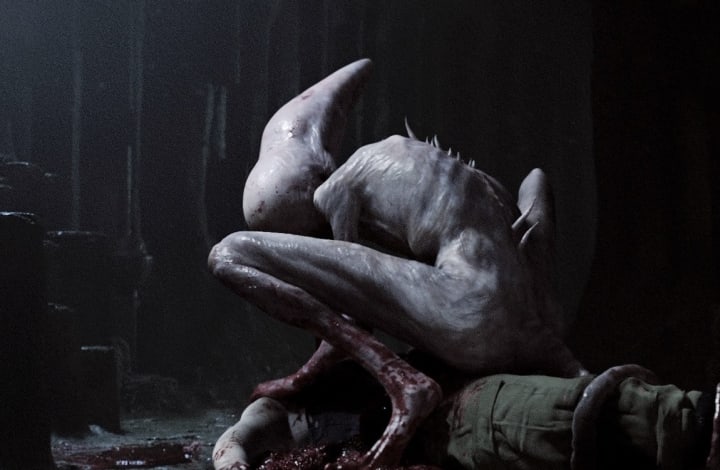
While the film gives us plenty of monsters and violent horror early on, it isn't until the final act that the classic creature finally arrives. Well, more or less; the Protomorph still appears to be an early draft of the original Alien, not quite the terrifying finished product. For good or for ill, there's no skulking in shadows anymore; these new variants are fast and relentless.
While individual elements of the film work well, sometimes brilliantly, the film never quite gels, and I think it's due to its place in the overall saga. It follows Prometheus but kills off its focus – not only Shaw, but apparently the entire Engineer civilisation. It looks to be leading to Alien itself, but doesn't quite fit. It's never quite clear whether David really did create the species that the Company will pursue for the next 75 years, or whether he's working to recreate something that already existed. The latter would fit better with what's seen in Alien, where an Engineer seemingly crashed carrying a cargo of eggs thousands, if not millions, of years ago.
Frankly, I don't think the Alien needs an origin story, and the franchise has since started to move away from the idea of David as creator. A disappointing performance by Covenant meant that a third instalment was never made, with questions remaining unanswered. While this makes the Prometheus-Covenant story as a whole more frustrating, I feel it's better in the long run, and Covenant itself is more effective with its chilling open ending. (Even if the “wrong android” twist is painfully predictable.)
Scott was prepared for a third, possibly fourth, and maybe even up to a sixth prequel, reports wavering between the next one leading directly into Alien or a whole franchise being squeezed in. Some interviews with Scott suggested that the focus would shift from the aliens to David and the growing population of androids, a route that could genuinely allow the overall franchise to expand without relying on the same creature features. Alongside Scott's plan, Neill Blomkamp became the frontrunner for a new direction in the series, with Sigourney Weaver reportedly back for an “Alien 5” which would follow Aliens, overwriting Alien 3 and Resurrection. This project was seemingly greenlit and cancelled more than once, before the eventual buyout of 20th Century Fox by Disney scuppered it completely. It would be another seven-year gap before Fede Alvarez's Alien: Romulus arrived.
About the Creator
Daniel Tessier
I'm a terrible geek living in sunny Brighton on the Sussex coast in England. I enjoy writing about TV, comics, movies, LGBTQ issues and science.
Keep reading
More stories from Daniel Tessier and writers in Futurism and other communities.
Revisiting the Alien Saga, Part 1
Alien: Romulus has hit cinemas at last, while I wait for a chance to see it, I've decided to rewatch and re-assess every film in the saga. Yes, that includes the Alien vs Predator crossover movies. Is this a treat or a gruelling endurance test? Well, a bit of both. Settle down for the first part of this extraterrestrial overview, as I revisit the first four films, telling the life, death and rebirth of Ellen Ripley.
By Daniel Tessier2 years ago in Futurism
Voice Over LTE (VoLTE) Market Outlook: 4G Network Expansion and Enhanced Communication Growth Opportunities
According to IMARC Group's latest research publication, The global voice over LTE (VoLTE) market size reached USD 23.2 Billion in 2024. Looking forward, IMARC Group expects the market to reach USD 919.8 Billion by 2033, exhibiting a growth rate (CAGR) of 50.5% during 2025-2033.
By Michael Richard6 days ago in Futurism
Flower Bloom 369
FLOWER Bloom 2/25/26 Wednesday By Mariann Carroll Karen had been with Tony for 7 years. Tony started acting strangely after her surgery. He would mow the lawn in the rain and be on his cellphone. He started pushing Karen away. Tony came clean about seeing someone. Karen moved out two months later. Karen moved in with a friend. She felt betrayed.
By Mariann Carroll3 days ago in Fiction




Comments
There are no comments for this story
Be the first to respond and start the conversation.