
Revisiting the Alien Saga, Part 1
From Birth to Resurrection


Alien: Romulus has hit cinemas at last, while I wait for a chance to see it, I've decided to rewatch and re-assess every film in the saga. Yes, that includes the Alien vs Predator crossover movies. Is this a treat or a gruelling endurance test? Well, a bit of both. Settle down for the first part of this extraterrestrial overview, as I revisit the first four films, telling the life, death and rebirth of Ellen Ripley.

Alien
1979 – Ridley Scott
Setting: USCSS Nostromo and LV-426, 2112
It goes without saying, of course, that this is a masterpiece. Alien was a landmark in science fiction and horror cinema, influencing forty-five years' worth of media, and this long shadow is why there are eight more films and counting. In a rare instance of multiple writers actually making a script better, Ronald Shusett helped O'Bannon fine-tune the story, with David Giler and Walter Hill of Brandywine Productions then making their own, sweeping changes,including the addition of the android Ash. Their combined approaches came together as a tight, evocative chiller.
However, it's the design and direction that made Alien the enduring classic it is rightly seen as. Bringing on Ridley Scott, an award-winning but little known director and set-designer with only one film under his belt (1977's The Duellist), was a fantastic gamble. The true visionary, of course, was H. R. Giger, whose horrific sexualised artwork inspired both O'Bannon and Scott. Recruited to design the Alien in its many life stages, as well as the mysterious, gigantic Space Jockey and its bizarre environment on LV-426, Giger worked with Scott to create the most original and memorable monster in cinema history. Of course, all of this would have been wasted if not for the work of Bolaji Badejo, the 6' 10'' Yoruba who proved that a man in a monster suit can be truly terrifying.

What really sets Alien apart from both its contemporaries and modern sequels is how real it all is. The practical effects are literally visceral, incorporating real blood, meat and bone. The Nostromo looks beaten-up and lived-in. The characters are people, not action heroes. Sigourney Weaver rightly became a household name for her resolute performance as Ellen Ripley, a practical, determined and entirely believable heroine, light years away from horror cinema's usual final girls. She is just one of a crew of blue-collar workers and jobbing professionals, who just happen to work in space. If you were to watch this not knowing the story at all, you'd likely think that John Hurt's Kane, Ian Holm's Ash and Tom Skerritt's Captain Dallas were the main protagonists. It's only gradually that Ripley becomes the centre of the story, and its only survivor. Except the cat, of course.

Something that really stands out, especially compared to today's films, is just how restrained Alien is. The plot moves at a glacial pace; the dialogue is functional; there's remarkably little gore after the initial, legendary chestburster scene; and the adult Alien itself is barely glimpsed until the final, climactic moments. It's a carefully crafted film, taking things slowly and then throwing in terrifying surprises at exactly the right moment. It remains one of the most disquieting films in sci-fi history, with a story that is very powerfully about male rape fears and distrust of pregnancy. Again, it takes the traditional female role in a horror movie and inverts it, leaving the men to be violated while Ripley escapes. It's a pity, although understandable for pacing reasons, that the scene where Dallas is being slowly converted into eggs was cut from the theatrical release, as this only adds to the theme. Add to this the ever-present evil of “the company,” our first brush with the megalithic Weyland-Yutani, personified by Holm's chilling and ruthless Ash, and you have an almost equally threatening villain to complement the brutal monster. It's never been bettered, although one film came close.

Aliens
1986 – James Cameron
Setting: USS Sulaco and LV-426, 2179
Aliens is an almost perfect sequel. Conceptually, it's so simple. It takes the most successful and inventive new monster of modern cinema, and asks: what if there were lots of them?
With Aliens, Cameron managed to create something that was as powerful and effective as the original, but in a wholly different way. Working from story suggestions by Hill and Giler, Cameron constructed a surprisingly elegant script for such a brutal film. Ripley's narrow escape from the Alien and the Nostromo becomes a curse, leaving her drifting in stasis for 57 years, finally awoken to discover that literally all that's left of her life is the alien threat and the damned Company. Aliens is even more critical of the drive of capitalism than its predecessor; there, Weyland-Yutani was a faceless threat, operating through the proxy of Ash. Here, Paul Reiser's oily Carter Burke is present every step of the way, manipulating Ripley and unashamedly dismissing human lives.
I find most military jocks in film to be painfully annoying, but the marines in Aliens, thanks to some strong writing and impeccable casting, are fun to be around, even at their most obnoxious. Bill Paxton stands out, of course, for his iconic performance as the panicky Hudson, while Jenette Goldstein is, in spite of the weird racelift, perfect as Vasquez. Cameron's decision to bring Michael Biehn back after their success together with The Terminator pays dividends. His performance as Hicks holds much of the film together, giving Ripley someone equal to play off. Lance Henriksen's Bishop is one of cinema's best androids (sorry, artificial person), subtly inhuman but likeable and compassionate.

The script develops logically and thematically from that of Alien. The obvious question is answered: what laid those eggs? The original Alien's disturbing life cycle was based on that of a solitary, parasitoid wasp; Aliens extrapolates that further into an insect-like hive. The creatures themselves are redesigned to make them gnarlier, and now overwhelm the troops with speed and numbers, while the Queen, once she's revealed, is almost ludicrously over-the-top. This should spoil the original Alien's unique design, but in the all-or-nothing context of this film, it works. While it's at it, the script drops in the term xenomorph, which was immediately leapt on by fans as a proper name for our monsters, in spite of being, and being used in the script, as an equally generic term as “alien.”
Meanwhile, Ripley undergoes a remarkable character evolution, from the tough but frightened final girl to being both an action hero and surrogate mother. The inverted pregnancy horror of the first film is replaced by an overriding theme of motherhood. Newt loses her entire family to the Queen's drive to breed, only for Ripley to take her as her own. Later, Ripley annihilates the Queen's offspring, spurring her furious attack. It's a shame that the brief appearance of Weaver's mother, Elizabeth Inglis, as Ripley's elderly and now deceased daughter was cut, as this would have worked to strengthen this further.

It's perhaps Weaver's best performance as Ripley, helped by the chemistry she shares with Biehn and Carrie Henn. It's a pity Henn chose not to act again after this; she is perfectly cast as Newt, giving a natural and real performance, so much so that it's hard to believe this was her first, and indeed only, role. Whether you prefer the first or second film is largely down to personal taste. I dislike the gun fetishism of Aliens (something Weaver also disapproved of), and I prefer the slow burn horror of the original to the all-out action here. Still, it's inarguable that Aliens is one of the best sci-fi action films ever produced.

Alien 3
1992 – David Fincher
Setting: Fiorina-161, 2179
The third film in the franchise is, notoriously, where it all starts to go downhill. Even by the standards of Alien films, which have never had the easiest route to the screen, Alien 3 had a troubled development. There were a huge number of rejected and cancelled scripts, all of which had promise, and a long parade of directors attached at different times. Cyberpunk pioneer William Gibson's script, based on a rough outline by Giler and Hill, was an interesting take (the audioplay adaptation, available from Audible, is well worth a listen). Director Vincent Ward's concept, of a monastic society inhabiting a wooden planetoid, is genuinely fascinating. Hill and Giler eventually took elements of several treatments to create a working script, settling on a desolate prison planet whose violent convicts have adapted into a sort of religious order, with Ripley becoming both the only outsider and only woman.
Fox made the risky decision to hire David Fincher, a music video director with, at the time, no cinema experience at all. Fincher's subsequent career speaks for itself, but this was a huge gamble on what was, by now, a major property. Fincher made his own amendments to the script, giving us the version filmed, but even this was brutally cut down in editing.
The result is a deeply flawed, very dark film which, nonetheless, has a lot to recommend it. Fincher may have disowned the work, but his direction is genuinely effective, making the prison colony feel huge yet horribly claustrophobic. Disquieting lighting and Elliot Goldenthal's oppressive score add to the atmosphere. There are some great performances here from the largely British cast: Brian Glover, as Warden Andrews, gets to do something more than act the heavy for once; Charles Dance brings a much-needed gravitas to the part of disgraced surgeon Dr. Clemens; and Danny Webb, as Morse, is just solidly entertaining throughout.

However, the film criminally wastes the talents of such actors as Paul McGann, Pete Postlethwaite and Phil Davis. Weaver and Charles S. Dutton, the latter as the spiritual leader Dillon, do what they can but are handicapped by some shockingly poor dialogue. Henriksen is good in his dual role as the almost-destroyed Bishop and Company representative, also called Bishop, although its never entirely clear if he really is the human model for the line or just another droid. The effects are, somehow, less impressive than those of the previous two decades, and the entire film looks cheap. The single biggest issue is the opening sequence. Killing off Newt and Hicks is a kick in the teeth to those who cheered their escape in Aliens, immediately souring this film and losing audience goodwill.
What does work is the alien itself. Hatching this time from a dog (or an ox, in the superior Assembly Cut version), the Dragon or Runner variant is an effective take on the creature. Even more animalistic, the Runner was brought to life by a mixture of puppetry and a remarkable physical performance by Tom Woodruff Jr, who also worked on the make-up and effects. Returning to a single alien might seem like a backwards step after the second film, but anything grander wouldn't work in this setting. The Runner stands in for its entire species here, in the final stand-off against Ripley. With Ripley herself impregnated with the Runner's baby brother, her story comes to its inevitable conclusion. Weaver only agreed to return if her character would be killed at the end, and her final sacrifice is a fitting end to her story; as, for all its flaws, is Alien 3.
It wouldn't last, though.
Alien Resurrection
1997 - Jean-Pierre Jeunet
Setting: USM Auriga, 2379
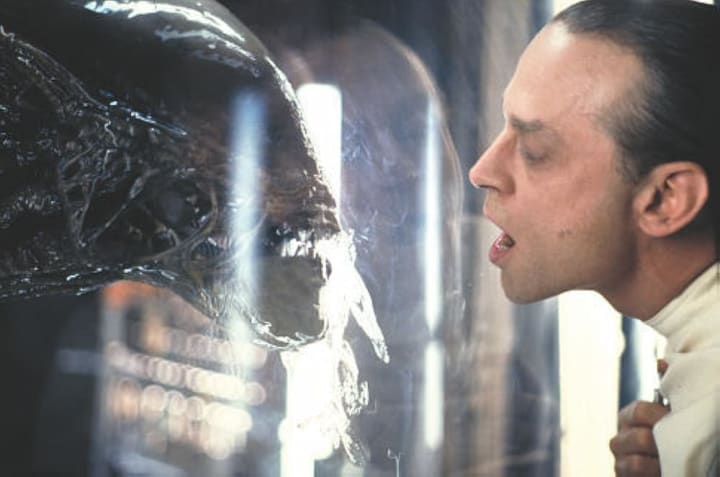
There was no need for a fourth movie, but after three successful films it was inevitable. Alien Resurrection is not a good film, not by a long chalk. It is, however, a fun film, if you approach it as a bit of popcorn, and frankly, that's needed after the unending nihilism of Alien 3. It's certainly a long way from the thoughtful science-horror of the original. Gone is the realism; no one in this film talks like a real person. This is not unexpected, in a script by Joss Whedon, but his usual wit and flair deserted him for this, with some truly painful dialogue. It's a tremendously over-the-top film, with a swarm of aliens, an omnipresent Queen, a weird new mutant version, choreographed action and excessive gunplay. After the remarkable restraint of the earlier films, Resurrection ups the gore, throwing in as many revolting deaths as possible.
The central concept is genuinely good, and you can understand why Weaver decided to come back for this after all. Two centuries after her death, the military has cloned Ripley, recreating her with the alien embryo in her belly, with the alien's knack of horizontal gene transfer creating hybridised versions of both. (This is sci-fi cloning, which bears only a passing resemblance to the real science.) The original Ripley is still dead, and she has the opportunity to play an entirely new version of the character, retaining the original's memories but combined with a bizarre, predatory instinct. Weaver excels at this new, hybridised version, giving an unsettling yet charismatic performance, and is clearly having fun.

Most of the new cast give solid performances with the uninspiring material. Ron Perlman and Brad Dourif are always good value. Winona Ryder makes the next-gen synthetic Call a loveable character who completes the evolution of the machines from emotionless villains to compassionate heroes who are better people than their human forebears. (The uprising and subsequent recall of the new “autons” sounds like a much more interesting film than the one we actually got.) There are some glaring exceptions, though, particularly Dan Hedaya as General Perez, who seems to be under the impression that the film is a comedy. (I mean, he's not entirely wrong there, but still.)
By 1997, CGI was fast becoming the primary monster-making method, but it's not overused here. Indeed, where it is, it stands up, with the underwater sequences being especially impressive. Jean-Pierre Jeunet, a spectacularly left-field choice of director fresh off Amelie, brings some interesting choices to the film, but never gets as weird as you'd hope. The most effective scene in the film is undoubtedly Ripley's discovery of her abandoned failed clones, a truly haunting sequence that horrifies far more than any amount of chest-bursting gore.

Tying Resurrection into the ongoing story is the continued theme of motherhood. Ripley refers to herself as the aliens' mother, sharing an affinity with them, while the Queen enters a new stage of its life cycle, developing a womb and giving birth like a human: slowly and painfully. The new, half-human, half-alien creature, known as Newborn, latches onto Ripley as its true mother, only to be betrayed by her as she instead chooses Call as her latest surrogate daughter. Unfortunately, the Newborn is quite the most hideous design to have made it to the franchise; albeit with a sorrow and patheticness to its appearance that makes the viewer feel sorry for it, even as it rips everything apart. We must be grateful that Jeunet rethought his decision to give the creature enormous, malformed genitals and had them digitally painted out.
While there are elements that work and some interesting concepts at play, Resurrection is a mess, with a reliance on frenetic violence to cover up largely incoherent storytelling. The planned fifth film, which would have brought the aliens to 24th century Earth, never materialised. Their arrival there was bound to happen of course, as the franchise completed its transformation into pure popcorn with Alien vs Predator.
About the Creator
Daniel Tessier
I'm a terrible geek living in sunny Brighton on the Sussex coast in England. I enjoy writing about TV, comics, movies, LGBTQ issues and science.
Keep reading
More stories from Daniel Tessier and writers in Futurism and other communities.
Review: The Orville 3-5 - "A Tale of Two Topas"
The Orville: New Horizons continues to deliver relevant surprising and important stories in its revitalised third season. The five episodes released so far have, on the whole, been excellent. After the powerful season opener, “Electric Sheep,” “Shadow Realms” built on the Krill-Union storyline while delivering an effective sci-fi horror story. Episode four, “Gently Falling Rain,” was a thriller with spectacular visuals, strong action and some genuinely touching moments. Further developing the Krill storyline, it commented on political popularism, while briefly taking a swipe at the abortion debate and religious extremism on the whole. Only the third episode, the throwaway “Mortality Paradox,” failed to really make an impact; obvious filler that isn't really about anything.
By Daniel Tessier4 years ago in Futurism
AI Hurtles Ahead: Investor Memo Says the Last Three Months Changed Everything
The author says he originally explored the “AI bubble” question in a December memo, Is It a Bubble? After speaking with technologists in their 30s and 40s, he returned to them for an update. One of them suggested a simple test: ask Claude, Anthropic’s AI model, to produce a tutorial explaining AI and what has changed in the last three months. The result, he writes, was astonishing — a 10,000-word, personalized curriculum that felt less like an encyclopedia entry and more like “a personal note from a friend or colleague.”
By Behind the Techa day ago in Futurism
GCC E-Pharmacy Industry Analysis: Market Size, Key Players & Future Growth Prospects
According to IMARC Group's latest research publication, global GCC e-pharmacy market size reached USD 2.37 Million in 2024. Looking forward, IMARC Group expects the market to reach USD 9.44 Million by 2033, exhibiting a growth rate (CAGR) of 15.4% during 2025-2033.
By Abhay Rajput5 days ago in Futurism



Comments
There are no comments for this story
Be the first to respond and start the conversation.