
Review of 'Dune: Prophecy' 1.3-1.4
The Voice and the Ambience
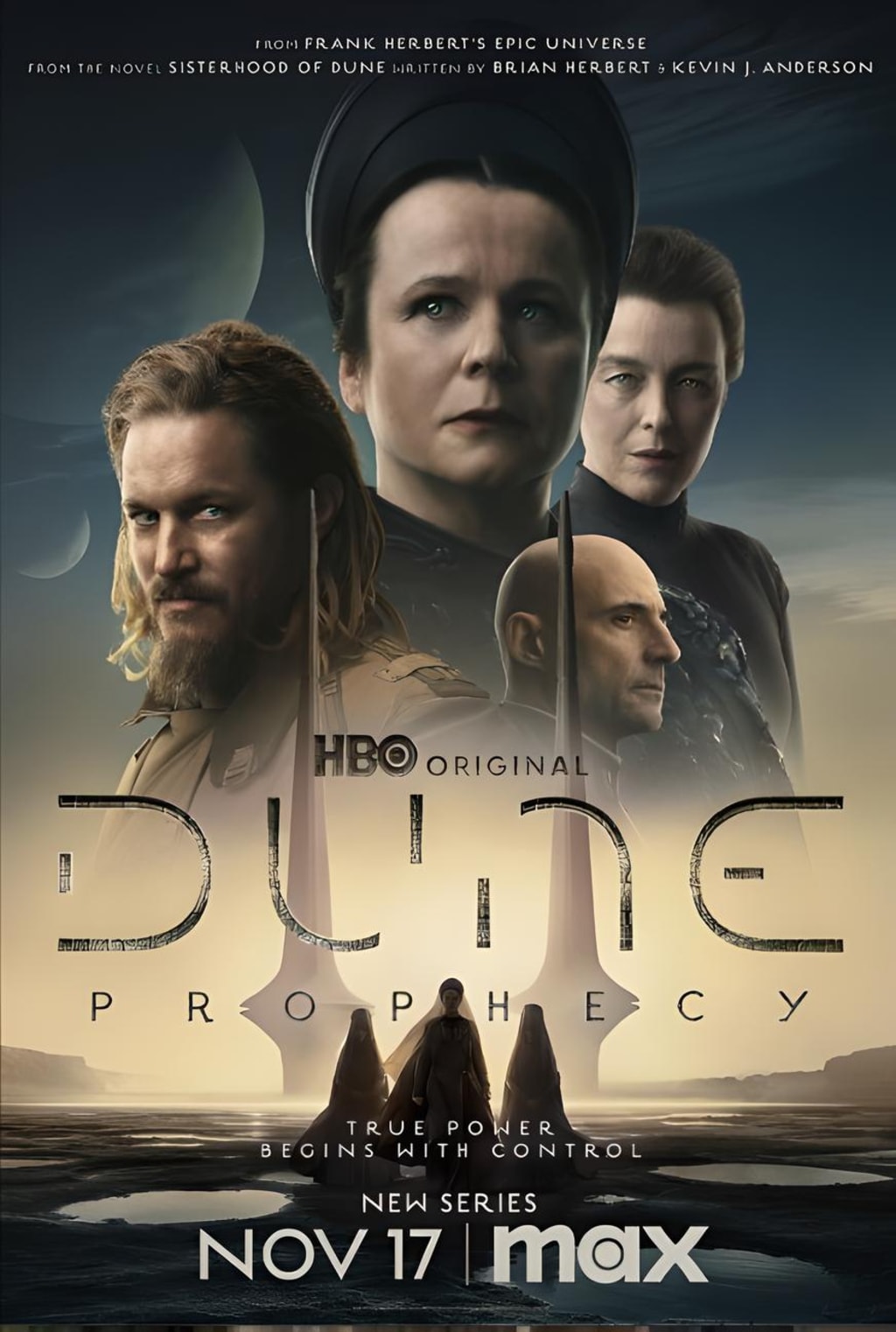
Lots of dramas on TV give us flashbacks to the earlier lives of current characters, to give us a sense of who they are and their motives, but Dune: Prophecy is doing that better than most, and in episode 1.3 devotes most of an entire episode to the younger Valya and Tula sisters, at the time Reverend Mother Raquella, the first Reverend Mother and founder of the Bene Gesserit, was still alive and very much in charge.
[Spoilers ahead ... ]
And this makes what Valya was able to do with her Voice -- stop Reverend Mother Raquella in her tracks -- and not do to Desmond Hart last week -- get Desmond to follow her order, given in Voice, to slit his own throat -- all the more impressive. If the Bene Gesserit are the heroes in this story, and Desmond Hart the villain -- both vying for control of humanity -- it makes the outcome of their confrontation all the more difficult to predict. Valya's Voice stops Raquella and kills Dorotea, but has little effect on Hart. (Of course, since this is a prequel to the Dune saga we already know, we already know the general outcome of this struggle. But it will still be fun to see exactly how it all plays out, and what seeds it sows for all future stories in Dune.)
The other big part of this excellent episode is young Tula, who makes a habit of doing more than expected. She kills Orry Atreides -- after they make love and he proposes to her -- to avenge the death of her beloved brother by the Atreides, because she loves her family more than the man she just made love to. And in the future -- the present in our overall narrative -- she defies the Bene Gesserit policy and keeps Sister Lila alive by some forbidden means. Although both Harkonnen sisters are very complex and therefore interesting characters, I think I find Tula a little more so. I guess I'm a sucker for defiance and going your own way. In a way, that difference between the two sisters reflects differences in the overall Sisterhood, and that's probably part of its strength.
***
We learn a lot in every episode of Dune: Prophecy. Before I tell what specifically I learned in episode 1.4, let me begin with an overall ambience I realized I was experiencing when I was watching this episode the other night: there's something about the pacing, the cinematography, the dialogue, the acting, I don't know, about Dune: Prophecy that makes me feel I'm in the original Frank Herbert Dune novel and its Dune Messiah sequel. More so, much more so, than the original David Lynch movie, and the more recent efforts by Denis Villeneuve. I haven't read the Sisterhood of Dune prequel by Kevin J. Anderson and Brian Herbert that is the basis of Dune: Prophecy and of this authenticity feeling I have about it -- whether it's in the Sisterhood of Dune, or just in Dune: Prophecy, or in both -- so I don't know who deserves credit and thanks for this. I guess like the Dune saga itself, it's real and powerful, but its specific contours are blurry (cool, in Marshall McLuhan's sense), and it maybe, likely, adds to the charm of this narrative on HBO Max, or even is responsible for it.
Now on to some more specific things I learned in episode 1.4:
- It's confirmed that Desmond's fearsome ability to burn people from the inside out can indeed extend across the galaxy -- it's the case that Kasha's burning at the same time as Pruet was not somehow a reflection of Pruwet's burning. He and Kasha were both burned by Desmond at the same time.
- Desmond's power to burn people extends to more than two at a time.
- A single Bene Gesserit is so far no match (for want of a better word) for a one-on-one with Desmond. It will likely take some sort of group of Bene Gesserit to do him in.
What other powers does Desmond possess? Is he responsible for Lila's awakening? Also, as I said above, I'm liking Tula more than Valya. I'm also beginning to think that Tula not Valya may be the one to bring Desmond down (if anyone can do that). There is something about Valya that is too ... obvious. She and her wiles are easier to spot than Tula's. We'll see.
And I'll be back here soon with my review of the subsequent episodes.
More books about McLuhan and the media at Connected Editions
About the Creator
Paul Levinson
Novels The Silk Code, The Plot To Save Socrates, It's Real Life: An Alternate History of The Beatles; LPs Twice Upon A Rhyme & Welcome Up; nonfiction The Soft Edge & Digital McLuhan, translated into 15 languages. Prof, Fordham Univ.
Keep reading
More stories from Paul Levinson and writers in Futurism and other communities.
Your Face is Getting a Major Upgrade: 5 Game-Changing Features Coming to Meta Ray-Ban Display
When the $800 Meta Ray-Ban Display glasses hit the market in October, they felt like a prop pulled straight from a high-budget sci-fi thriller. For the early adopters who secured a pair, the experience of a heads-up display (HUD) glowing within their field of vision was nothing short of exhilarating. However, as with many first-generation devices, the initial thrill was tempered by a lingering sense that we were wearing a high-tech prototype—one that excelled at snapping photos and answering voice queries but remained largely tethered to a static, limited framework.
By Tech Horizonsa day ago in Futurism
Australia Pro AV Market: Hybrid Work Demand, Digital Signage & Smart AV Technologies
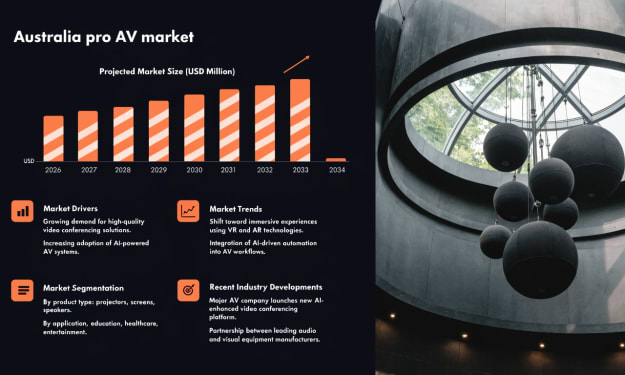
According to IMARC Group, the Australia pro AV market reached a value of USD 93.9 Million in 2025 and is projected to reach USD 133.6 Million by 2034, growing at a compound annual growth rate (CAGR) of 3.88% during 2026–2034. The market is expanding as organizations increasingly adopt advanced audiovisual solutions to support communication, collaboration and digital engagement. Hybrid work environments are encouraging businesses to invest in video conferencing systems, smart displays and integrated collaboration platforms that connect remote and in-office teams. At the same time, industries such as retail, hospitality and tourism are investing in digital signage to improve customer engagement and brand communication. As companies focus on creating interactive and technology-driven environments, professional AV solutions are becoming essential tools for modern workplaces, entertainment venues and commercial spaces across Australia.
By Kevin Cooper7 days ago in Futurism
My First Time Skiing and I Got Lost, Alone, in the French Alps
Looking back, I can trace some of my life’s biggest adventures to a simple action from my sister. She’d introduced me to Tommy (a very long time ago), a colleague of hers, who had overshared his penchant for Italian-looking women, and I ticked that box.
By Chantal Christie Weiss3 days ago in Humans


Comments (1)
Oh dude, it's nice.