
Radio Astronomy Driving New Competencies and Innovation
New Way of Observing Astronomy


Radio astronomy involves studying celestial objects at radio frequencies. It’s a more favored approach to observational astronomy because the amplitude and phase of radio waves are relatively easier to measure than that of photons or light waves. Radio astronomy is conducted through radio telescopes using techniques like radio interferometry and aperture synthesis.
While gathering information about the stars and galaxies, and the rest of the universe, radio astronomy is driving new competencies and innovations, such as:
Low-Frequency Radio Array (LOFAR)
The world’s largest and most sensitive radio telescope, developed by ASTRON, now spans Europe, from Ireland to Poland, after a new antenna station was built in Latvia. LOFAR observing is currently accessible to all scientists from around the world. There are currently 52 antenna stations in eight countries in Europe. As compared to classical dish telescopes, LOFAR makes use of a large network infrastructure that has the ability to handle extremely large data volumes. Its long-term archive has a capacity of 40 petabytes of astronomical data. Moreover, LOFAR telescopes operate at 10–240 MHz, enabling scientists to do impactful things like explore high-energy cosmic rays or observe the skies for rare phenomena.
Development in Africa with Radio Astronomy (DARA)
DARA is a Newton Fund project launched in 2014. Together with their partner organizations, DARA involves training local students in radio astronomy. The goal is to share technical and commercial expertise to inspire students to contribute to the growth of the economy and pass their knowledge and skills to the next generations. To operate and develop radio telescopes, astronomy enthusiasts should have a deep knowledge of physics, mathematics, chemistry, and computing.
DARA also has importance in transferring radio astronomy skills in computing areas, including healthcare, food security, and sustainable agriculture, according to Goonhilly – an industry partner for DARA.
Phased Array Feed (PAF)
Another innovation in the field of radio astronomy is the development of a newer version of the unconventional radio-astronomy instrument called Phased Array Feed (PAF). This instrument enables multiple views of astronomical objects with unparalleled efficiency. The new Phased Array Feed design resembles tree-like antennas. When mounted on a single-dish radio telescope, it combines signals from 19 dipole antennas that resemble a miniature umbrella without a covering. This new technology serves as a multipurpose tool for exploring the universe and a virtual multi-pixel camera. The instrument is highly beneficial in many aspects of astronomical research, including the study of hydrogen gas in the galaxy as well as in the search of enigmatic Fast Radio Bursts.
Atacama Large Millimeter/Submillimeter Array (ALMA)
Another leap in the astronomical field is ALMA. Since its creation in 2014, it changed the business of astronomy forever. ALMA has 66 antennas that spread a maximum distance of 16 kilometers and has 10 times more resolution than the Hubble Space Telescope.
Other Technological Innovations from Radio Astronomy
Radio astronomy has led to a greater understanding of physical processes in the universe, which in turn became a catalyst for basic and applied research in other fields.
For instance, radio astronomy has significantly contributed to the development of other technologies like microwave antennas, receiving systems, data analysis, and visualization methods. It was also utilized in fields like navigation, computer processing technology, and time and frequency standards.
911 Call Locations
The integration of radio astronomy interferometry techniques helped find locations of 911 callers with an accuracy of 500 feet. Another radio astronomy application is in a commercial system that can locate faulty transmitters interfering with the operation of communication satellites.
Time and Frequency Standards
Radio astronomy also has an indispensable role in the Time and Frequency Standards. For thousands of years, scientists rely on the earth’s rotation served as the fundamental clock in which all timekeeping was synchronized. However, since the earth’s rotation is variable, there has been a gradual migration of time standards to atomic time. Precise navigation requires an extremely accurate connection between the Earth’s rotation rate and atomic time. And a key element to this is the use of VLBI (Radio astronomers developed very long baseline interferometry) – a technology developed by radio astronomers to achieve a resolution of celestial objects that is a hundred times better and clearer than the Hubble Space Telescope.
GPS
The GPS satellite system, which is used by almost everyone – from astronomers and pilots to motorists, hikers, and everyone else – is another technological innovation triggered by radio astronomy. Each GPS satellite includes four atomic clocks to send precise time information to GPS navigation systems. GPS is extensively used even in digital marketing. For instance, all-in-one marketing platforms like Adrack utilize this technology to gather data from consumers, such as their location. The information obtained by GPS is very useful for marketers in planning for search engine optimization, social media marketing, and other online marketing campaigns.
Medical & Scientific Applications
The use of radio signals is the basis for medical imaging technologies like the tomography of human tissues. Such image processing, which involves the use of a technique uses for analyzing seismic data is currently utilized to address problems of blurred images of non-astronomical objects, such as in the sharpening of images in forensic analysis.
Grid Computing Applications
One of the fascinating applications of radio astronomy is the Searches for Extraterrestrial Intelligence (SETI). This technology required a vast amount of computing capacity, which then led to a unique grid computing concept that is currently used in a wide range of applications.
About the Creator
Michael Jacobs
Author
Michael is a marketing and creative content specialist at GotVape.com with a primary focus on customer satisfaction. Technology and fitness combined with healthy lifestyle obsession are his main talking points
Keep reading
More stories from Michael Jacobs and writers in Futurism and other communities.
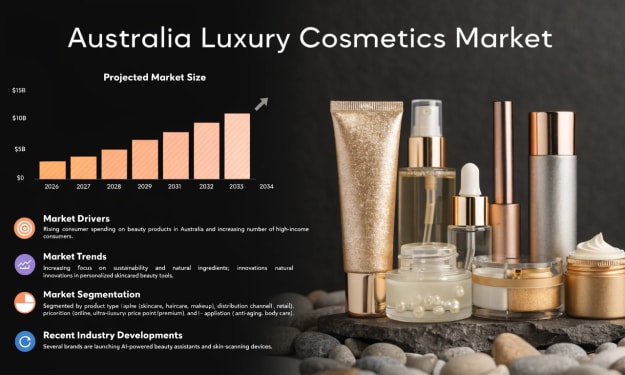
Australia Luxury Cosmetics Market: Premium Demand, Retail Expansion & Brand Innovation
According to IMARC Group, the Australia luxury cosmetics market reached USD 1.6 Billion in 2025 and is projected to grow to USD 2.3 Billion by 2034, exhibiting a compound annual growth rate (CAGR) of 3.92% during 2026–2034. The steady expansion of the market reflects rising disposable incomes, evolving beauty standards, and a growing preference for premium personal care products across Australia. Consumers are increasingly investing in high-end skincare, makeup, and fragrance products that promise quality, performance, and exclusivity. With digital influence reshaping purchasing decisions and sustainability becoming central to brand identity, the Australia luxury cosmetics market share continues to expand within the broader beauty and personal care industry.
By Shrestha Roy7 days ago in Futurism
Bomb Scare
It was 2027, and the world never thought it would happen. A missle hit the United States, but it wasn't where they had anticipated. A little town in the northeast was hit by a missile strike, they didn't know why, and they didn't know exactly where it hit, but they did know it was a coastal community, somewhere between Maine and Delaware.
By Gregory Payton4 days ago in Fiction



Comments
There are no comments for this story
Be the first to respond and start the conversation.