
Quantum Mechanics: Unveiling the Subatomic Realm
DIVE INTO THE INTERESTING TOPICS OF QUANTUM MECHANICS

Introduction
Quantum mechanics, often dubbed the “weird science,” governs the behavior of particles at the tiniest scales. From electrons dancing around atomic nuclei to the mind-bending concept of superposition, let’s unravel the mysteries of this captivating field.
1. Wave-Particle Duality
At the heart of quantum mechanics lies the wave-particle duality. Imagine a photon—a particle of light. Sometimes it behaves like a wave, spreading out and interfering with itself. Other times, it acts as a discrete particle, striking a detector. This dual nature challenges our classical intuitions.
2. Heisenberg’s Uncertainty Principle
Werner Heisenberg famously stated that we can’t simultaneously know a particle’s position and momentum with absolute precision. The more accurately we measure one, the less we know about the other. This inherent uncertainty is fundamental to quantum reality.
3. Quantum States and Superposition
Particles exist in quantum states described by wavefunctions. These states can overlap, creating superposition. Imagine Schrödinger’s cat—a hypothetical feline simultaneously alive and dead until observed. Superposition defies classical logic but is essential for quantum computing.
4. Entanglement
Einstein called it “spooky action at a distance.” When two particles become entangled, their properties become linked—even if separated by vast distances. Change one particle’s state, and the other instantly responds. Entanglement fuels quantum communication and teleportation experiments.
5. Quantum Computing
Traditional computers use bits (0s and 1s). Quantum computers leverage qubits, which can exist in superposition. This promises exponential speedup for certain problems—like factoring large numbers or simulating quantum systems.
Quantum mechanics is a fundamental theory in physics that describes the behavior of nature at and below the scale of atoms1. Here are some key points:
Wave-Particle Duality: Quantum mechanics explains how extremely small objects, such as photons and electrons, simultaneously exhibit both particle-like and wave-like behavior2. This duality challenges our classical intuition.
Quantization: Quantum systems have quantized properties (e.g., energy, momentum, angular momentum) that can only take specific discrete values. Classical physics allows continuous measurements, but quantum mechanics introduces quantization.
Uncertainty Principle: There are limits to how accurately we can predict a physical quantity (like position or momentum) prior to measurement. The uncertainty principle states that certain pairs of properties cannot be precisely known simultaneously.
Wave Functions: In quantum mechanics, a mathematical entity called the wave function provides information about a particle’s properties. It gives probability amplitudes for measurements of energy, momentum, and other physical quantities.
Historical Development: Quantum mechanics emerged from early attempts to explain phenomena that classical physics couldn’t account for. Pioneers like Niels Bohr, Erwin Schrödinger, and Werner Heisenberg contributed to its development in the mid-1920s.
Schrödinger Equation: This fundamental equation describes how the wave function of a quantum system evolves over time. It’s analogous to Newton’s second law in classical mechanics but applies to wave functions.
Quantum States and Observables: A quantum state represents the complete information about a system. Observables (like position, energy, or spin) correspond to measurable properties. When we measure an observable, the wave function collapses to an eigenstate of that observable.
Quantum Entanglement: One of the most intriguing aspects of quantum mechanics is entanglement. When two particles become entangled, their states become correlated, even if they’re far apart. Changes in one particle instantaneously affect the other, defying classical intuition.
Quantum Superposition: Quantum systems can exist in superpositions, where they simultaneously occupy multiple states. For example, an electron can be in a superposition of spin-up and spin-down states until measured.
Quantum Tunneling: Quantum particles can “tunnel” through energy barriers that classical particles couldn’t overcome. This phenomenon plays a crucial role in phenomena like nuclear fusion in stars and scanning tunneling microscopy.
Remember, quantum mechanics challenges our everyday understanding of reality, but it’s also the foundation for technologies like transistors, lasers, and quantum computers. If you have more specific questions, feel free to ask! 😊
Conclusion
Quantum mechanics challenges our classical worldview. It invites us to embrace uncertainty, explore parallel realities, and marvel at the interconnectedness of the universe. As we peer into the subatomic abyss, we find wonder, complexity, and the promise of technological revolutions.
About the Creator
Keep reading
More stories from daniel aggrey and writers in Futurism and other communities.
Upsetting Transportation: The Ascent of Electric Vehicles and Independent Vehicles
The fate of transportation is quickly developing with the appearance of electric vehicles and independent vehicles. This article dives into the mechanical progressions and cultural ramifications of these developments.
By daniel aggrey2 years ago in Futurism
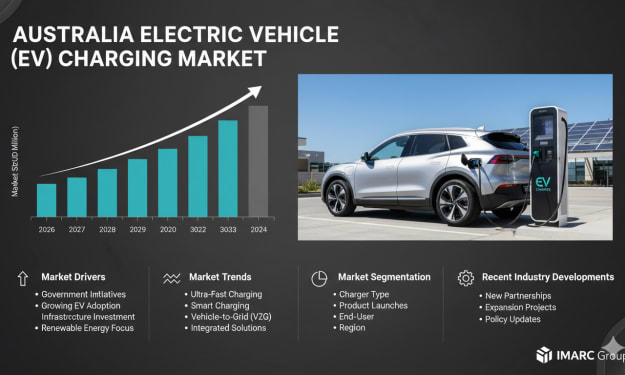
Australia EV Charging Market: Infrastructure Expansion, Smart Charging Tech & Government Incentives
According to IMARC Group, the Australia electric vehicle (EV) charging market reached USD 304.4 Million in 2025 and is projected to expand significantly to USD 1,692.2 Million by 2034, exhibiting a compound annual growth rate (CAGR) of 21.00% during 2026–2034. This rapid growth reflects the accelerating transition toward electric mobility across Australia. Increasing adoption of electric vehicles by consumers and commercial fleets is driving demand for a reliable and widespread charging infrastructure network. Governments and private investors are expanding public charging stations while businesses and residential property developers integrate charging solutions into new infrastructure. At the same time, advancements in smart charging technologies and energy management systems are strengthening Australia EV charging market share by improving efficiency, convenience, and grid integration.
By Kevin Cooper5 days ago in Futurism
Australia Non-Dairy Coffee Creamers Market: Plant-Based Demand, Coffee Culture & E-commerce Growth
According to IMARC Group, the Australia non-dairy coffee creamers market reached a value of USD 78.5 Million in 2025 and is projected to reach USD 154.9 Million by 2034, growing at a compound annual growth rate (CAGR) of 7.85% during 2026–2034. The market is expanding as consumers increasingly shift toward plant-based alternatives due to lactose intolerance, dietary preferences and growing health awareness. Many consumers experience digestive discomfort when consuming dairy products, encouraging the adoption of non-dairy creamers made from ingredients such as almond, soy, coconut and oat. Australia’s strong café culture and rising coffee consumption are further supporting demand for plant-based creamers across households and foodservice outlets. At the same time, expanding e-commerce platforms and online grocery services are improving product accessibility and enabling consumers to explore a wider range of dairy-free coffee creamer options.
By Shrestha Roya day ago in Futurism



Comments
There are no comments for this story
Be the first to respond and start the conversation.