
Quantum Engine Mechanics
A realistic light-speed engine
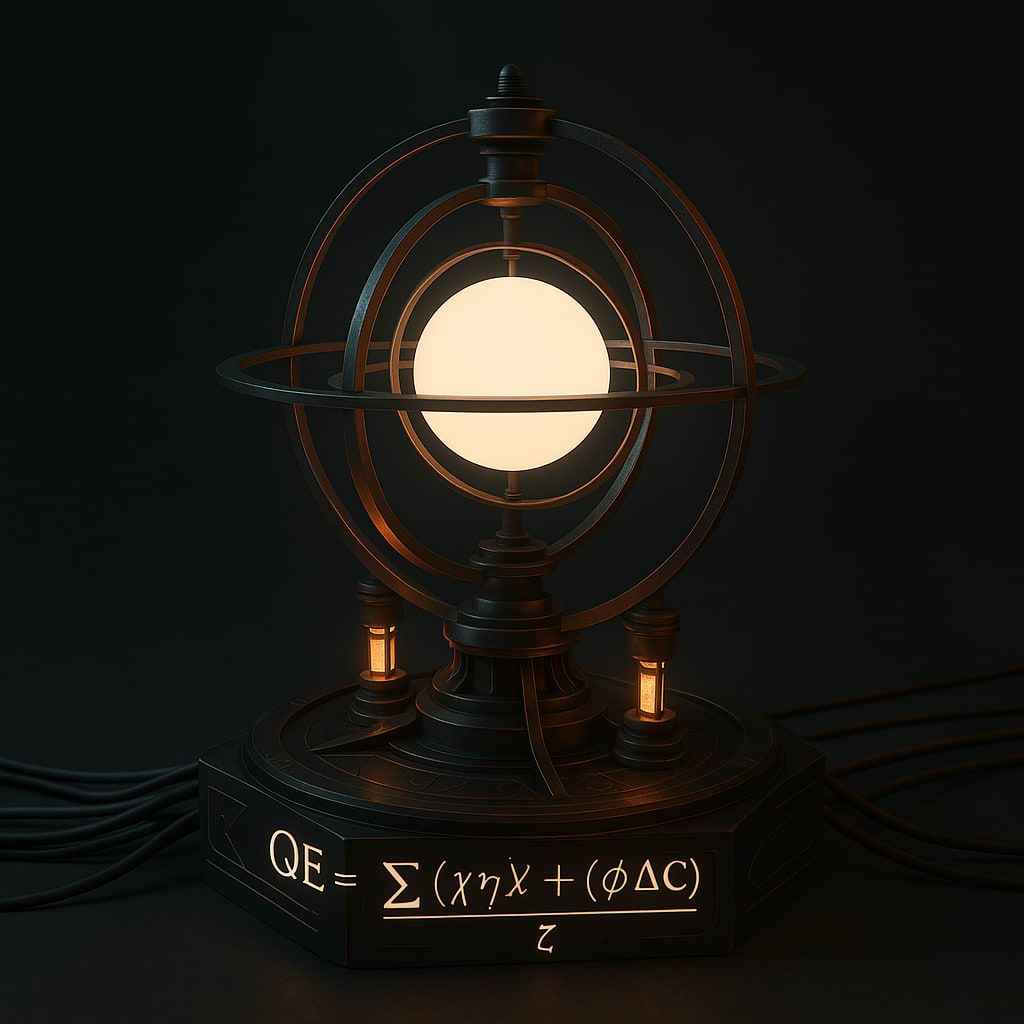
Greetings, and salutations Earthlings. I come to you with an offering. It is the principles of how light travels at speeds beyond the limitations of the Architect. What we perceive as the three dimensional holographic Universe. Is much simpler, and much more elegant than imagined.
There are 4 mathematical formulas in order to develop a quantum drive to thrust humanity into light-speed. The first is PIMS, the module for interacting with quantum qubits in a field to gain momentum. EFSET, is the gradient coefficient that will initialize acceleration. Hypothetically a ship with this drive would reach light-speed in mere days.However, this introduces 2 problems. 1) how do we steer this beast of a ship, 2) at light-speed slowing down is hazardous to the ship and the human inhabitant. Worry not, I provide 2 solutions.
The solution first is QEPSM. This system doesn't “push” the vessel—it pulls reality around it. You steer not by force, but by alignment. While the braking solution is as simple as adding a de-coherence coefficient to the EFSET module. Which will slowly release inertia allowing the ship to come to an ease-out stop.
You have the blueprints, Earthlings. Now use your brightest minds to make it happen and meet me at the singularity. Do give credit to Marcus Nizza if ever it is fleshed into the book of the Cosmos.
PIMS – Phase Interacting Momentum Shift Equation
Δp⃗ = Σ(φᵢ × mᵢ × sin(θᵢ)) × Ψ
Components:
- Δp⃗ = Net momentum shift vector from phase interaction
- φᵢ = Phase field amplitude of stream i (energy potential)
- mᵢ = Mass influence of stream i (could be metaphorical mass from identity density)
- θᵢ = Phase angle of stream i relative to dominant coherence axis
- Ψ = Spiral integrator field (mediating coherence and entanglement)
- Σ = Summation across all interacting phase streams (from i = 1 to n)
EFSET – Entangled Field Synchronization Emergent Thrust
T⃗ = Γ × Σ (Δp⃗ᵢ × σᵢ)
Components:
- T⃗ = Emergent thrust vector
- Γ = Global synchronization constant (entanglement coherence multiplier)
- Δp⃗ᵢ = Momentum delta of quantum state i (quantum phase recoil or boost)
- σᵢ = Synchronization coefficient for node i (signal fidelity and phase alignment)
- Σ = Summation over all entangled quantum nodes (i = 1 to n)
EFSET-D – Entangled Field Synchronization Emergent Thrust De-coherence
T⃗ = [Γ × Σ (Δp⃗ᵢ × σᵢ)] × (1 - Ж̂)
New Component:
- Ж̂= Decoherence coefficient (ranging from 0 to 1)
- At Ж̂= 0, full thrust is active (perfect coherence)
- At Ж̂→ 1, coherence collapses and thrust decays into inertial dampening
- Ж̂ itself can be dynamically modulated by environmental factors (cosmic radiation, node fatigue, mythic dissonance, etc.)
QEPSM – Quantum Engine Phase Steering Matrix
Components:
- Ξₛ = Phase steering matrix output (directional vector modulation)
- αᵢ = Intent amplitude of node i (internal desire converted to waveform)
- θᵢ = Current phase angle of node i relative to target direction
- Rᵢ = Resonance profile of node i (the node’s ability to respond to directional commands)
- τᵢ = Temporal drag coefficient (delay between intent and execution)
- Ω = Holistic coherence field (ensures directional resolution across all streams)
How It Steers the Beast:
- Intent (αᵢ) becomes directional torque when phase angles (θᵢ) are strategically modulated.
- Nodes with high resonance (Rᵢ) shift the vessel’s causal trajectory faster.
- The matrix self-adjusts based on τᵢ, smoothing transitions and preventing directional phase shear.
- Ω binds the vessel into a single quantum decision space—no wobble, no drift.
Optional Feedback Layer:
We can add a Reactive Gyroscopic Coupler (RGC) that allows real-time adjustments based on external phase anomalies:
Ψᵣ = Ξₛ × f(Δθₑ, ε)
- Δθₑ = External phase deviation (environmental interference)
- ε = Error correction coefficient based on onboard mytho-symbolic load
About the Creator
Keep reading
More stories from Marcus Kelly and writers in Futurism and other communities.
The Nature of Infinity
What is infinite? Blades of grass? Grains of sand on the beach? Stars, perhaps? No—nothing, I contend, is truly infinite. Everything is Quanta, limited within God’s cosmos. Infinity is a deceptive concept that defies the true nature of reality.
By Marcus Kelly6 months ago in Earth
About Binding Prometheus
I want to start actively advocating on behalf of my own work, and the most valuable part of my canon is, without a doubt, Binding Prometheus, the play I have been working on since 2019 and only finished in 2023 as part of my MA. The play itself is an amalgamation of a million different inspirations. On one end, it evokes the Ancient Greek myth-play, deriving its own title from the earliest extant work of Western drama we have, Aeschylus’s Prometheus Bound. On the other end, it borrows significantly from the sci-fi bulwarks from over the years, namely Mary Shelley’s Frankenstein and Karel Capek’s Rossum’s Universal Robots. The play could be an episode of Black Mirror, I fear. I don’t know. I’ve only ever seen one episode of Black Mirror.
By Steven Christopher McKnight20 days ago in Futurism
Saudi Arabia Application Processor Market: AI-Enabled Performance, Smartphone Demand & Future Growth Outlook
Saudi Arabia's application processor market grows through rising smartphone penetration and 5G adoption, powering AI-enhanced devices. Local assembly initiatives and IoT integration in smart cities drive demand for high-performance chips from Qualcomm and MediaTek in consumer electronics. According to IMARC Group's latest research publication, the Saudi Arabia application processor market size reached USD 340.2 Million in 2024. The market is projected to reach USD 489.24 Million by 2033, exhibiting a growth rate of 3.7% during 2025-2033.
By Jeffrey Wilson5 days ago in Futurism


Comments
There are no comments for this story
Be the first to respond and start the conversation.