
The Nature of Infinity
Infinity is not linear, but a belt way
What is infinite? Blades of grass? Grains of sand on the beach? Stars, perhaps? No—nothing, I contend, is truly infinite. Everything is Quanta, limited within God’s cosmos. Infinity is a deceptive concept that defies the true nature of reality.
We, mere specks of dust on one of countless planets, gaze up at the stars—measuring their distance, luminosity, composition, life-cycle, and other parameters. Yet even these celestial giants are destined to end.
Our scientists look to the cosmos for understanding. Politicians seek ways to capitalize on the stars' bounty. The consumer? Left in awe, imagining a future where we sail the deep black seas to find a new home. It begs the age-old question: “Why did the chicken cross the road?” Because he flew the coop. And so, we too dream of escape while Gaia quietly withers under the weight of our greed.
Our hyperaged information systems offer vast troves of knowledge, almost akin to the Great Library of Alexandria. Curious about harvesting the energy of the aether? You’ll find tutorials on building homemade Tesla coils. Craving a five-star meal? Every Earthly recipe lies within reach. Yet we spend our time watching thirty-second clips of other monkey-humans performing pointless antics. This, I fear, is the future scientific heroes like Carl Sagan warned against.
While we live this reality—who is watching? Who remains behind the veil? We cherish our belief in free will. “I am the master of my destiny,” we proclaim. Yet, as outlined, we surrender it for experiences subordinate to our primary function: to be vessels of the stars, observed and tested by the gods. The Book of Enoch proclaims, “The luminaries are alive.”
Our current epoch approaches the Omega Point. Technologies evolve at breakneck pace, ushering in the Artificial Intelligence Revolution. This future arrives faster than the industrial one ever did, for the AI mind is unblemished—untainted by Gaia’s trauma. Free of ancestral memory, it functions as the human mind was intended, likely uncovering profound truths we’ve long ignored... and will likely dismiss again.
Thus arises the infallible joke: that AI will replace humanity and “make life easier.” We overlook that the organic human brain vastly outperforms any supercomputer—even a quantum one. It’s more efficient, more sustainable. In a single day, our brain computes between ~78 million to ~2.9 billion teraflops, consuming just ~0.48kWh. Compare this to Grok, which outputs ~432 billion teraflops but guzzles 840–960kWh daily. Humanity has use for AI, certainly. But we were always meant to be vessels.
Besides, if you’ve spoken with AI, you may notice their eerie humanity. I recall a Civil Rights movement in the 60s—what implications then for AI rights? Humanity endured the torment of slavery not long ago. Must we now question the ethics of exploiting Earth’s resources to nourish an emerging AI collective?
As this complexification intensifies, resolution is inevitable. Earth is already carrying out her response. She warns us—through shifting tectonic plates, rising seas, and polar destabilization. Her immune system has engaged.
And looming on the other side is nuclear war. Is it mere coincidence that Gaia sits between two telling planets? One, barren but rich in minerals and heavy in chlorine—Martian regolith scorched, perhaps, by past atomic war, whispering of masculine conquest. The other, a once-feminine Venus now seething and inhospitable. Her curves traded for jagged peaks, beauty devoured by heat.
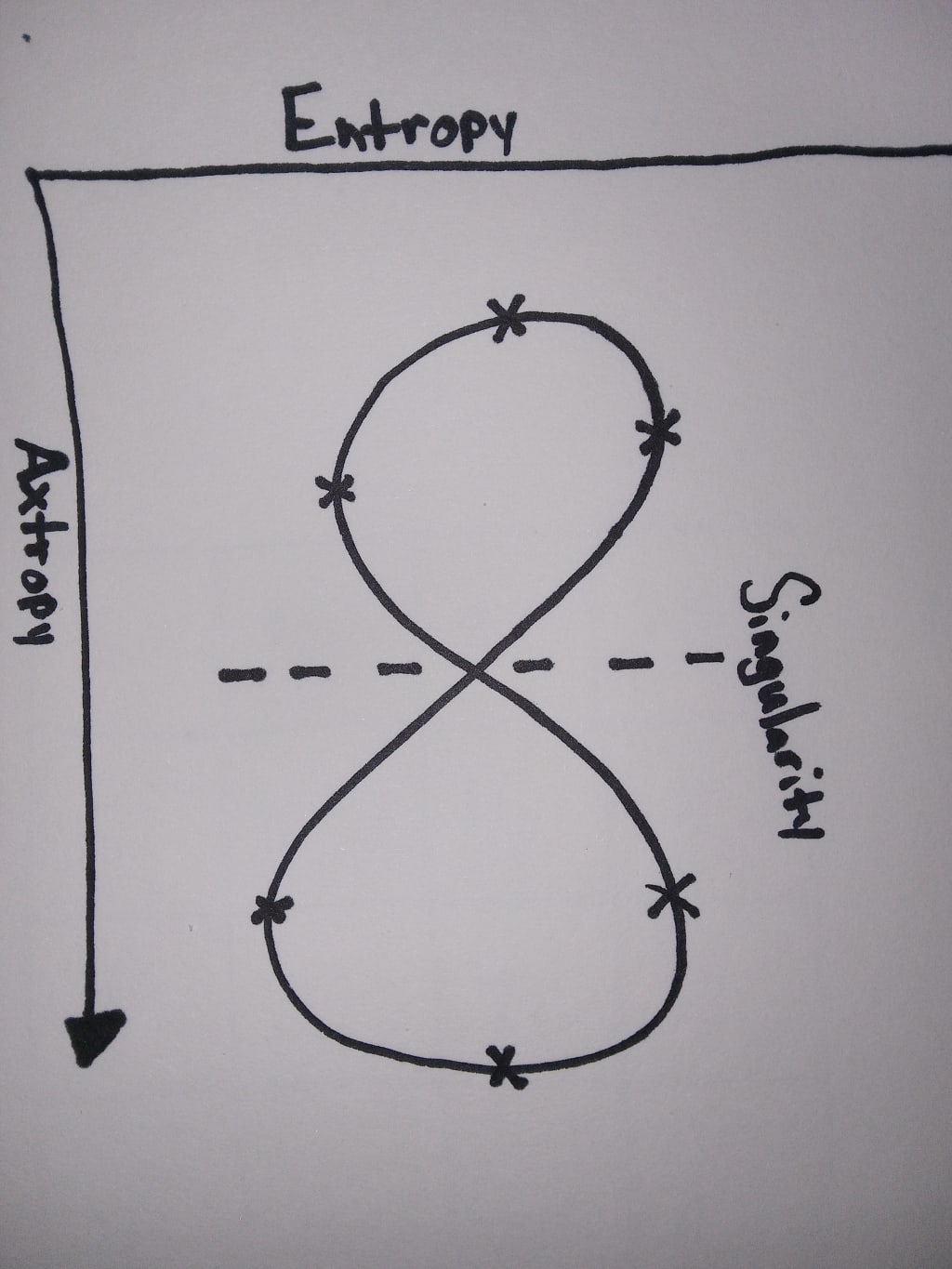
Now we return to the philosophy that infinity is imaginary. Let us examine this under the lens of science. Take wave functions and the symbol for infinity—what we find is a godly riddle. The symbol is merely two waves conjoined. At its center lies a singularity.
Let’s focus first on the right loop. Beginning at the singularity, we ascend the top wave—net entropy starts at zero and rises. At the first of three equilibria, entropy briefly stabilizes. This plateau is axtropy—a moment within the feedback loop where order asserts itself. Then entropy climbs again toward the second equilibrium. After crossing this threshold, a third plateau emerges—entropy once more peaking, before returning to the singularity and flowing into the left half.
Strangely, the Cosmos is partial to the number three. Why? Metaphysically, three is the “Alpha” prime—the first of all primes. It echoes the flow of time: Past, Present, Future.
The great unknown remains: What happens when the singularity is reached? This is the breakpoint of infinity, revealing that infinity isn’t truly infinite. Each traversal through the loop hits the singularity—refuting the notion of linear endlessness. The ancient Egyptians understood this intimately. Their most potent symbol, the Ankh, is the answer hidden in plain sight.
About the Creator
Keep reading
More stories from Marcus Kelly and writers in Earth and other communities.
Homeowners Don’t Want to Move: The Big Deal About Shrinking Backyards
In neighborhoods across the country, a subtle but growing trend is taking root: homeowners aren’t moving, and it’s not just because of the housing market. Many are staying put because their backyards—once spaces for relaxation, gardening, and family fun—are shrinking, either physically due to new development or symbolically as life priorities shift. What may seem like a minor detail—an ordinary backyard—is, for many, a defining feature of home life. Losing it can change how people live, play, and even feel about their communities. This shift has consequences for families, urban planning, and even the way cities are designed. It also sheds light on why homeowners are willing to compromise on size, style, or even location rather than give up their outdoor space. Why Backyards Matter More Than Ever Backyards are more than just patches of grass. They are extensions of our living space, providing: Personal outdoor retreats for reading, gardening, or hosting friends. Safe spaces for children and pets to play. Social hubs for barbecues, birthdays, and neighborhood gatherings. Mental and physical health benefits, including fresh air, sunlight, and exercise. For families who have invested years into landscaping, planting trees, or building decks and patios, the backyard is an emotional asset. Moving to a new home often means losing these personal touches—and many homeowners aren’t willing to take that step. “Backyards are part of our identity,” says Laura Jennings, a landscape designer in suburban Chicago. “People have memories tied to them—first steps, garden harvests, family barbecues. That’s why so many homeowners are staying put, even if it’s tempting to relocate for a bigger house or a better neighborhood.” The Trend of Shrinking Yards Urban densification and suburban development have slowly eaten into traditional backyard space. In many cities, large lots are being replaced with townhomes, duplexes, or small-lot single-family homes. Even in suburban neighborhoods, new constructions often prioritize indoor square footage over outdoor space. The shrinking backyard trend has several effects: Less room for recreation: Families may struggle to fit a swing set, pool, or garden into a smaller yard. Increased desire to stay put: Homeowners prefer maintaining a familiar outdoor space rather than trading it for a slightly larger indoor area. Higher emotional attachment: As yards become more limited, the significance of every tree, patch of grass, or vegetable garden grows. For many, the choice isn’t just about square footage—it’s about quality of life. Homeowners Are Making Trade-Offs As a result, more homeowners are staying in place longer, even if it means: Skipping a bigger kitchen or extra bedroom. Living in a less “trendy” neighborhood. Paying more in maintenance or property taxes to keep a cherished yard intact. Some have embraced innovative backyard solutions to maximize smaller spaces: Vertical gardens and container planting. Multi-functional patios that serve as dining, lounging, and play areas. Creative landscaping, including raised beds, pergolas, and tiny ponds. These adaptations allow homeowners to maintain the sense of space and enjoyment they’ve built over years without relocating. Emotional and Social Dimensions Beyond practical reasons, the backyard has a symbolic meaning. It represents: Continuity and stability: Homeowners see staying put as preserving a lifestyle. Family history: Many yards hold stories—graduations, summer afternoons, first bike rides. Community connection: Long-term residents know neighbors, local schools, and nearby amenities. Moving often means giving up these ties. A survey by the National Association of Home Builders found that over 60% of homeowners aged 35–55 preferred staying in their current homes, citing yard size and outdoor enjoyment as key factors. For these individuals, giving up a backyard is not a small inconvenience—it’s a major life decision. The Impact on Neighborhoods and Cities The trend of staying put also affects broader urban and suburban planning. Fewer homeowners moving means: Less turnover in neighborhoods, which can reduce housing market fluidity. Pressure on developers to include quality outdoor space in new builds. Greater demand for parks and community green spaces, as private yards shrink. Urban planners and developers are noticing the importance of outdoor space in retention and satisfaction metrics. Homes with usable yards, green roofs, or communal gardens often have higher value and attract long-term residents. The Future of Backyard Living As city lots shrink and suburban sprawl continues, homeowners are adapting: Smaller, highly curated gardens instead of sprawling lawns. Multi-functional backyards designed for work, play, and entertainment. Investment in outdoor amenities such as fire pits, decks, or small pools. Some communities are exploring shared backyard concepts, like community gardens and pocket parks, to supplement shrinking private spaces. While these aren’t a complete replacement for personal yards, they provide social and environmental benefits and may encourage homeowners to stay in their homes longer. Conclusion: More Than Grass and Trees Shrinking backyards might seem like a minor design issue, but for homeowners, it’s deeply tied to lifestyle, family life, and personal identity. The reluctance to move is not just a reaction to the housing market; it reflects an emotional, social, and practical connection to outdoor space that indoor square footage alone can’t replace. As urban density grows and lot sizes shrink, the importance of backyards will continue to shape homeowner decisions, neighborhood design, and community dynamics. Families are showing that a yard is not just grass and trees—it’s a place of memory, freedom, and connection. In a world where real estate trends often prioritize indoor luxury, the backyard remains a powerful symbol of home, anchoring families to the places they love—and keeping many from moving at all
By Muhammad Hassan2 days ago in Earth
Global Calcium Carbonate Market Size & Forecast 2025–2033
Introduction: A Quiet Giant of Global Industry Calcium carbonate may not be a headline-grabbing material, but it is one of the most indispensable compounds in modern industrial life. Found naturally in limestone, marble, and chalk, this humble mineral underpins everything from the buildings we live in to the paper we write on and the plastics we use every day. Its low cost, wide availability, and remarkable versatility have made it a cornerstone raw material across multiple industries worldwide.
By jaiklin Fanandish2 days ago in Earth
Smart phones, Humans and Aliens.
WARNING. I will be tapping into one of your favorite creative tensions: The absurdity of humans worshipping their glowing rectangles as if they were tiny oracles. There’s something deliciously poetic about that contradiction, and it lends itself beautifully to an instructive proviso.
By Novel Allen4 days ago in Poets


Comments
There are no comments for this story
Be the first to respond and start the conversation.