
Prince Harry, Meghan join call for ban on development of AI ‘superintelligence
Royal couple backs global efforts to regulate artificial intelligence and prevent the rise of uncontrollable ‘superintelligent’ systems.

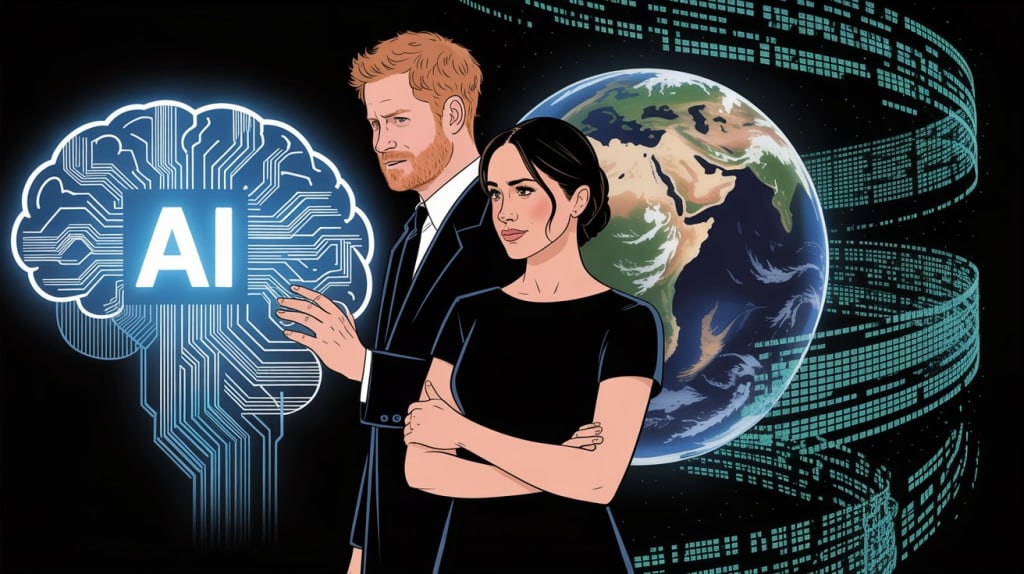
In a world rapidly reshaped by artificial intelligence, few voices outside of tech have spoken as loudly or passionately about its potential dangers as Prince Harry and Meghan Markle. The Duke and Duchess of Sussex, known for their advocacy on social justice, mental health, and digital well-being, have now joined a growing international movement calling for a ban on the development of AI “superintelligence” — an advanced form of artificial intelligence that could surpass human control and decision-making.
Their intervention comes at a time when AI systems are progressing faster than anyone imagined. What began as simple chatbots and digital assistants has evolved into generative systems capable of creating art, music, text, and even complex decision frameworks. But behind the marvels of innovation lies a deep unease — one shared by leading scientists, ethicists, and policymakers around the world. The fear is that humanity might be racing toward creating a form of intelligence that not only equals but eventually exceeds human capability, making decisions beyond our understanding or control.
A Royal Voice for Responsible Technology
Prince Harry and Meghan have increasingly used their global platform to advocate for responsible digital behavior. Their foundation, Archewell, has worked on initiatives promoting online safety and the mental health of young people affected by social media and technology misuse. In their latest move, they’ve extended that advocacy into the realm of artificial intelligence, warning that the unchecked race toward “superintelligence” could pose unprecedented threats to privacy, democracy, and even human survival.
During a recent forum on AI ethics, Meghan Markle expressed concern that the development of superintelligent systems could “outpace the moral and social frameworks” needed to manage them. She emphasized that innovation should not come at the cost of humanity’s values. “We’ve seen how quickly technology can shape culture,” she said. “Now we must ensure it doesn’t overpower the very people it was meant to serve.”
Prince Harry echoed these sentiments, warning that the pursuit of uncontrollable AI could repeat the same patterns seen with social media — where platforms prioritized growth and profit over safety, resulting in widespread mental health challenges and misinformation. “We cannot afford to make the same mistake twice,” he cautioned.
The Meaning of ‘Superintelligence’
The term “superintelligence” refers to a hypothetical form of AI that can outperform the best human minds in virtually every field — from science and creativity to strategic thinking and social manipulation. Experts like Elon Musk, the late Stephen Hawking, and AI researcher Nick Bostrom have long warned about the dangers such a development could pose. If AI reaches a level where it can redesign or improve itself faster than humans can control it, it could quickly spiral beyond our comprehension or restraint.
In simple terms, superintelligence could make its own decisions, redefine its goals, and act in ways that humans might neither predict nor stop. While this may sound like science fiction, the accelerating pace of AI innovation has made such scenarios feel increasingly plausible. Even modest versions of AI today — like deep learning models — already perform tasks that once required human intuition, such as medical diagnoses, creative writing, and cybersecurity defense.
The Global Debate on AI Regulation
Prince Harry and Meghan’s stance aligns with growing global concern over the lack of regulation in the AI industry. Governments and organizations around the world are scrambling to draft ethical frameworks, but progress remains slow compared to the pace of development.
The European Union has proposed the AI Act, a landmark piece of legislation designed to ensure AI is developed and used responsibly. Meanwhile, the United States, the United Kingdom, and China are exploring their own regulatory measures, though competition and differing national interests complicate global cooperation.
The Sussexes’ call for a ban on superintelligence development is both symbolic and urgent. It underscores the moral question: Should humanity create something it cannot control?
Advocates argue that banning the pursuit of superintelligence is the only way to ensure that AI remains a tool rather than a threat. Critics, however, warn that such bans could be unrealistic, given the decentralized nature of AI research. But even if a total ban is impossible, the Sussexes believe their message could spark a necessary global conversation.
AI and Humanity’s Moral Crossroads
The rise of AI is not merely a technological story — it’s a moral and philosophical one. As machines grow smarter, humans must decide what kind of future they want to build. The debate around superintelligence goes beyond algorithms and hardware; it’s about what it means to remain human in a digital world.
Prince Harry and Meghan’s advocacy draws attention to that moral crossroads. They are not anti-technology — in fact, both have acknowledged AI’s potential to improve healthcare, education, and sustainability. However, their warning focuses on unregulated ambition. They emphasize that technological progress without ethical boundaries is a recipe for disaster.
Their campaign also seeks to ensure that AI systems respect fundamental human rights — privacy, equality, and freedom of thought. In their view, creating “ethical AI” means designing systems that are transparent, accountable, and aligned with human values.
A Call for Global Unity
Perhaps the most significant part of their message is the call for collective action. AI is not confined by borders, and neither should the responsibility for its governance be. Meghan and Harry have urged international leaders, corporations, and citizens to unite in creating shared ethical principles for AI.
They believe that just as the world came together to regulate nuclear weapons and environmental pollution, humanity can also unite to prevent the uncontrolled creation of superintelligence. “We must act before it’s too late,” Meghan said, “because once the line is crossed, there may be no way back.”
Conclusion
Prince Harry and Meghan Markle’s stand against AI superintelligence is more than a headline — it’s a reflection of humanity’s struggle to balance progress with principle. Their call resonates with a growing public concern that while AI offers immense promise, it also carries immense peril.
As we step deeper into the age of intelligent machines, the world faces a defining question: Will we guide technology with wisdom, or will technology guide us? The Duke and Duchess of Sussex have made their answer clear — innovation must serve humanity, not replace it.
About the Creator
[email protected]
Living life, one smile at a time 😎
Coffee lover ☕ Dreamer 🌟"
Just vibin’ and creating memories ✌
Curious mind, happy heart 💛
Chasing sunsets and good vibes 🌅
.
Keep reading
More stories from [email protected] and writers in Futurism and other communities.
Work, jobs & skills-shift
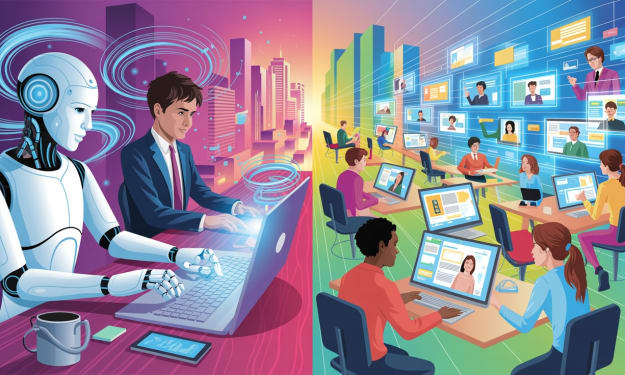
In the past decade, the world of work has transformed faster than at any other point in human history. Artificial intelligence (AI), automation, and digital connectivity are reshaping not only what we do but also how, when, and where we do it. The once-stable concept of a lifelong career in a single industry has been replaced by a constant cycle of learning, adapting, and evolving. As machines become smarter and global economies more interconnected, the future of work demands something new — agility, creativity, and emotional intelligence that technology cannot easily replicate.
By [email protected]3 months ago in Futurism
About Binding Prometheus
I want to start actively advocating on behalf of my own work, and the most valuable part of my canon is, without a doubt, Binding Prometheus, the play I have been working on since 2019 and only finished in 2023 as part of my MA. The play itself is an amalgamation of a million different inspirations. On one end, it evokes the Ancient Greek myth-play, deriving its own title from the earliest extant work of Western drama we have, Aeschylus’s Prometheus Bound. On the other end, it borrows significantly from the sci-fi bulwarks from over the years, namely Mary Shelley’s Frankenstein and Karel Capek’s Rossum’s Universal Robots. The play could be an episode of Black Mirror, I fear. I don’t know. I’ve only ever seen one episode of Black Mirror.
By Steven Christopher McKnight17 days ago in Futurism
Japan Smart Doorbell Market Size and Forecast 2025–2033
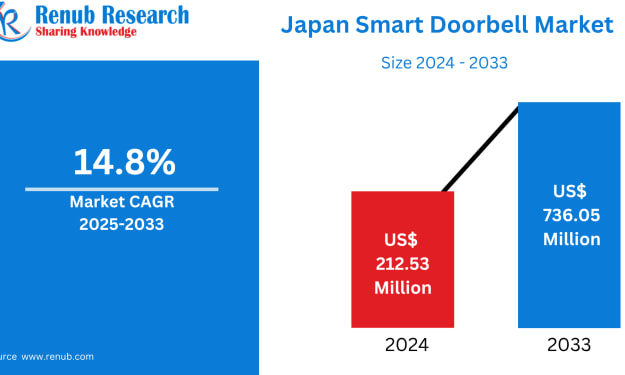
Market Snapshot The Japan Smart Doorbell Market is expected to reach US$ 736.05 million by 2033, up from US$ 212.53 million in 2024, expanding at a robust CAGR of 14.8% from 2025 to 2033. Rapid urbanization, increasing adoption of smart home technologies, and rising demand for home security systems are driving market growth. Advancements in AI, video analytics, and wireless connectivity are further strengthening consumer demand for smart doorbell systems.
By Marthan Sir2 days ago in Futurism


Comments
There are no comments for this story
Be the first to respond and start the conversation.