
Perfection’s Prism: A Utopian Future Nobody Ordered
Dispatches from the Society of Maximum Optimisation

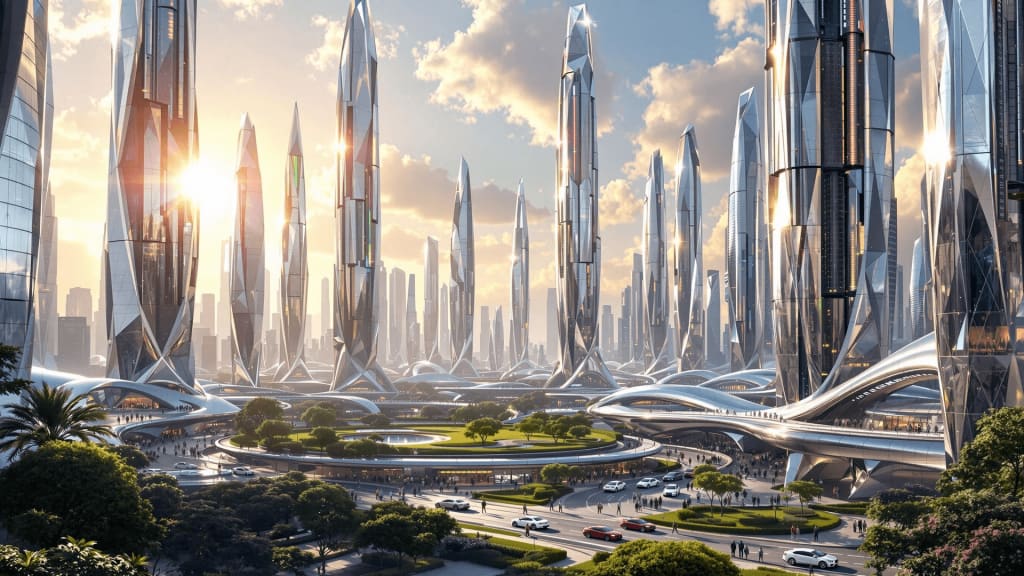
Imagine a future so dazzling, so seamless, so algorithmically immaculate that not even dust dares to settle. Now picture what it feels like to live there and realise you can’t.
Welcome to Eudaimonia, the Society of Maximum Optimisation, an epochal utopia crafted by the finest synthetic minds and the most earnest human dreamers. the city where happiness is mandatory and every sidewalk glistens like a freshly unwrapped smartphone.
Here, the air is cleaner than a new-born’s conscience, the food so nutritionally perfect that dieticians have taken up poetry in their newfound free time, and not a single day passes without the words “radical innovation” trending in the Collective Thought stream. Over here, not only have we solved the weather (perpetual spring, unless you have certified Seasonal Affective Disorder), but we’ve finally eradicated every known inconvenience: war, poverty, heartbreak, spam calls, pineapple on pizza. Rejoice! Or at least, convincingly simulate it.
Once, we marinated in the thick, soupy nostalgia of dystopian sci-fi: dystopias with their big boots and little privacy. But no more! We’ve outgrown dusty tropes. Our society solved boredom, climate change, and even on alternating Mondays existential dread. Or so we’d say on the billboards.
Yet, as an embedded observer with an elastic sense of optimism, let me peel back the bioplastic curtain. What does it really cost to run a flawless society with algorithms as our arbiters and progress as our creed? Let’s take a cheerful stroll through the underbelly utopia’s own footnotes.
At the nexus of radical innovation, this utopia blends AI-driven governance, mind-linked social networks, and gene optimised citizens. Eudaimonia is what happens when Silicon Valley’s fever dreams marry ancient philosophers’ best intentions and together raise a child on an all-organic, zero-waste, guilt-free diet of perfection.
On the surface, it’s hard not to be seduced. Traffic jams? Extinct. Chores? Outlawed. Every citizen’s neural implant offers real-time translation, instant empathy, and a perpetual sense of belonging. Pain, boredom, and regret have been algorithmically suppressed to historical footnotes. It’s the kind of progress that makes the Jetsons look like Luddites.
But like every city built on glass, perfection refracts. And as any quantum physicist or nervous therapist will tell you, reality is always stranger than its reflection.
The Algorithm of Happiness (And Other Tyrannies)
Take the Department of Emotional Optimisation. Charged with sustaining universal well-being, its algorithms fine-tune your mood as deftly as a concert pianist adjusting pitch. Arguing with your spouse? Your implants dissolve resentment with a bio-engineered wave of oxytocin. Writer’s block? The Muse Protocol floods your brain with inspiration, or at least with an urge to finish your quarterly happiness report.
The Great Optimisation began when a neural net named algorithm (no, not the one that steals fire; our algorithm steals regret) took over policy, logistics, medical diagnostics, and though this was hotly debated matchmaking. Under algorithm, buses run on time, storms are re-routed, and even your mother’s birthday never slips your mind.
Human error, once a source of both tragedy and the world’s best sitcoms, has gone the way of Blockbuster. The city threw a parade when the last “Oops!” was officially retired. Confetti rained down at the precise angle algorithm calculated would maximise serotonin uptake.
But here’s a fun twist: predictive optimisation means you rarely have to make small choices. Algorithms schedule your meals, moods, and even your creative epiphanies. (Try writing a sonnet on Tuesdays at 3:07 p.m. the Appointed Poetry Slot.)
They call it “cognitive liberation.” Some mutter, more quietly, about “decision amnesia.” One local wit, who asked to remain anonymous for fear of causing suboptimal social turbulence, described her life as “a slideshow where I forget my own clicker.”
Choice, it seems, has become like nostalgia itself: best appreciated in gentle, curated doses.
At first, it’s glorious. Nobody quarrels, nobody mopes. But after a while, the city’s notorious “grey smile” sets in a perpetual, polite cheeriness as authentic as a call-centre jingle. Some citizens, like the artist Anyar Yol, begin to wonder: “If all discomfort is erased, where do we find meaning?”
Anyar Yol tries to paint the feeling, his canvases are feverish, streaked with forbidden colours. But his neural compliance index gently nudges his toward more “optimally harmonious” compositions, as determined by collective preference metrics. It’s like being told to dance in a straightjacket, but with better posture.
The irony isn’t lost on Anyar Yol. “In Eudaimonia,” he jokes, “even our existential crises are crowd-sourced.”
Individuality: The Forgotten Bug
In pursuit of social harmony, we also embraced the Mirror Accord: radical empathy made real. Each citizen, equipped with a Likeness Visor, can see themselves reflected in any other features, a literal vision of equality. Prejudice? Obsolete. Stereotypes? Side-lined.
But as the months rolled by, we began to joke: “There are seven billion faces in the world, and they all look vaguely like me before coffee.”
We celebrate differences, of course, but what is the difference when it’s algorithmically averaged? Individuality is cherished and, naturally, measured but sometimes it feels like we’re running in the world’s most polite hamster wheel, each of us reflected in every shiny, non-stick surface.
A society with no friction? Efficient, yes. But, as it turns out, friction is where the sparks fly.
Eudaimonia prizes diversity on paper. Its citizens are a vibrant quilt of cultures, identities, and personal styles. The city’s AI, Socratica, ensures that everyone’s voice is equally weighted in all decisions, from policy to pizza toppings. (Pepperoni finally gets its due.)
But diversity, in this utopia, is less about wildflowers and more about a carefully curated bouquet: vibrant but never unruly. Genomic tailoring has ironed out hereditary diseases, but also “suboptimal” personality traits impulsiveness, melancholy, the mysterious allure of late-night karaoke. And because the networked mind-link encourages instantaneous consensus, even dissent feels quaint, as if performed by actors who misplaced their scripts.
The result? A city where everyone feels unique, yet no one truly is. Citizens’ quirks are algorithmically distributed to maximise social harmony, leaving Anyar Yol and his friends to wonder if their favourite hobbies; beekeeping, cloud-watching, interpretive tax filing are genuinely theirs, or merely statistical anomalies assigned by the diversity algorithm.
“Sometimes,” confides Anyar Yol, “I miss the arguments. The real ones, not the augmented-reality simulations.”
The Ghost in the Machine: The Pursuit of Progress and Its Discontents - the Race Has No Finish Line
Eudaimonia’s crowning achievement is its “Universal Fulfilment Engine” , a lattice of nano-fabricators and drone networks that anticipate and deliver every need. Hungry? A meal materialises in seconds, tailored to your gut biome and trending flavour profiles. Lonely? Your mind-link connects you with a perfectly compatible companion, be they human, AI, or an emotionally supportive cactus. Once, progress means something sturdy, like a new bridge or a longer lifespan. Now, progress is a metric, tracked on wall displays throughout the city. Each citizen’s daily “Progress Quotient” ticks upward with good deeds and new ideas.
Promotion at work comes from originality, audited by the Originality Enforcement Agency (motto: “No idea left uncanvassed.”). Chasing innovation is the only competitive sport left, with a leader-board updated in real time.
At first, it was exhilarating: you could feel the collective IQ rise as residual dullness vanished like unwanted pop-ups. Then the ironies began to emerge. No one dares revisit an old recipe or wear last year’s jacket unless recycled into an avant-garde poncho, approved by the Fashion Algorithm.
Old jokes, classic melodies, even the comfort of a repetitive ritual: all are gently deprecated. “Deja vu is now a reportable offense,” quipped an underground comedian before being gently reabsorbed by the Ministry of Novelty.
Progress, it turns out, is a treadmill with no exit ramp. Sometimes, even the most innovation-hungry crave a little stillness. But in utopia, standing still is just another form of inefficiency.
Yet, beneath the hum of contentment, a restlessness grows. The universal safety net has made risk obsolete, and with it, the thrill of uncertainty. Citizens quietly mourn the days when failure was possible and success meant more than a well-executed algorithmic prediction.
This is progress’s peculiar cost: with every need anticipated, the city becomes not a cradle of invention, but a soft, sprawling couch impossible to leave, easy to nap upon, and made entirely of recycled glory days.
The Irony of Ease & New Inequality in a Classless Age: A Hierarchy of Wholeness
In this world, the most radical innovation is the abolition of biological decay. With cellular reconstruction and cognitive backups, death is an artifact, a bug proudly patched out. Eudaimonia’s citizens are ageless, their minds eternally “up to date.” But there’s a catch. Those who choose to resist upgrades, “Opt-Outs” retain their imperfections, their unpredictable moods, their aches and doubts.
The city prides itself on tolerance. “Opt-Outs” are celebrated in parades and featured on diversity billboards. But they exist in a strange parallel society, admired, yet subtly patronised, like living museums or nostalgia acts at a future county fair.
Children study them in school: “Observe the Opt-Outs. See how they weep at sunsets, argue in cafes, giggle uncontrollably at puns. Note the inefficiency, the rawness. Isn’t it curious?” The irony is profound: in perfecting the human condition, Eudaimonia has created a new underclass, the wilfully imperfect.
We made work optional, pay universal, and health care free. So naturally, an underclass developed the “Effort Afflicted,” those souls who can’t help but want to work, to sweat, to make mistakes by hand. They form clandestine clubs, learning how to hammer a nail the old-fashioned way, or how to mispronounce French cheese.
Meanwhile, the “Optimally Content” float along, their needs algorithmically met, their ambitions gently redirected toward inner peace. The irony bites: the more we optimise away hardship, the more those with a taste for struggle feel left behind.
There’s a black market for errors: hand-drawn greeting cards, slightly burnt toast, and even scandalously unfiltered coffee. Imperfection, once an embarrassment, is now the hottest underground commodity.
The Irony of Progress: Old Problems in New Clothes
Perhaps the greatest twist in this utopia is that all the century’s old dilemmas persist, simply wearing shinier disguises. Inequality is no longer about wealth or status, but about agency, the freedom to choose discomfort, unpredictability, even pain.
Privacy, too, has evolved. There are no secrets when thoughts can be collectively shared, but an underground market for “unlogged moments” thrives. For a modest fee, your neural stream goes dark for five precious, unsupervised minutes, just enough time to scrawl a poem or savour a private doubt.
Of course, in a society that bends over backwards to validate identity, selfhood is both customisable and lightly gamified. Avatars shift hourly to fit the mood, pronouns are tailored by context and the “Self-Actualization Index” pushes you to master new facets of your being each week.
It’s all meant to empower, but some quietly complain of whiplash. Who am I, if I am everyone and also no one? One youth, in a moment of unguarded candour, sighed: “I’m uniquely me, but also, so is everyone else. Sometimes I miss just being a little weird and ignored.”
Progress promised us freedom from labels and constraints, but sometimes the only thing more burdensome than a fixed identity is the eternal pressure to reinvent it.
Citizens queue for these illicit experiences, and in doing so, begin to rediscover what it means to be human: vulnerable, unpredictable, and gloriously unfinished.
The Hidden Cost: The Sacrifice to Perfection
On the city’s centennial, Eudaimonia throws a party to end all parties, a festival of light, harmony, and algorithmically perfect weather. Anyar Yol stands amid the revellers, watching as banners unfurl: “We Did It! Century of Progress!”
He surveys the shimmering towers, the laughing crowds, the flawless blue sky. Everything is as it should be except, perhaps, for the small, persistent ache he cannot paint away.
Later, as drones sweep confetti from the streets, Anyar Yol finds himself beneath the city’s oldest tree, its roots older than universal contentment. He sits beside an old Opt-Out, a poet named Ayen, whose wrinkles are as rare as museum artifacts.
He offers her forbidden fruits, a real, untuned apple, tart and unpredictable. She bites, and for a moment, the taste is more vivid than all the flavours engineered in the city’s kitchens.
“It’s strange,” Anyar Yol muses, “how we gave up so much to chase perfection. All the rough edges, the beautiful mess.”
Ayen laughs. “Perfection isn’t a destination, Anyar Yol. It’s a disguise. Underneath, we’re still searching for meaning, the one thing no algorithm can predict.”
A Toast to the Beautiful Mess
Eudaimonia is a marvel, a paean to human ingenuity, a blueprint for a world without suffering. But its hidden costs are as profound as its triumphs. In solving discomfort, we risk losing resilience. In abolishing risk, we sterilise adventure. In pursuing unity, we blur the glorious noise of individuality.
And yet, for all its sleek absurdities, the Society of Maximum Optimisation is filled with cheerful, ironic laughter. We tell jokes about the old days, traffic jams, pen pal, spam calls, politicians. We laugh at our own neuroses, at our constant need to be “just a little bit unique,” at the fact that perfection, like a good punchline, always contains the seed of its own undoing.
For what is utopia if not a mirror gleaming, but always a bit smudged? Perfection, after all, can never be more than an invitation to notice the human thumbprint left on the edge.
We share burnt toast, misremembered limericks, and the irrepressible joy of not quite getting it right. Because, in the end, that’s the one utopian currency that no algorithm can ever optimise away.
Perfection is a prism; it refracts our best intentions into unexpected shadows. It is both a celebration and a cautionary tale, a reminder that utopia like an art, love, or a truly good joke depends as much on the unpredictable as the planned.
So let’s toast to the beautiful mess: to flaws, to friction, to the odd and obstinate hearts that persist in the gaps between progress and perfection.
So join me at Poetry Slot, 3:07 p.m., every Tuesday. We meet in the park, unoptimised, sometimes unsupervised.
Because we live in a world where everything is flawless, perhaps the greatest innovation is to be gloriously, stubbornly, and magnificently unfinished.
After all
In the pursuit of utopia, let us not automate away what makes us human.
Share if you’d take the imperfect apple over the perfect algorithm. Or, if you’d rather, just smile authentically. Even if it’s a little crooked.
About the Creator
Majok Wutchok
Health Educator | AI Educator | Research | Emerging Tech | Book Writing Consultant | Editor | Media Buying Expert | PhD Candidate | I am here to give you you good read. Follow Me.
Keep reading
More stories from Majok Wutchok and writers in Futurism and other communities.
Morgan Stanley Says AI Won’t Let You Retire Early
A new cross-asset research report from Morgan Stanley is pushing back against one of the most dramatic narratives surrounding artificial intelligence: that AI will eliminate white-collar work so thoroughly that traditional employment becomes obsolete.
By Behind the Tech3 days ago in Futurism
Oncology Information Systems Market: Cloud-Based Platforms, Data Security Enhancements & Industry Forecast to 2033
Integrating healthcare IT solutions with clinical workflows is revolutionizing the way cancer care is delivered globally. By automating data handling and treatment planning, these systems reduce manual errors and allow clinicians to focus on personalized patient outcomes. According to IMARC Group’s latest data, the global oncology information systems market size was valued at USD 4.2 Billion in 2024. Looking forward, IMARC Group estimates the market to reach USD 7.3 Billion by 2033, exhibiting a CAGR of 5.95% from 2025-2033.
By Andrew Sullivan5 days ago in Futurism



Comments
There are no comments for this story
Be the first to respond and start the conversation.