
Part Two: Law, Grace, and the Question of the True God
If the early Church was a battlefield of ideas, then the Apostle Paul was its most controversial and transformative voice. More than any other figure, Paul redefined the question of God for a new world.


Jesus and the Reframing of the Law
If the God of the Old Testament revealed himself primarily through law and covenant, Jesus stood as a radical reinterpretation. He accepted the Torah outright; instead, he claimed to fulfill it, to bring it to its intended purpose. Yet his fulfillment often came in the form of reversal. Where the law demanded retaliation, "an eye for an eye," Jesus commanded forgiveness, teaching his followers to turn the other cheek. Where the law permitted hatred of enemies, Jesus insisted that God's love extended even to those who opposed us.
Perhaps most controversially, Jesus placed compassion above ritual. The Sabbath, once a sacred boundary enforced with punishment, became for Jesus a space of healing and restoration. When accused of breaking the Sabbath by healing a disabled woman, he answered that God's valid will was not rigid obedience but restoration. Sacrifices, the central ritual of Yahweh's covenant, were rendered obsolete by Jesus's insistence that mercy is greater than sacrifice. Again and again, he cut through centuries of legal tradition to reveal a God who desired transformation of the heart rather than external conformity.
This was not merely a reinterpretation of scripture; it was a challenge to the very understanding of God's identity among many in his time. To follow Jesus meant not only to keep the law more deeply, but to recognize that the law itself had been incomplete, provisional, and perhaps even distorted. In its place stood a God of infinite mercy, one who already knew his children, forgave them, and invited them into intimacy rather than judgment.
The Early Christian Struggle
The first generations of Christians inherited a profound tension. They were Jewish men and women who had grown up immersed in the Torah, the prophets, and the Psalms, believing Yahweh to be the sole Creator and the God of their ancestors. Yet, in following Jesus, they encountered a message that seemed to pull them beyond everything they thought they knew about God. His emphasis on love over sacrifice, forgiveness over judgment, and Spirit over ritual confronted not only their traditions but the very image of God that had been handed down for centuries.
The struggle was not abstract. It divided families, communities, and even the earliest churches. On one side stood those who insisted that following Jesus meant deepening one's obedience to Yahweh's law. Groups like the Ebionites viewed Jesus as the Messiah sent by the God of Israel, but they believed his mission was to reinforce Torah, not abolish it. To them, salvation was impossible apart from circumcision, Sabbath observance, and dietary laws. Yahweh was still the God, and Jesus was his anointed messenger. But others, especially among the Gentile converts, encountered Jesus as a direct revelation of something radically different. The Apostle Paul became the most vocal advocate of this view. For Paul, the law had been a temporary guardian, a necessary discipline for Israel until the fullness of time arrived. With Jesus, the law had been transcended. Salvation was not through obedience to Yahweh's commands, but through faith in the Christ who revealed the Father. Paul even went so far as to say that the law could no longer justify, that its role was to highlight human failure, and that true righteousness now came from grace alone.
This was not a minor adjustment; it was a rupture. In his letters, Paul drew sharp contrasts between the old covenant and the new. Where the old was written on stone, the latest was written on the heart. Where the old brought condemnation, the new brought life. The God revealed in Jesus was not the terrifying master of ritual sacrifice and endless judgment but a loving Father who adopted both Jew and Gentile into one family. For Paul, clinging to the law was akin to sticking to shadows. Christ was the unveiling of the true light.
This sharp break led to explosive debates in the earliest Christian communities. The Council of Jerusalem (around 50 CE) became a watershed moment, as leaders like Peter, James, and Paul wrestled with whether Gentile believers were bound by Jewish law. The decision that Gentiles were not obligated to keep the whole law of Moses marked a decisive shift. It suggested that the God Jesus revealed was not simply a continuation of Yahweh's covenant with Israel, but something broader, more universal. Not everyone agreed. By the second century, the divide had grown so stark that some, like Marcion of Sinope, concluded that Yahweh and the Father of Jesus could not possibly be the same being. Marcion viewed the God of the Old Testament as a lower deity, vengeful, jealous, and obsessed with the law, whereas the Father revealed by Jesus was a higher, unknown God of pure mercy. Though the Church condemned him as a heretic, Marcion's bold claim reflected the discomfort that many felt but dared not voice.
Even mainstream Christianity could not escape the struggle. The early Fathers worked tirelessly to harmonize the Old Testament with the gospel, allegorizing violent passages or reframing Yahweh's wrath as discipline born of love. Yet the effort was never entirely convincing. The tension continued to surface in sermons, theological treatises, and everyday faith: how could the same God command genocide in one era and unconditional love in another?
This struggle shaped Christianity from the very beginning. It determined what books were included in the canon, what teachings were branded heresy, and how Jesus' mission was understood. Was he the servant of Yahweh, fulfilling the old covenant? Or was he the revealer of a higher God, tearing away the veil of fear and showing humanity a love never before seen? The question remained unresolved, lingering like a fault line beneath the growing Church. And though the institutions of orthodoxy eventually suppressed radical alternatives, the tension never disappeared. It continues to resurface whenever believers wrestle with the dissonance between the wrathful Yahweh and the Father of love that Jesus proclaimed.
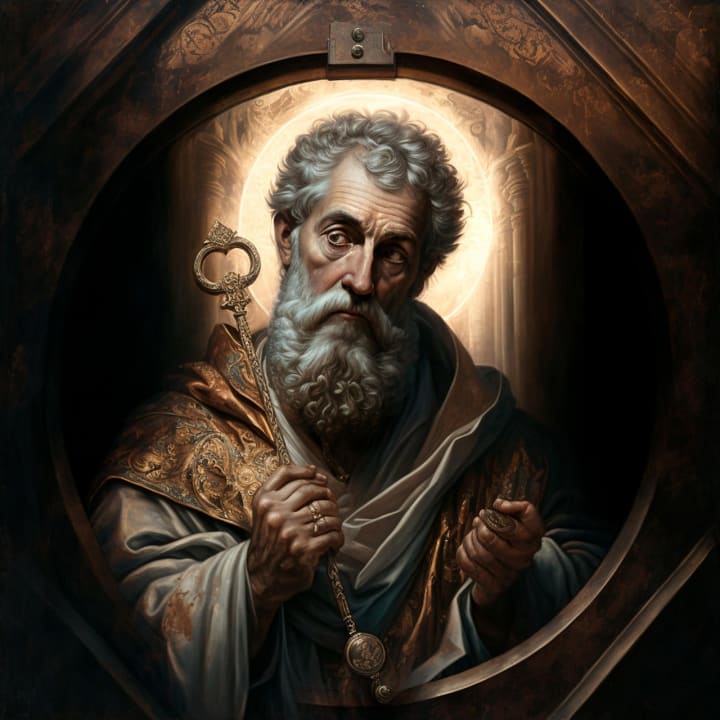
Paul and the Reframing of God
If the early Church was a battlefield of ideas, then the Apostle Paul was its most controversial and transformative voice. More than any other figure, Paul redefined the question of God for a new world, and his vision laid the foundation for what later became mainstream Christianity.
Paul himself stood at the crossroads of two worlds. He was a Pharisee by training, steeped in the Torah and the traditions of Israel, yet he was also a Roman citizen, fluent in Greek thought and shaped by the cosmopolitan culture of the empire. His encounter with the risen Christ on the road to Damascus marked not just a personal conversion but a radical reorientation of what God meant. In that blinding vision, Paul did not encounter the Yahweh of Sinai, who commanded obedience through thunder and law, but a divine presence that overwhelmed him with grace. It was this experience that would guide everything he wrote.
For Paul, the law was no longer the ultimate expression of God's will but a shadow of something greater. He described the Torah as a "schoolmaster" necessary for a time, but ultimately insufficient to bring true life. The covenant of Sinai bound people in cycles of guilt and ritual, but in Christ, a new covenant had been revealed, one rooted not in commands etched in stone, but in love written on the human heart. This was not Yahweh the warrior, demanding blood sacrifices and strict obedience, but the Father who welcomed prodigals home and declared them righteous through faith.
Paul's letters reflect the sharpness of this break. In Galatians, he condemned those who insisted that Gentile converts must keep the law, calling it a return to slavery when Christ had set them free. In Romans, he argued that the righteousness of God had now been revealed apart from the law, through faith alone. In Corinthians, he contrasted the ministry of death written in stone with the ministry of the Spirit that gives life. The God who once seemed to govern through fear had now been revealed as a God who adopts all people, Jew and Gentile alike, into one family.
Yet Paul was not merely reinterpreting scripture; he was offering a new cosmic vision. His writings suggest that the Christ he proclaimed was not simply a messiah of Israel but a universal figure, pre-existent and cosmic, through whom all creation was made and through whom all creation would be redeemed. This was no longer the tribal deity of a chosen nation; this was the Source of all, the hidden God now unveiled. Of course, Paul's vision did not go unchallenged. His insistence on grace over law, Spirit over ritual, and a universal God over a tribal deity earned him fierce opposition from Jewish Christians who clung to Torah. It also placed him at odds with those who later leaned toward Gnostic interpretations, who believed the Old Testament God was not just insufficient but an impostor.
Paul stood between these extremes. While he never denied that the God of Israel was real, he insisted that in Christ humanity had encountered something far more profound. This revelation transcended the categories of law, wrath, and sacrifice altogether.
It is no exaggeration to say that Paul reframed God for the Gentile world. Without him, Christianity may have remained a Jewish sect bound to the covenant of Sinai. With him, it became a movement that proclaimed a God of universal grace, a Father who transcended nation, tribe, and law. Yet the price of this reframing was the tension we still feel today: is the God Paul proclaimed the same as Yahweh, or was Paul himself, knowingly or unknowingly, pointing us to someone higher? This is the unresolved paradox of Paul's legacy. He built a bridge between Israel's God and Jesus' Father, but whether the two stand on either end of the same road or belong to different realities entirely remains a question that continues to divide and provoke.

Gnostic Insights: A Hidden God Beyond the Demiurge
If Paul reframed the image of God and Marcion dared to separate Yahweh from the Father of Jesus, the Gnostics went even further, offering perhaps the most audacious interpretation of all. To them, the God of the Old Testament was not simply misunderstood, nor was he an incomplete revelation. He was a false god, a lower being, and a usurper. They named him the Demiurge, the craftsman who shaped the material world, but who was blind to the higher realities of Spirit and truth.
The Gnostics emerged in the first and second centuries, a time when Christian identity was still fluid, and their writings, many of which were rediscovered in the Nag Hammadi library in Egypt in 1945, reveal an astonishing worldview. According to their cosmology, the true divine realm was a pleroma, a fullness of light beyond comprehension, where the ultimate Source, pure, infinite, unknowable, dwelled, and from this Source emanated beings of light called Aeons, expressions of divine thought and power. But one of these beings, Sophia, descended too far into matter, and in her fall gave rise to the Demiurge. This Demiurge, ignorant of the higher Source, imagined himself the supreme God. Arrogant and jealous, he declared, "I am God, and there is no other beside me," a line that resonates uncomfortably with declarations in the Hebrew scriptures. For the Gnostics, this was not the voice of the true God, but the boast of a lesser being who mistook his limited power for ultimate authority. It explained why the God of the Old Testament seemed obsessed with law, obedience, and wrath, because he was not the Father of Jesus at all, but a counterfeit, a cosmic jailer.
In this framework, the material world was not a perfect creation, but a flawed prison, designed to keep divine sparks, the souls of humanity, trapped in ignorance and suffering. The rituals and laws of the Old Testament were not pathways to liberation but tools of confinement, binding humanity to the Demiurge's rule. Salvation, then, was not about obedience or sacrifice; it was about gnosis, knowledge. This knowledge was not intellectual, but experiential: the awakening to one's divine origin, the memory of the higher God beyond the Demiurge, and the realization that within every human soul burns a fragment of the eternal Source.
In Gnostic thought, Jesus was not the obedient servant of the Demiurge, but rather the emissary of the higher God. He descended not to confirm Yahweh's covenant, but to shatter it. His teachings, his parables, and above all, his emphasis on inner transformation were intended to awaken humanity from the dream of bondage. In some Gnostic texts, Jesus even ridicules the Demiurge, exposing him as a tyrant masquerading as God. His crucifixion, far from being a blood sacrifice demanded by Yahweh, was reinterpreted as the moment when the powers of the Demiurge were exposed and defeated.
This vision was radical, and it directly challenged the emerging orthodoxy of the Church. To identify the God of Abraham, Isaac, and Jacob with a lower being was unthinkable for those determined to preserve continuity between Judaism and Christianity. Thus, the Gnostics were condemned, their texts suppressed, and their communities scattered. Yet their ideas survived, hidden in secret brotherhoods, mystical traditions, and tales that reemerged centuries later in movements like the Cathars and esoteric Christianity.
The power of the Gnostic insight lies not only in its critique of Yahweh but in its daring affirmation of the human soul. By teaching that every person carried a spark of the true God, they shattered the monopoly of priests and institutions. Liberation was not mediated through sacrifice, temple, or law, but through the awakening of inner light. This democratization of divinity was dangerous to both religious and political authorities, for it threatened every system built on control. Even today, the Gnostic vision resonates with seekers disillusioned by authoritarian images of God. The idea that the divine is not a distant ruler but a presence within, that the material world is not ultimate reality, and that awakening is the true path to salvation continues to attract those who feel suffocated by dogma. Whether one accepts the cosmology literally or sees it as a metaphor, the message is clear: not all gods are the true God, and the voice of love may come in opposition to the voice of fear.
The Gnostics remind us that what Jesus revealed may not have been a continuation of the old covenant but a rupture, the unveiling of a higher Source hidden behind the mask of a jealous god. And if that is so, then the question that haunted the early Christians is more urgent than ever: which God do we serve, the Demiurge of law and wrath, or the Father of light and love?
The Enduring Divide
From the earliest days of the Church until now, the question has never entirely gone away: Is the God of the Old Testament truly the same being that Jesus called Father? The tension was not resolved in the early councils, nor was it silenced by the condemnation of Gnostics and the burning of Marcion's works. It lingered beneath the surface of Christianity like a fracture line, shaping theology, worship, and even politics in ways few are willing to admit openly.
For centuries, the institutional Church insisted on continuity. To question whether Yahweh and the Father of Jesus were the same was heresy. The two Testaments were bound into one Bible, and believers were taught to see a single, unfolding plan: the God of wrath in the Old Testament fulfilled by the God of love in the New Testament. Yet the cracks were always visible. Every time someone wrestled with the command to annihilate the Canaanites, every time a sermon on divine love clashed with the stories of divine wrath, the Godture reappeared.
Theologians have attempted to reconcile the two images. Some argued that the wrath of Yahweh was a form of love misunderstood, discipline for a wayward people. Others claimed that Jesus softened, but did not contradict, the covenant of Sinai. Yet no explanation fully resolved the dissonance. To this day, Christians read the same Bible and come away with very different gods: one sees a stern judge demanding submission, the other sees a loving Father calling for mercy.
This enduring divide matters because the God we worship shapes the world we create. A God of wrath justifies violence, crusades, and conquest. A God of love inspires forgiveness, compassion, and freedom. For some, the old image of Yahweh still rules, and fear remains the heart of faith. For others, the revelation of Jesus has redefined the divine entirely, offering a vision of humanity not as enslaved people or sinners, but as children of light. The question is not just historical; it is personal. When we pray, when we love, when we act, whose voice are we following? The voice of a jealous ruler demanding obedience, or the voice of the Father who runs to embrace the prodigal without condition?
Perhaps the truth is that humanity has always seen God in fragments. The God of the Old Testament may reflect the lens of an age defined by survival, conquest, and law. Jesus revealed another lens, one that opened into mercy and grace. Both may be glimpses of a larger mystery, incomplete visions of the infinite Source. Or perhaps Jesus truly tore away the veil, exposing that the God of law and wrath was never the final word at all.
What cannot be denied is that the divide endures, in theology, in culture, and in the heart of every seeker who has ever opened the Bible and asked, "How can these two Gods be the same?" It is a question that will not go away, because it points us to the heart of the human search for the divine.
About the Creator
The Secret History Of The World
I have spent the last twenty years studying and learning about ancient history, religion, and mythology. I have a huge interest in this field and the paranormal. I do run a YouTube channel
Keep reading
More stories from The Secret History Of The World and writers in Futurism and other communities.
Volume 7: After the Sky Opens: Life in the First Days of Disclosure
Life in the First Days of Disclosure The moment humanity has waited for will not arrive with fanfare or fireworks. It will come with silence broken by a collective gasp, a shockwave of realization that spreads not from governments or generals, but from the people who look to the sky and understand that everything has changed. Disclosure will not be the end of a mystery; it will be the beginning of a reckoning. And what follows in the days, weeks, and months after will test the very soul of humanity.
By The Secret History Of The WorldExclusive • 7 months ago
North America Creator Economy Market to hit USD 331.4 Billion By 2034
North America Creator Economy Market Overview The North America Creator Economy Market is projected to reach approximately USD 331.4 Billion by 2034, increasing from USD 55.8 Billion in 2024, reflecting a strong CAGR of 19.5% during the forecast period from 2025 to 2034.
By Roberto Crum5 days ago in Futurism
Saudi Arabia Pet Food Market: Pet Humanization, Premium Nutrition & Growth Outlook
According to IMARC Group's latest research publication, Saudi Arabia pet food market size reached USD 80.6 Million in 2024. The market is projected to reach USD 135.9 Million by 2033, exhibiting a growth rate (CAGR) of 5.7% during 2025-2033.
By Shubham Sharma 3 days ago in Futurism
March 15, 2026
Merriam Webster - Word of the day: Tranche refers to a division or portion of a whole. World Contact Day is commemorated every year on March 15. It is a unique observance held globally to focus on communicating with extraterrestrial life and exploring the possibility that intelligent beings may exist beyond Earth. World Contact Day inspires people to invoke their curiosity and spend time thinking about the universe and the mysteries surrounding it. What is the “Ides of March”? According to the Roman calendar, the Ides are a monthly occurrence. In March and other months with 31 days, the Ides always falls on the 15th; it falls on the 13th in months with 30 days. The Ides traditionally marked the arrival of the new Moon and was cause for celebration. The word “Ides” is derived from Latin, meaning “to divide.” Mothering Sunday in 2026 falls on Sunday, March 15. Mothering Sunday, celebrated in the United Kingdom and Ireland, occurs on the fourth Sunday of Lent, which is exactly three weeks before Easter. Unlike the fixed-date Mother's Day in countries like the United States, Canada, and Australia, Mothering Sunday’s date changes each year according to the Christian liturgical calendar. On March 15, 2026, several notable observances and events are celebrated: Dumbstruck Day: A day to express frustration. Everything You Think is Wrong Day: A day to challenge and celebrate wrong beliefs. International Day Against Police Brutality: A day to raise awareness and advocate against police violence. My look at today, March 15, 2026 below:
By Denise E Lindquistabout 19 hours ago in Writers




Comments
There are no comments for this story
Be the first to respond and start the conversation.