
OpenAI's Soaring Valuation Hits $150 Billion
OpenAI's rapid rise in the tech industry has captivated investors and developers alike, with the company now negotiating to raise $6.5 billion at a staggering valuation of $150 billion.


It felt like a turning point at a 150 billion-dollar valuation not just for the company but for all of us in the developer community who have been tracking it from day one. It felt uncanny. I still remember when ChatGPT first came out in 2022; it felt like this novelty, this advanced chatbot that could converse. But as the months went by, it became clear it wasn't just an experiment in a class of AIs. It was enormous and the sort of tool that would alter how we worked, thought, and built.
For developers, it was like they had unearthed superpowers. You did have AI for the first time that was able to write code, debug issues, and even complete applications in one place. What started as an assistive tool proved indispensable in the toolkit. OpenAI had been pushing boundaries, and with each update-be it GPT-3, GPT-4, or beyond technology grew increasingly sophisticated and intuitive. It wasn't about saving time; different ways of looking at problems.
But the other day, while listening to that valuation of $150 billion, it hit differently. OpenAI wasn't just that cool tech company anymore; it was the beacon of how artificial intelligence went from that experimental development phase into the cornerstone for the future economy. AI isn't that far-off, sci-fi-like thing anymore. Finally, it has come. And we, as developers, stand at the forefront of that revolution.
The Growth of OpenAI - More Than Just a Company
I still remember those days when OpenAI was more like a research lab publishing white papers on neural networks and machine learning algorithms. For the rest of us in the development world, AI was still living in academia, if not in some high-tech labs in the heart of Silicon Valley. But then came ChatGPT, hitting the market.
What seemed like distant possibilities-the AI writing the code, debugging errors, or even building whole applications overnight. Web developers had to quickly adapt to this new era. The way we wrote code changed; the way we architected systems changed. No longer was it about coding willy-nilly. AI was now our collaborator, showing us even better ways, faster, solving problems we did not even know existed.
And with the growth of OpenAI, possibilities did too. AI was no longer merely a productivity tool but started to find its place right at the core of business models in financial services, healthcare, and logistics. Fintech firms began applying AI in fraud detection, while healthcare organizations applied the very same in predictive diagnostics. Logistics firms route- and supply chain-optimized with machine learning models. And voilà, we weren't coding anymore; we were building the future, line by line.
Impact on Developers and the IT Industry
That 150 billion dollars in valuation is a figure not taken lightly by developers, but it gets across the seal that artificial intelligence is here to stay and will continue to shape the future of technology in ways little understood as of now. But with growth, excitement is ignited along with a whole new level of challenges.
On the other hand, AI makes us more productive. Now, I can automate what would have taken hours or even days, like code reviews and bug fixes. Sometimes, features get generated on their own. It's like an extra pair of hands ever to get tired, complain, or lag at all. A dream come true for a developer, I say.
But the learning curve exists. AI is not something where we plug in a model and voilà, it does magic. We as developers need to understand the intricacies of machine learning, neural networks, and the ethical challenges that come with building AI-powered systems. The more dependent we are on AI, the greater will be our responsibility to make sure it is applied ethically and responsibly.
As AI evolved, so did the job market. It became no longer just about developers who could code but how to fit AI into current systems, work with machine learning frameworks, and build intelligent, adaptive applications. Slowly but surely, what equates a developer to become successful is changing, and right at its core is AI.
AI Opportunities
This rather stratospheric valuation also underlines an important inflection point for businesses. This is no longer a case of startups alone experimenting with AI. Apple and Nvidia - behemoths in their right - are placing multibillion-dollar bets on AI's success. And why should they not? AI has already proved its worth across a range of industries, from automating customer support systems to optimizing supply chains.
No more are we strictly building software for the users or businesses. We're creating intelligent systems that learn, adapt, and improve over time. Whether developing an AI-powered chatbot for a retail company or building predictive analytics for a financial institution, what we could create has expanded dramatically.
But where there is opportunity, there is also responsibility. AI is an immensely powerful tool, and with that power comes great sensitivity regarding ethical issues that may pop up. Bias in AI models is very real, and we developers are called upon to know how our algorithms impact society. It is no longer cool technology; rather, it is the right technology-building technology that will be non-discriminatory, inclusive, and responsible.
Challenges and Promise
As the valuation of OpenAI continues to rise, it is far too tempting to get caught up in all the hype. But for us, hackers are in the trenches- developers who build AI-driven applications day in and day the grass is only getting greener. AI will continue with the wait-and-watch attitude, changing healthcare, finance, education, and more. And right at the heart of it all will be the developers.
The question for us now is, how do we balance innovation with responsibility? The tools we build can revolutionize industries and economies, but they also raise a host of ethical questions that, out of necessity, we must answer. How do we make sure AI is fair? How will we prevent bias from seeping into our algorithms? How do we construct systems that are transparent, and accountable?
These are the questions we will need to wrestle with as OpenAI continues its growth.
But one thing is certain thatAI isn't just the future; it is the present.
And we, as developers, have the privilege and responsibility to shape that future line by line of code.
But the rise of OpenAI to a US$150 billion valuation is not a business story; it is that of a developer. It's a testament to how far we have come and also looks at what incredible potential lies ahead. Whether you are building the next AI-driven application or learning to integrate machine learning into your existing systems, this is just a great time to be a developer.
Ultimately, it is not about the tools we're going to make; it is actually how those tools start shaping the world around us. And as AI continues to evolve, one thing is for sure-developers are going to lead the charge into this new frontier of technology.
About the Creator
Keep reading
More stories from Sukhpinder Singh and writers in Futurism and other communities.
The Interactive Shift: Exploring the Future of Storytelling in Digital Age
For centuries, storytelling was a one-way street. We sat around campfires, listened to bards, turned the pages of novels, and watched silver screens. In these scenarios, the creator was the architect, and we—the audience—were the passive observers. We cried for characters we couldn't warn and cheered for heroes we couldn't help. But we are currently standing at a massive crossroads in cultural history.
By Muhammad Owais SEO3 days ago in Futurism
Australia Power Market: Renewable Energy Expansion, Grid Modernization & Electricity Demand Growth
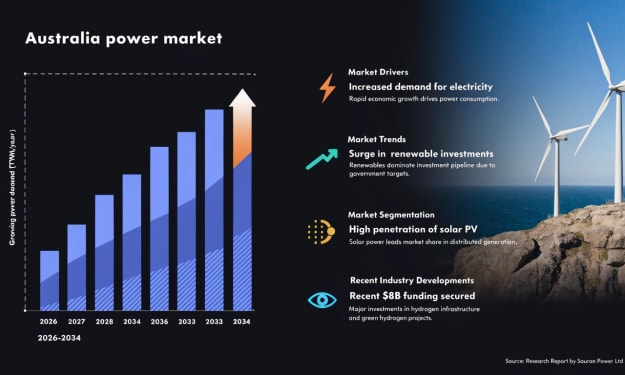
According to IMARC Group, the Australia power market reached 285.7 TWh in 2025 and is projected to reach 377.0 TWh by 2034, growing at a compound annual growth rate (CAGR) of 3.04% during 2026–2034. The market’s growth is being shaped by accelerating renewable energy adoption, increasing electricity demand and large-scale investments in grid modernization. Government incentives supporting clean energy transition, combined with rising corporate sustainability commitments, are encouraging the expansion of solar, wind and battery storage infrastructure. At the same time, the gradual phase-out of coal-fired power plants is transforming the structure of Australia’s electricity generation mix. With emerging technologies such as hydrogen energy systems and virtual power plants gaining traction, Australia’s power sector is evolving into a more diversified, digitally integrated and sustainable energy ecosystem.
By Kevin Cooper7 days ago in Futurism



Comments
There are no comments for this story
Be the first to respond and start the conversation.