

The entry point wasn't a door; it was a wound in the city’s municipal memory.
I crouched in the shadows of a service alley three blocks from the Central Library, staring at a rusted ventilation grate that had been paved over by three decades of asphalt and apathy. This was the "Dead Zone." In the late 1990s, the city’s urban planners had suffered a collective seizure of budget cuts and bureaucratic oversight, leaving a three-block radius of the underground poorly mapped and even more poorly maintained. During the seismic retrofitting of 2014, while I was drafting the stabilization plans for the library’s sub-basements, I’d found the discrepancy. According to the city’s digital map, this space was solid earth—a dense pack of silt and basalt. According to my memory, and the yellowed blueprints I’d stolen from the archives, it was a pneumatic waste corridor.
It was a hollow artery, a relic of a failed mid-century dream where trash would be whisked away by air pressure rather than garbage trucks. Now, it was a ghost-road that led directly into the Vane Corporation’s legacy vault.
I used a crowbar to pry back the edge of the asphalt. The sound of metal groaning against stone. The smell hit me next: the metallic tang of old dampness, the scent of wet soot, and finally, the ozonated, recycled air of a high-security facility. It was the scent of my former life—sterile, temperature-controlled, and utterly devoid of humanity. I slid into the dark, my boots clattering against the metal rungs of a vertical shaft that felt like a descent into the city's throat.
As I crawled through the narrow, galvanized ducts, the transition in architecture was immediate and offensive. I moved from my own clean, utilitarian lines—the work I’d done before the fall—into a section of the tunnel that had been "retrofitted" by Marcus during his first year as Senior Partner.
It was a masterclass in the architecture of incompetence. Marcus had installed a series of high-end, gold-plated sensor arrays along the ventilation ribs. To a corporate auditor or a Vane board member, they looked cutting-edge—sleek, expensive, and reassuring. They signaled "security" through sheer cost. To me, they were a structural disaster.
The sensors were placed on non-load-bearing joints, their weight causing the galvanized steel ductwork to sag and whistle with every cycle of the HVAC system. He hadn't understood the physics of airflow; he had simply wanted the most expensive equipment visible on the blueprints to justify a higher billable rate. He had draped Category 6 cables like jewelry instead of shielding them in conduits, leaving them to leak data-noise into the humid air. It was architecture as performance art—all facade, no foundation.
Diamonds and rust, I thought, the words a bitter, internal refrain that paced my heartbeat.
I remembered Marcus humming that old Joan Baez tune in our shared studio a decade ago. We were kids then, or at least we felt like it, fueled by caffeine and the delusion. Back then, his obsession with the "diamonds" had seemed like a harmless quirk—his need for the right brand of scotch, the tailored Italian suits. I had been content to study the "rust." I spent my nights in the shipyard, watching the way salt air interrogated suspension cables, and the way gravity eventually won every argument it entered.
I thought we complemented each other: I provided the bones, he provided the skin. I was the math; he was the sales pitch. I never realized that to Marcus, the bones were just an obstacle to the beauty of the curve. He viewed my obsession with structural integrity as a personal insult that made him feel small.
Now, the metaphor had become reality. I was rust, a creature of the sub-strata, crawling through the decaying guts of a city. Marcus sat in a diamond-clad office forty floors up, presiding over a grid he didn't even understand. He chose the glitter of the Order over the honest truth of iron.
Here, inside the Vane perimeter, the Static was curated. It was a low thrum, a heartbeat of the cooling fans. It felt like a predator.
Marcus replaced seismic dampeners with "Resonators." I could feel them through the ductwork. Instead of absorbing the city’s vibrations, they amplified them, tuning the building to a hungry frequency.
I reached a junction where the ductwork widened into the Sub-Level 3 monitoring station. I moved with grace, my fingers hooking into the rusted brackets. I wasn't just Silas Thorne the Architect anymore. The fall stripped away the "Glass King" and left something sharper.
I pressed my face against the louvers of the vent. The room below was a sterile, tiled laboratory of surveillance. In the center sat the main console, a monolith of obsidian glass that looked like a tombstone for my career. The purple light—the Order’s signature—pulsed in redundant loops along the ceiling, reflected in the polished tiles.
It was gaudy. It was insecure. It was a monument to a man who played at being an architect but lacked the discipline to respect the math of the universe. Marcus built a palace of glass, forgetting that glass doesn't bend. It shatters.
I pulled a small, hand-soldered bypass tool from my jacket—a device I’d built from the scraps of a discarded radio and a fractured circuit board I’d found in the shipyard. I didn't need a diamond-tipped drill to get through Marcus’s security. I didn't need his encrypted keys or his biometric scans. I just needed to know where the rust had already started to eat the hinges of his vanity.
"You always did prefer the shine, Marcus," I whispered into the dark, the metal of the vent cold against my cheek. "But the shine doesn't hold the weight."
I triggered the bypass. The purple lights flickered, stuttered, and then dimmed into a compliant, exhausted grey. The magnetic lock on the vent hissed as it lost its grip, a sigh of relief from a machine that was tired of lying. I dropped into the room, landing softly on the white tiles, the impact radiating through my bad leg like a reminder of why I was here.
I was inside the brain of the Scythe. Now, I had to find the proof that my own brother had calculated the cost of my family’s lives and decided they were worth the price of a seat at the table.
I stood before the central server—a monolith of obsidian glass and pulsing circuitry that seemed to swallow the light of the room. This wasn't just a computer; it was a reliquary. In the old world, a server was a tool for storage and calculation. Here, in the belly of the Vane Corporation’s legacy vault, it felt like an organ—a rhythmic lung that breathed in the city’s data and exhaled a filtered, predatory silence.
Unlike the rest of the bunker, which hummed with the mechanical inefficiency of Marcus’s "retrofitted" sensors, this console didn't make a sound. It respired. A low-frequency respiration that matched the "Static" of the city above, a 17.4-hertz heartbeat that I could feel in the marrow of my teeth.
I didn't use a keyboard. Marcus had moved beyond the tactile simplicity of typing; he’d installed a series of harmonic overrides, a security system that required a specific bio-resonant signature to unlock. He thought he was the only one who held the key. He forgot that we shared the same blood, the same DNA, and the same fundamental frequency of existence.
I pressed my thumb against the glass. The obsidian was cold, as if the machine were sucking the heat directly from my skin. I focused on the Static, I let it bleed into the glass, disrupting the frequency locks. For a second, the server resisted, a digital snarl vibrating against my thumb. Then, the screen flared. A cascade of gold and purple light—the colors of the Order, the colors of a royal funeral—resolved into a directory that read: Project Scythe – Personnel & Lineage.
I bypassed the executive boards. I bypassed the municipal leads and the slush funds used to bribe city council members. I scrolled past the lists of "Harvest Yields" and "Acoustic Dampening Zones" until I found the folder that had been calling to me from the dark: Thorne, M. – Contract of Intent.
The first file was a video log dated three years ago. The metadata was a knife to the gut: it had been recorded in the penthouse of the Vane Tower during the very hour I had been on stage at the Municipal Awards, receiving a standing ovation for the Blackwood Bridge design. While the city was crowning me as their god of steel, my brother was in the clouds, selling the nails for my coffin.
The video flickered to life. Marcus sat in a leather armchair, his face illuminated by the amber glow of a high-end scotch. He looked nervous, but it wasn't the stuttering, pathetic nervousness I’d grown used to covering for. It was the twitchy, predatory nervousness of a man who was finally about to get what he felt he deserved. He looked like a scavenger who had finally found a weakness in a lion.
Across from him sat Kael. The camera only caught the back of Kael’s head and the sharp, unnatural stillness of his posture. He didn't move. He didn't breathe. He just listened, a black hole of attention that drew Marcus’s desperation out of him like a confession.
"My brother is a man of 'absolute truths,'" Marcus’s voice came through the server’s speakers. It sounded thin and tinny in the sterile room, stripped of the charm he used to woo clients. "He thinks the bridge is a masterpiece of physics. He thinks he’s built something eternal. He doesn't realize it’s actually a masterpiece of vulnerability."
"Explain," Kael said. His voice was a cold anchor, a sound that made the Static in my head spike into a warning.
Marcus leaned forward, his eyes bright with a feverish, desperate envy that I had seen a thousand times but never truly understood. "Silas found a resonance flaw during the final stress tests. A specific frequency—17.4 hertz—that could turn the entire suspension system into a tuning fork. If that frequency is sustained, the steel doesn't just snap; it liquefies. The molecular bonds of the concrete lose their grip. The bridge becomes a liquid."
I felt the floor shift beneath me. I gripped the edge of the console, my knuckles white, my breath coming in shallow, jagged gasps. I remembered that day. I remembered the cold sweat on my brow when I saw the needle on the seismograph hit that specific, terrifying harmonic. I had spent six months of my life—and millions of the firm’s capital—installing the corrective dampeners. I thought I had buried the secret under a mountain of math. I thought I had protected the city.
"He spent six months 'correcting' it," Marcus continued, a sneer twisting his features. "He thinks he fixed it. But I have the original schematics. I have the dampener bypass codes he wrote into the master controller. I can give you the frequency that will bring his 'Gospel' to its knees. I can give you the exact moment the tide hits the pylon to trigger the oscillation."
"And what do you want in return, Marcus?" Kael asked.
"I want the firm," Marcus snapped, his composure breaking, his voice rising in a sharp, hysterical peak. "I want his name off the door. I want the 'Architect of the New Century' title to be a punchline in every architectural journal from here to London. I want him to watch the world I build while he’s rotting in the District of Rust. I want to be the one who finishes the 'Architecture of the Scythe.' He’s too soft for what’s coming. He believes in buildings. I believe in results."
The screen went black. A final document appeared—a scanned copy of a signed contract. It wasn't a standard employment agreement. It was a "Blood-Bond Transaction." The ink looked dark, almost purple, on the white digital background. Marcus hadn't just signed for a job; he had traded the structural integrity of the city’s most vital artery for a seat at the table of the "Grand Harvest."
He knew Maya would be on that bridge. I had told him that morning over breakfast that they were driving into the city for the ceremony. He had smiled at them. He had patted Maya on the head. And then he had gone to the penthouse and handed over the frequency that would turn their car into a plummeting casket.
The silence in the server room became heavy, a pressurized vacuum that felt like it was trying to implode my skull. I didn't cry. I didn't scream. The grief was too large for that; it had transcended emotion and become a structural failure of my soul.
Suddenly, the cooling fans slowed to a stop. The rhythmic respiration of the server died. The silence was absolute, followed by a sharp, metallic click from the overhead vents.
"You always were a better researcher than me, Silas," a voice boomed through the room’s intercom. It was Marcus. He wasn't speaking from the past anymore; he was watching me in real-time through the hidden lenses in the gold-plated sensors. "But you never understood the value of the shine. You’re obsessed with the bones of the building, but the people? They only care about the facade. They want the tragedy, Silas. They want the 'before and after.' They didn't want your perfect bridge; they wanted the story of its fall."
"You killed them, Marcus," I rasped, looking up at the camera lens, my voice a dry rattle. "You gave them the frequency. You turned my life’s work into an altar."
"I gave the city a reason to believe in something bigger than your sterile math," Marcus replied, his voice dripping with a casual, corporate cruelty that made him sound exactly like Kael. "I gave them a tragedy to mourn, and in that mourning, the Order harvested enough energy to power the Grid for a decade. And in return, the Order gave me the diamonds. You? You chose the rust, Silas. You chose to survive. So, it’s only fitting that you die in the mess you left behind."
The purple lights in the room began to pulse in a rapid, staccato rhythm—17.4 hertz. The vibration didn't just rattle the servers; it began to liquefy the very adhesive holding the glass panels of the floor together. The hunt was over. The duel had begun.
The vault didn’t just vibrate; it shrieked.
The 17.4-hertz frequency was no longer a mere sound—it had become a physical weight, a low-frequency hammer that bypassed my ears and struck directly at my internal organs. My vision blurred into a kaleidoscopic smear of white and purple. The air in the room, rapidly thinning as the pneumatic seals pulled the oxygen into the vents, began to thicken with the scent of ionizing dust and ozone. I could feel my own heartbeat trying to synchronize with the room, a rhythmic intrusion that threatened to stop my chest from moving.
Marcus was right about the vacuum, but he was wrong about the nature of my death. I wasn't going to suffocate; I was going to be shattered by the very "Gospel of the Grid" he had corrupted.
"The bones, Marcus," I wheezed, my lungs burning as I inhaled the metallic ghosts of the room. "You forgot... the bones."
I dropped to my knees, not in a gesture of surrender, but to find the "structural epicenter" of the vault. Every building has a soul, a singular point where all the tension, compression, and weight converge. In this vault, Marcus had followed the aesthetics of the Order—placing the server racks at the corners to maximize the empty, sterile floor space. It was a cosmetic choice, a move for the "shine." But the load-bearing center was a singular, reinforced column disguised as a minimalist decorative pillar.
I crawled toward it, the rebar in my hand humming like a live wire. The "Static" in my head was screaming now, a white-noise hurricane that fought against Marcus’s 17.4-hertz pulse. I was a man of cold lines, but I was being forced into a world of curves—the curves of sound waves, the curves of failing structural integrity.
"Look at you, Silas," Marcus’s voice boomed, distorted by the vibration of the intercom’s diaphragm. "The great Architect of the New Century, crawling on a white-tiled floor like a rat in a maze. You spent your life building cages for people and calling them masterpieces. Did you ever think you’d end up in one of your own design?"
"I didn't design this," I coughed, my palms flat against the tile. I could feel the adhesive beneath the floor losing its grip. The tiles were beginning to float on a layer of liquefied glue. "You did. You... and your lack of discipline."
"Discipline is for people who can't see the big picture," Marcus sneered. "I’m not building bridges, Silas. I’m building a legacy. The Order doesn't care if the dampeners are off by a fraction of a degree. They care about the resonance. They care about the way the city feels when the frequency hits. You were always too busy with your slide rule to notice that the world is moving toward the chaos you hate."
He was right, in a way. I had hated the chaos. I had built the Vane Tower and the Blackwood Bridge as bastions against the entropy of the world. But standing here, in the heart of the machine, I realized that Marcus hadn't conquered chaos—he had simply dressed it in a suit and gave it a seat on the board. He was using my math to feed the hunger of a cabal that viewed humans as nothing more than batteries for their occult grid.
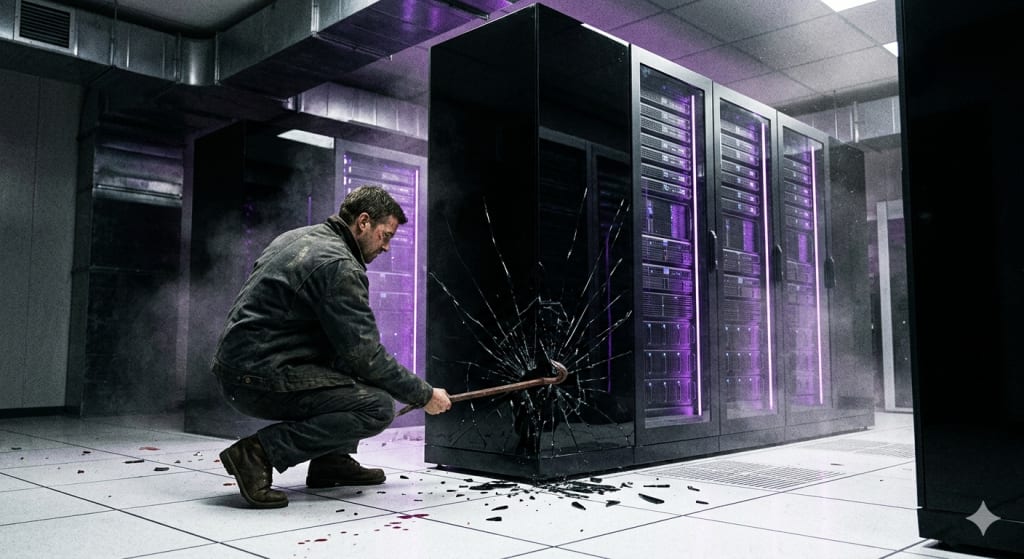
The vibration reached a new, terrifying threshold. The glass panels of the server racks began to spider-web, the cracks spreading like frost. A row of monitors detonated, showering the room in sparks and shards of liquid crystal. The purple light of the Order flickered, turning the room into a strobe-lit nightmare of failing geometry.
"This room is a vacuum-sealed resonance chamber," Marcus’s voice was fading now, losing the battle against the roar of the frequency. "In three minutes, the pressure will drop low enough to boil the blood in your veins. Enjoy the silence, big brother. It’s the only thing you ever truly wanted."
The intercom cut out with a sharp, final pop. I was alone with the frequency.
I pressed my ear against the central pillar. I could hear the concrete groaning deep inside the obsidian cladding. Marcus had tuned the room to 17.4 hertz because he knew it was the bridge's weakness, but he had failed to realize that every material has a limit. By tuning the room to destroy me, he had inadvertently tuned the vault to destroy itself. He had focused on the "diamonds"—the hard, reflective surface of the obsidian—without calculating the "rust"—the internal stress of the reinforced core.
I felt the pulse hit its peak—a moment of maximum tension where the glass was literally screaming under the stress, vibrating so fast it looked like it was made of smoke. This was the point of no return. In any structure, there is a moment before collapse where the weight is no longer being supported; it is being endured.
I gripped the rusted rebar, my fingers bleeding where the metal bit into my skin. I didn't need to be an architect anymore. I needed to be a demolitionist. I needed to find the one point where the "shine" was too brittle to hold the weight of the lie. I closed my eyes, letting the Static guide me, waiting for the frequency to hit the perfect, terminal note.
The obsidian didn’t just crack; it detonated.
Because Marcus had "retuned" the vault to vibrate at the pylon's terminal frequency, the glass had no flexibility left. It had become a pressurized solid waiting for a reason to fail. When my rusted rebar—a jagged piece of the old world—pierced the surface, the structural tension released in a singular, violent event. Shards of black glass, fine as needles and sharp as scalpels, sprayed outward like a claymore mine. I threw my arm over my eyes, feeling the sting of a thousand micro-cuts, but I didn't stop.
The vacuum seal faltered. As the glass cladding disintegrated, the shards were sucked into the intake vents by the very pressure differential Marcus had created to kill me. The scream of the 17.4-hertz pulse changed instantly, dropping into a jagged, mechanical grind as the HVAC motors choked on pulverized obsidian.
I scrambled up the server rack, my boots slipping on the blood-slicked white tiles. My bad leg was a pillar of fire, every nerve ending screaming in protest, but the Static in my head was louder. It was no longer a roar; it was a compass. I reached the ceiling and tore away a vent cover that Marcus had ignored because its placement disrupted the symmetrical "gold thread" lighting of his 3D model.
Behind it lay the "Sub-Level Bypass." It was a narrow, soot-choked crawlspace used for fire suppression pipes and ancient pneumatic lines. It was the "rust" of the building—the dark, ugly veins that the Vane Corporation tried to pretend didn't exist. I hauled myself into the dark just as the vault below reached its terminal resonance.
Behind me, the server racks buckled, the obsidian pillar groaned, and the "Honed Ashlar"—the Order’s master tuner—fell from its pedestal. I heard the sickening crunch of millions of dollars of hardware collapsing into a heap of silicon and glass. Marcus’s "diamonds" were finally breaking under the weight of the structural truth.
The crawl was a vertical labyrinth of agony. The bypass was never intended for human passage, certainly not for a man with a shattered gait and a mind fractured by the Static. The air was thick with the dust of half a century, a dry, choking powder that tasted of coal and forgotten blueprints. I climbed, my fingers hooking into rusted pipe brackets that sliced my palms, my shoulders scraping against the rough concrete of the secondary flues.
Every inch was a battle against gravity—the same gravity I had spent my life trying to master. In the penthouse, I had looked down on the world as its architect. Here, in the bypass, I was its prisoner. I felt the heat of the building’s core rising through the pipes, a feverish warmth that made my sweat turn to grime. I wasn't Silas Thorne, the Architect of the New Century, anymore. I was a creature of the sub-strata, a ghost moving through the veins of a dying giant.
"I’m coming for the firm, Marcus," I whispered into the soot, the words catching in my throat. Each syllable was a promise, a structural calculation of the revenge to come. "I’m coming for the name on the door."
I moved through the "blind spots" I had identified years ago. I bypassed the motion sensors by moving in sync with the building’s own seismic tremors. I navigated the junction boxes by memory, feeling for the cold iron pipes that led away from the central core and toward the city’s older, forgotten nervous system.
I emerged twenty minutes later through a storm drain three blocks away, a rusted iron grate being the only thing between me and the sky. I pushed it aside with the last of my strength and rolled onto the wet pavement.
The rain was a mercy. It was a cold, grey, washing the soot and the blood and the stench of the Vane Corporation from my skin. I lay there for a long time, staring up at the belly of the clouds, my chest heaving. The 17.4-hertz vibration was gone, replaced by the natural, entropic rhythm of the city: the hiss of tires on wet asphalt, the distant groan of the MAX train, the rhythmic drip of water from a broken gutter.
The city skyline loomed above me, shimmering with its fake "diamond" lights and its predatory purple glow. The Vane Tower stood at the center, a needle of glass piercing the heart of the mist. To anyone else, it was a masterpiece of modern design, a symbol of progress and power.
But as I stood up, leaning heavily on my rebar cane, I didn't see a skyscraper. I didn't see the "diamonds" or the "shine." I saw the cracks in the foundation. I saw the brittle joints and the misaligned load-paths. I saw a target.
The math of the lie was about to be solved, and I was the only one who knew the formula for the collapse. The "Architect of the New Century" was dead. The Man of Rust had arrived.
About the Creator
Nathan McAllister
I create content in the written form and musically as well. I like topics ranging from philosophy, music, cooking and travel. I hope to incorporate some of my music compositions into my writing compositions in this venue.
Cheers,
Nathan
Keep reading
More stories from Nathan McAllister and writers in Futurism and other communities.
Online Trading Platform Market Trends: Mobile Trading Adoption, AI-Driven Analytics & Industry Forecast to 2034
Rising internet penetration, the widespread adoption of smartphones, and the integration of advanced technologies like AI and blockchain are driving the demand for online trading platforms. These systems provide retail and institutional investors with real-time market access, automated tools, and a wide range of asset classes, including equities, cryptocurrencies, and derivatives. According to IMARC Group’s latest data, the global online trading platform market size was valued at USD 11.4 Billion in 2025. Looking forward, IMARC Group estimates the market to reach USD 17.9 Billion by 2034, exhibiting a CAGR of 4.96% from 2026-2034.
By Andrew Sullivan4 days ago in Futurism
I Wired ChatGPT Into My Daily Workflow
How automating “just a few tasks” with AI exposed the uncomfortable truth about knowledge work I wired ChatGPT into my daily workflow to save time on emails, documentation, and research. Within a month, I realized something unsettling: if I could design my job so that an AI could do 60–80% of it, what exactly was I being paid for?
By abualyaanart7 days ago in Futurism
Bomb Scare
It was 2027, and the world never thought it would happen. A missle hit the United States, but it wasn't where they had anticipated. A little town in the northeast was hit by a missile strike, they didn't know why, and they didn't know exactly where it hit, but they did know it was a coastal community, somewhere between Maine and Delaware.
By Gregory Payton8 days ago in Fiction




Comments
There are no comments for this story
Be the first to respond and start the conversation.