
Nvidia’s RTX 5070: Can It Really Rival the RTX 4090 for Just $549?
"How Nvidia's RTX 5070 Aims to Deliver Flagship Performance at a Fraction of the Price"

Nvidia has stirred up excitement in the gaming and tech world with a bold claim from CEO Jensen Huang. At CES earlier this week, Huang stated that the upcoming RTX 5070 graphics card would deliver RTX 4090-like performance at a much lower price of $549. Naturally, this statement has sparked plenty of debate online, with PC gamers and tech enthusiasts questioning how a mid-tier GPU could rival Nvidia's flagship RTX 4090, which costs a hefty $1,599.
So, can the RTX 5070 truly match the performance of the RTX 4090? The short answer: Yes and no. The longer answer lies in Nvidia’s new AI-powered DLSS 4 technology and how it’s redefining performance in gaming.
What’s Behind Nvidia’s Claim?
The RTX 5070’s claim to fame rests heavily on DLSS 4 (Deep Learning Super Sampling), the latest iteration of Nvidia’s AI-powered rendering technology. DLSS has been a game-changer for Nvidia, using artificial intelligence to generate high-quality frames and improve gaming performance.
The key feature of DLSS 4 is something called Multi Frame Generation. This technique allows the GPU to generate up to three extra frames for every frame traditionally rendered by the graphics card. In simpler terms, the AI fills in the gaps, boosting frame rates and making gameplay smoother.
Nvidia’s CEO even admitted, “Impossible without artificial intelligence,” emphasizing that the RTX 5070’s performance leap is thanks to cutting-edge AI technology. This approach allows the RTX 5070 to achieve performance levels that were previously only possible with the RTX 4090.
Are “Fake Frames” Really a Problem?
Not everyone is thrilled about Nvidia’s reliance on DLSS. Some gamers argue that AI-generated frames, often referred to as “fake frames,” aren’t the same as true rasterized frames—the kind we’ve been used to for decades. These critics believe that relying on AI for performance doesn’t reflect the raw power of the hardware.
This debate isn’t new. When Nvidia introduced DLSS 3, it faced similar criticism. However, for many gamers, the results were undeniable: higher frame rates, smoother gameplay, and impressive visuals.
According to Lars Weinand, a senior technical product manager at Nvidia, the RTX 5070 isn’t trying to outclass the RTX 4090 in every way. “Using neural rendering and DLSS 4, we can reach performance levels [on an RTX 5070] that were only possible with an RTX 4090,” Weinand explained. But he also clarified that this doesn’t mean the RTX 5070 will outperform the RTX 4090 in all scenarios.
The Reality of RTX 5070 vs. RTX 4090
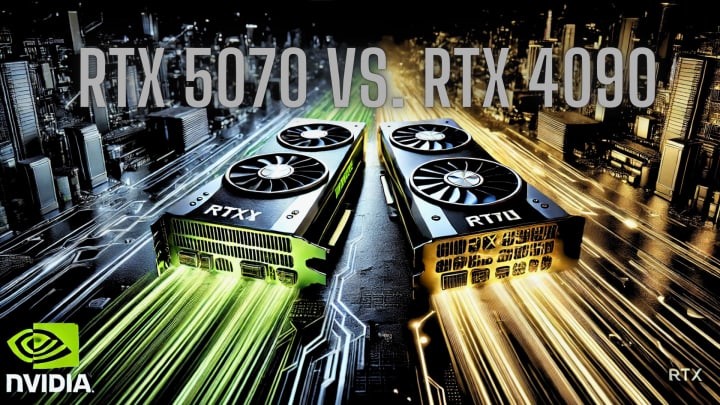
While the RTX 5070 can reach similar performance levels as the RTX 4090 in specific cases, it’s important to understand the context. The RTX 4090 is a powerhouse when it comes to raw hardware performance, with significantly more CUDA cores, memory bandwidth, and other features that make it the ultimate choice for demanding tasks like 4K gaming, ray tracing, and content creation.
The RTX 5070, on the other hand, relies on AI to bridge the gap. DLSS 4’s ability to generate additional frames allows it to deliver smooth performance in games, even if its hardware specs are more modest. This makes the RTX 5070 a fantastic option for gamers who want high performance without spending over $1,000.
However, there are limits. The RTX 5070 may struggle in situations where AI-based techniques can’t be applied, such as non-DLSS-supported games or tasks that require raw computational power.
Why the RTX 5070 Still Matters
Even with the debate over “fake frames,” the RTX 5070 is shaping up to be a game-changing GPU for most gamers. At $549, it offers a huge leap in performance compared to previous generations, thanks to AI innovations like DLSS 4. For gamers who prioritize value, the RTX 5070 could deliver an experience that rivals top-tier GPUs without breaking the bank.
Moreover, Nvidia’s focus on AI-driven technologies reflects a broader shift in the gaming industry. As games become more complex and visually demanding, traditional rendering methods alone may no longer be enough to meet performance needs. AI is stepping in to fill the gap, enabling smoother gameplay and better visuals without requiring massive hardware upgrades.
Final Thoughts
The RTX 5070’s claim of matching the RTX 4090’s performance is both exciting and controversial. While it’s clear that the $549 GPU won’t match the $1,599 flagship in raw power, it doesn’t need to. With DLSS 4 and Multi Frame Generation, the RTX 5070 offers a new way to achieve high performance, making cutting-edge gaming accessible to a much wider audience.
For many gamers, the RTX 5070 might just be the perfect balance of performance and price. And while some may still debate the value of AI-generated frames, the future of gaming is undoubtedly heading toward a blend of hardware power and AI-driven innovation. Whether you’re a skeptic or a believer, one thing is clear: Nvidia’s RTX 50-series GPUs are shaping the future of gaming.
About the Creator
Smart Home Technology: What Life Looks Like When Your Home Can Actually Think
It is seven in the morning and the kitchen already knows. The blinds have lifted just enough to let in soft light without waking anyone who is still sleeping. The kettle began heating two minutes ago.
By CurlsAndCommasa day ago in Futurism
Magnet Market Outlook: Industrial Machinery Demand, Automation Growth & Industry Forecast to 2025
The global magnet industry is undergoing a significant transformation, evolving from a traditional component sector into a strategic pillar of the modern green economy. According to IMARC Group’s latest data, the global magnet market size reached USD 41.75 Billion in 2024. Looking forward, IMARC Group estimates the market to reach USD 58.7 Billion by 2033, exhibiting a CAGR of 3.82% during 2025-2033.
By Andrew Sullivan7 days ago in Futurism




Comments (1)
Hello, just wanna let you know that if we use AI, then we have to choose the AI-Generated tag before publishing 😊