
North America Hydroponics Market Set to Hit US$ 10.75 Billion by 2033 as Smart Farming Moves Indoors
A decade of sustainable agriculture, tech-driven food security, and soil-free farming revolution


North America Hydroponics Market Synopsis
According to Renub Research, the North America Hydroponics Market is projected to reach US$ 10.75 Billion by 2033, up from US$ 3.64 Billion in 2024, growing at a robust CAGR of 12.79% from 2025 to 2033. Key catalysts include rising demand for locally grown pesticide-free produce, limited availability of arable land, water scarcity, increasing emphasis on sustainable agriculture, technological advancements, and growing public-private investment in controlled environment agriculture (CEA).
A New Era in Farming: Why Hydroponics is the Future
Hydroponics represents a leap from conventional soil-based agriculture to nutrient-rich water-based cultivation systems. It removes the dependency on fertile land and transforms how crops are produced—especially in regions facing urban expansion, soil depletion, and climate instability.
Unlike open-field farming, hydroponic methods feed nutrients directly to plant roots in controlled environments, enabling:
Up to 90% less water consumption
No soil dependency
Year-round crop cultivation
Minimal pesticide and herbicide requirement
Higher crop yield per square meter
Lower ecosystem disruption
Consistency in quality, regardless of seasonal shifts
From lettuce grown in vertically stacked trays inside urban warehouses to tomatoes ripening under AI-regulated LED lights, hydroponics is becoming the backbone of modern food systems, especially in North America’s climate-challenged regions.
Key Market Growth Drivers
1. Technological Advancements Fueling Precision Agriculture
North America leads the world in the adoption of advanced agricultural technologies. Hydroponic farms now deploy:
Artificial Intelligence (AI) to predict plant health and nutrient needs
IoT sensors for real-time monitoring of humidity, temperature, and crop stress
Automated climate control systems for optimized indoor environments
Energy-efficient LED lights that mimic sunlight wavelengths
Data analytics dashboards to track productivity and reduce waste
With smart automation becoming more accessible and cost-efficient, both commercial growers and small farm startups are increasingly transitioning to hydroponics, which significantly improves productivity while lowering operating risk.
2. Sustainability and Resource Conservation
Hydroponics supports green farming through:
Water recycling systems
Reduced carbon footprint from local production
No chemical runoff into soil or groundwater
Elimination of land degradation
Production closer to consumption points, reducing logistics emissions
A notable milestone in 2023 includes AeroFarms partnering with Amazon Fresh to expand consumer access to sustainably grown produce across online and retail platforms—an industry-signal event that validated hydroponics as a mainstream retail sourcing system.
3. Urbanization and Shrinking Farmland Availability
North America’s rapid urban expansion has reduced farmland accessibility. Hydroponics counters this by enabling food production in:
Rooftops of commercial buildings
Basement farming units
Indoor controlled greenhouses
Shipping containers
Vertical multi-layer farm stacks
This ability to decentralize farming makes cities more self-reliant, less vulnerable to global supply chain disruptions, and capable of producing ultra-fresh food within city limits.
Market Challenges That Need Addressing
High Initial Infrastructure Cost
The biggest barrier to widespread hydroponic adoption remains the high upfront capital cost. Setting up indoor farms requires investment in:
LED lighting arrays
HVAC climate systems
Hydroponic irrigation infrastructure
Fertilizer dosing systems
Monitoring sensors and automation controls
While long-term ROI is promising, small producers still struggle with entry affordability, especially without subsidies or financial incentives.
Regulatory and Certification Roadblocks
Hydroponic crops have long been caught in policy ambiguity around organic certification, since official organic norms traditionally require soil-based farming. This creates competitive uncertainty for hydroponic growers trying to win premium organic market segments, despite using cleaner and safer production methods than conventional farms.
Complex food safety compliance, zoning laws, and agricultural labeling rules also slow down expansion and investor confidence.
Country-Wise Market Outlook
United States: The Hydroponics Innovation Hub
The U.S. dominates the North American hydroponics landscape due to:
Rapid adoption of vertical and indoor farming
Heavy venture capital funding in AgTech
Retail partnerships, including grocery chains sourcing hydroponically grown produce
Consumer demand for clean, locally grown vegetables
Recent major developments include:
Hydrofarm opening a new distribution hub in California (Oct 2023) to support regional hydroponic farmers
Vertical Harvest securing funding to expand vertical farming capabilities
Growing integration of hydroponic produce into retail stores, restaurants, and institutional supply contracts
Canada: Year-Round Growth in Cold Climates
Hydroponics offers Canada a powerful solution to harsh winters and limited outdoor growing seasons. The method ensures:
Continuous production even in sub-zero climates
Stable domestic supply of fresh vegetables
Lower import dependency
Water-efficient farming practices
Urban food security initiatives and government-backed sustainability projects continue to boost hydroponics adoption in metropolitan areas like Toronto, Vancouver, and Montreal.
Mexico: Sustainable Farming Against Water Scarcity
Water scarcity remains one of agriculture’s biggest challenges in Mexico. Hydroponics mitigates this by:
Reducing agriculture water consumption
Supporting food cultivation in dry and semi-arid climates
Increasing crop reliability amidst climate unpredictability
Supporting agricultural exports with quality consistency
This presents hydroponics not just as an innovation, but as a practical agricultural expansion strategy.
Market Segmentation Overview
By Type
Aggregate Systems (Grow beds, gravel, sand, perlite, coco coir, etc.)
Liquid Systems (Nutrient Film Technique, Deep Water Culture, Aeroponics, etc.)
By Crop Type
Tomatoes
Herbs
Lettuce
Cucumbers
Peppers
Others
By Equipment
HVAC systems
LED grow lights
Irrigation systems
Material handling systems
Control systems
Others
By Geography
United States
Canada
Mexico
Rest of North America
Competitive Landscape Highlights
North America’s hydroponics market remains highly competitive, driven by innovation, scalable solutions, and strategic expansions across indoor farming networks.
Key Market Players
Village Farms International Inc.
Scotts Miracle-Gro
Signify NV
Bright Farms
FreshBox Farms
AmHydro
Lumigrow Inc.
GreenTech Agro LLC
Market Dynamics
Strong increase in indoor farming investments
Retail partnerships and grocery integration
Rising focus on farm-to-fork supply ecosystems
Increased R&D on energy-efficient equipment and automation
Industry Impacts and What Lies Ahead
Hydroponics is not just a farming alternative—it is restructuring the food economy by enabling:
Predictable supply chains independent of climate risk
Higher crop yield per square foot
Reduced environmental footprint
Improved food safety and traceability
Localized urban self-sufficiency in food production
With food demand expanding and farmland availability shrinking, hydroponics is no longer a fringe method but an essential future foundation for North American agriculture.
Final Thoughts
The hydroponics revolution is proving that future farming doesn’t need soil—just smart science, controlled environments, and efficient systems.
North America is at the forefront of this transformation, supported by sustainability goals, government initiatives, tech innovations, investor enthusiasm, and rapidly evolving consumer preferences for fresh, clean, and locally produced food.
By 2033, hydroponics will no longer be just a trend—it will be a cornerstone of how the region feeds itself.
About the Creator
Diya Dey
Market Analyst
About Binding Prometheus
I want to start actively advocating on behalf of my own work, and the most valuable part of my canon is, without a doubt, Binding Prometheus, the play I have been working on since 2019 and only finished in 2023 as part of my MA. The play itself is an amalgamation of a million different inspirations. On one end, it evokes the Ancient Greek myth-play, deriving its own title from the earliest extant work of Western drama we have, Aeschylus’s Prometheus Bound. On the other end, it borrows significantly from the sci-fi bulwarks from over the years, namely Mary Shelley’s Frankenstein and Karel Capek’s Rossum’s Universal Robots. The play could be an episode of Black Mirror, I fear. I don’t know. I’ve only ever seen one episode of Black Mirror.
By Steven Christopher McKnight19 days ago in Futurism
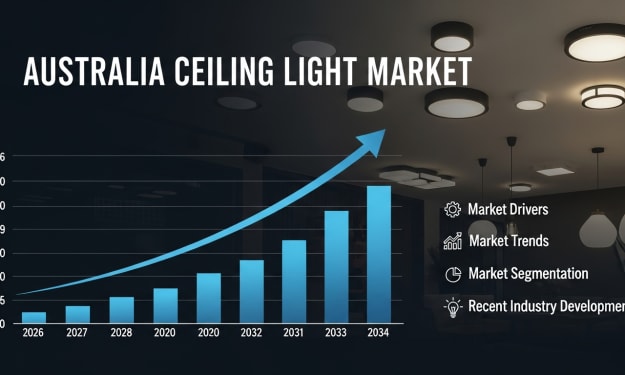
Australia Ceiling Light Market: Smart Illumination, Energy Efficiency & Future-Ready Living
In 2025, Australia ceiling light market was valued at USD 994.81 Million. Looking ahead, the market is projected to reach USD 1,461.66 Million by 2034, growing at a compound annual growth rate (CAGR) of 4.37% during 2026–2034.
By Kevin Cooper7 days ago in Futurism



Comments
There are no comments for this story
Be the first to respond and start the conversation.