
No Blindness Anymore; They Can See
How Neuralink’s Blindsight Could Restore Vision to the Blind


Imagine a world where a person who has never seen light, shape, or color suddenly begins to perceive the world around them—not through their eyes, but directly through their brain. Thanks to Elon Musk’s Neuralink, that world is no longer just a dream. With a revolutionary technology called Blindsight, Neuralink promises to restore vision in individuals who are completely blind—even those born without functioning eyes or optic nerves. This is not science fiction anymore. This is happening now.
What Is Blindsight?
Blindsight is Neuralink’s brain-computer interface (BCI) designed specifically to restore visual perception by directly stimulating the visual cortex of the brain. Instead of relying on the natural eye or optic nerve (which may be damaged or missing), Blindsight bypasses all traditional vision pathways and sends signals straight to the brain, enabling the person to "see" through artificial signals.
In September 2024, Neuralink received FDA Breakthrough Device designation for this innovative product, recognizing its potential to address a serious unmet medical need. Although not yet widely available, it’s a clear signal that the technology is headed for human trials—and eventually for the real world.
First Human Trials Coming Soon
Elon Musk has publicly stated that Neuralink is preparing to perform its first human trials for Blindsight by late 2025 or early 2026. Previous trials with Neuralink’s other BCI device, “Telepathy,” have already shown that paralyzed individuals can move cursors and type messages using only their thoughts.
Blindsight will take this a step further—by giving a blind person the ability to perceive visual information, even without using their eyes at all. A wearable external camera will capture the world in front of the user, and Neuralink’s implanted device will translate that information into neural signals that stimulate the brain’s visual center. At first, the vision will be basic—think Atari-style graphics, as Musk described. But for someone who has never seen light or shape, even the most primitive vision could be life-changing.
How Does It Work?
Neuralink’s system is based on an ultra-thin, flexible electrode array surgically implanted into the visual cortex using a custom-built surgical robot. These electrodes then stimulate specific neurons with encoded visual data. The visual data comes from a small external camera—worn like smart glasses—that captures images of the environment. The system’s AI converts those images into patterns of stimulation, sending them to the brain. The user’s brain then begins to interpret these signals as shapes, movement, light, or even text.
The amazing part is that it doesn't matter whether the user's eyes work or not. As long as the brain's visual processing areas are intact, Neuralink’s Blindsight can create a brand-new sensory experience.
What Will Users Be Able to See?
In its early stages, the vision restored by Neuralink will not match natural sight. Instead, users will likely see:
Points of light (called phosphenes)
Simple outlines or shapes
Contrasts between light and dark
Slow movement or basic direction of objects. For someone with total blindness, this can already restore independence—such as being able to navigate a room, walk outdoors, identify doors, or avoid obstacles.
Over time, as the technology improves, users could gain higher resolution and even enhanced perception beyond normal human capabilities.
The Road to Superhuman Vision
Neuralink’s long-term vision (no pun intended) goes far beyond restoring eyesight. Elon Musk has teased possibilities like:
Infrared vision for seeing in the dark
Ultraviolet detection for things invisible to the human eye
Object recognition through AI enhancement
Possibly even radar-like sensing for detecting motion through walls or smoke.
These advanced features could turn restored sight into augmented super-vision, allowing users not just to see again—but to see more than any human ever has.
What’s Next for Neuralink’s Blindsight?
Here are the major future milestones Neuralink is working toward:
1. Improved Resolution
Currently, the device supports hundreds to a few thousand electrodes. Future models will include tens of thousands, improving visual clarity and detail.
2. Smarter AI
The AI that converts camera input into brain signals will get better. Think of it as upgrading from a blurry camera to a 4K smart lens that learns your environment and personalizes your experience.
3. Adaptive Vision Software
The software will learn from the user's brain activity, adapting over time to improve accuracy and usability. With each use, the brain and Neuralink’s algorithm will grow more connected.
4. Wider Access
Neuralink plans to scale operations globally, opening surgical clinics and training specialized medical teams. Musk has indicated that within a decade, Neuralink may be able to perform 20,000 implants a year, changing thousands of lives.
Are There Risks?
As with all new medical technologies, there are challenges:
The surgical process involves brain implants, which carries risks of infection, tissue damage, or long-term compatibility issues. Congenital blindness (being born blind) may require more brain training, as the visual cortex may not be fully developed for image processing. Long-term studies are still needed to confirm how well the brain can adapt to artificial visual input. Neuralink is working closely with regulators and scientists to ensure safety, ethical testing, and transparent reporting.
Who Will Benefit?
Blindsight is aimed at people who are:
Fully blind, have lost eyes or have non-functioning optic nerves, have damage from trauma, genetic disorders, or degenerative diseases As long as the visual cortex is healthy, even if a person has been blind since birth, there is hope that they may be able to gain vision—something once thought impossible.
The Beginning of a New Era
For centuries, blindness was permanent. Medical science helped slow vision loss, but true vision restoration was out of reach. Now, thanks to Neuralink’s Blindsight, we’re on the verge of turning blindness into a treatable condition—perhaps even into an opportunity for augmented human vision. The path won’t be easy. The technology is still young. The journey has just begun. But the promise is undeniable:
No blindness anymore. They can see.
And soon, many more will.
About the Creator
Keramatullah Wardak
I write practical, science-backed content on health, productivity, and self-improvement. Passionate about helping you eat smarter, think clearer, and live better—one article at a time.
Keep reading
More stories from Keramatullah Wardak and writers in Futurism and other communities.
Now, you can message offline “Bitchat”:
In a digital age where connectivity is often considered a lifeline, the recent unveiling of Bitchat by tech entrepreneur Jack Dorsey feels nothing short of revolutionary. Bitchat is a peer-to-peer messaging app that does not require Wi-Fi, internet, or cellular service. Instead, it operates solely via Bluetooth, creating a mesh network among nearby devices. The idea is simple, yet transformative: to enable secure, private, and censorship-resistant communication—even during complete internet blackouts.
By Keramatullah Wardak8 months ago in Futurism
Ball Bearing Market: Aftermarket Replacement Demand, Maintenance Solutions & Industry Growth Ahead
According to IMARC Group's latest research publication, the global ball bearing market size reached USD 45.46 Billion in 2024. Looking forward, IMARC Group expects the market to reach USD 65.05 Billion by 2033, exhibiting a growth rate of 3.65% during 2025-2033.
By sujeet. imarcgroup7 days ago in Futurism
Australia Digital OOH Advertising Market: Technology Adoption, Audience Targeting & Programmatic Growth
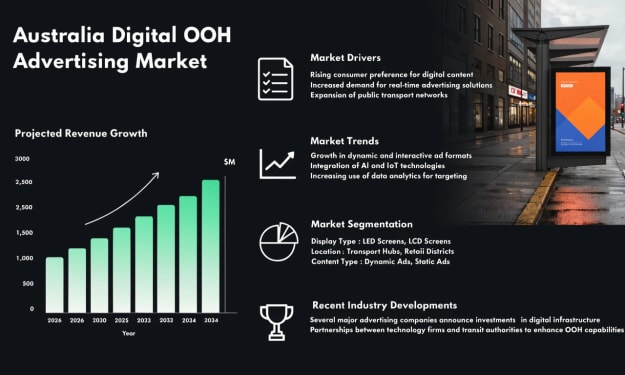
According to IMARC Group, the Australia digital out-of-home (OOH) advertising market reached USD 474.2 Million in 2025 and is projected to grow to USD 1,096.9 Million by 2034, exhibiting a compound annual growth rate (CAGR) of 9.47% during 2026–2034. The market’s expansion reflects the rapid digital transformation of outdoor advertising infrastructure across Australia. Increasing smartphone penetration, advancements in display technologies and the growing shift from traditional static billboards to data-driven digital platforms are redefining how brands connect with audiences. Government-backed smart city initiatives and the rising integration of programmatic buying are further strengthening market momentum.
By Kevin Cooper7 days ago in Futurism



Comments
There are no comments for this story
Be the first to respond and start the conversation.