
New Types of Antennas for Light-Year Communication: A Breakthrough in Interstellar Connectivity
Space

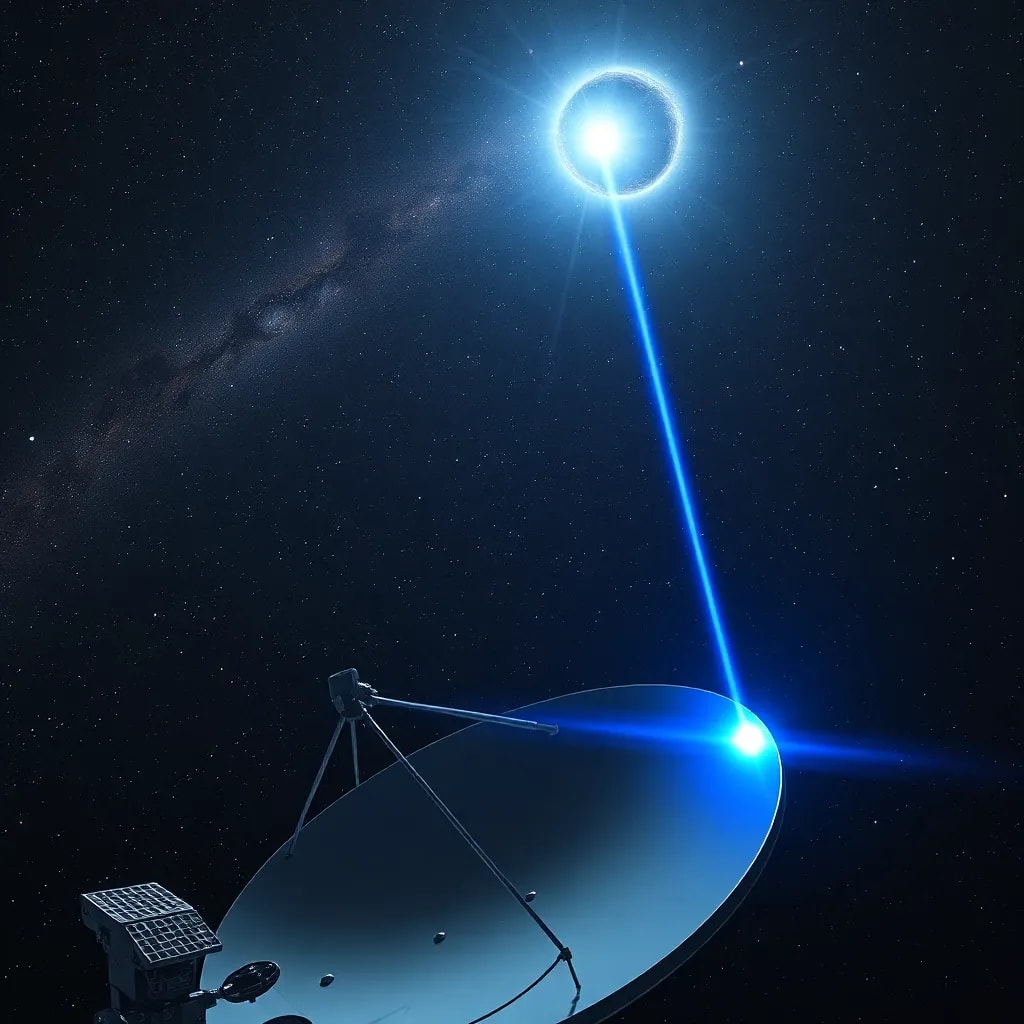
In the age of space exploration, one of the most profound challenges is communication over truly astronomical distances. Talking across millions even billions of kilometers isn’t just a matter of turning up the volume. It requires entirely new thinking. While traditional radio waves crawl through the vacuum of space at the speed of light, humanity is racing to develop smarter, faster, and more resilient ways to send messages to the stars. New generations of antennas are now being designed with interstellar ambitions and they could revolutionize how we stay in touch across light years.
Why Traditional Antennas Fall Short
Massive ground-based radio telescopes like the late Arecibo Observatory or the Very Large Array in New Mexico have served us well for deep space probes, planetary observations, and even receiving faint whispers from Voyager 1, now over 20 billion kilometers away. But beyond the Solar System, their limitations become painfully clear:
- Signal degradation: Energy dissipates exponentially over distance, following the inverse square law.
- Time delay: Even a message traveling at light speed takes 4.24 years to reach Proxima Centauri, the closest star.
- Low data rates: At interstellar distances, even sending a photograph becomes a technological feat.
Clearly, to connect across the stars, we need a new class of communication systems. And that starts with antennas.
Laser Antennas: Transmitting on Beams of Light
One of the most promising directions is the development of laser-based optical antennas. These devices don’t broadcast in all directions like traditional antennas; they use ultra focused beams of photons light particles to deliver information across vast distances.
Why this matters:
- Extreme precision: Narrow beams mean less dispersion and lower energy loss.
- High-speed data transfer: Theoretical rates range from gigabits to terabits per second.
- Resistance to noise: Unlike radio signals, laser communications are far less affected by cosmic background radiation.
Challenges? Accuracy is everything. To communicate across light years, both sender and receiver must be perfectly aligned, and even interstellar dust can scatter or absorb the signal. Still, NASA’s Deep Space Optical Communications (DSOC) project is already testing laser antennas for near-future missions.
Metamaterial Antennas: Sculpting the Wave Itself
Now enter the strange world of metamaterials engineered substances with properties not found in nature, like a negative refractive index. These materials can manipulate electromagnetic waves in extraordinary ways.
With them, scientists are designing hyper-directional antennas that "twist" and focus signals far more efficiently than conventional designs. These antennas could work across multiple frequencies, from radio to infrared and even visible light.
Imagine an antenna that doesn’t just send a signal it shapes it, bends it, and threads it through space like a needle through fabric.
Bio-Photonic Antennas: Nature-Inspired Nanotech
Some of the most unexpected breakthroughs are emerging from biology. Researchers are now exploring antennas modeled on bioluminescent creatures think glowing jellyfish, deep-sea fish, and luminous fungi.
By mimicking how these organisms emit and control light, scientists are developing nano structured antennas that use coherent light at the molecular level. In the future, such systems might be embedded in microscopic probes sent to explore other stars each one no larger than a grain of rice, but capable of whispering home across the cosmos.
Gravitational Lens Antennas: Using the Cosmos Itself
Perhaps the most mind-bending concept involves using the universe as a tool. In Einstein’s theory of general relativity, massive objects like stars and black holes can bend space-time creating gravitational lenses.
If we place a receiver behind the Sun, at around 550 astronomical units (over 80 billion kilometers away), it could theoretically use the Sun’s gravitational field to focus and amplify distant signals from another star system.
We haven’t built one yet but the idea is under serious consideration, especially for missions beyond the heliopause.
Quantum Superconducting Receivers: Detecting the Faintest Echoes
Some signals from deep space are so faint they barely exist. To catch them, we need quantum sensitive antennas that can detect individual photons. These receivers operate near absolute zero and use principles of quantum mechanics to extract usable data from nearly nothing.
Such antennas may become essential for receiving transmissions from interstellar probes like those envisioned in the Breakthrough Starshot initiative a project aiming to send tiny laser driven craft to Alpha Centauri at 20% the speed of light.
Why This Matters for Humanity
Fast spacecraft are pointless without fast communication. As we launch missions further from Earth and possibly beyond our star system we must ensure we can hear from them and talk back.
These new antenna technologies are more than just technical marvels. They’re the building blocks of a galactic internet, one that could someday link Earth with distant colonies, scientific probes, and who knows maybe even intelligent civilizations.
The Road Ahead
Imagine a future where Earth is a communication hub in a vast interstellar network. Billions of smart devices, spacecraft, and observatories exchange information not via primitive radio but through beams of coherent light, gravitationally focused transmissions, or even quantum teleportation.
We’re not there yet but the antennas of tomorrow are already being born. And they may be the key to turning the cosmic silence into a conversation.
About the Creator
Keep reading
More stories from Holianyk Ihor and writers in Futurism and other communities.
Space-Based Earthquake Forecasting: How Satellites and AI Are Transforming Seismology
Earthquakes are among the most destructive natural forces on our planet. They strike without warning, flatten cities, trigger tsunamis, and leave behind human and economic devastation. Despite decades of progress in geophysics and seismology, scientists still struggle to predict exactly when and where an earthquake will strike. But now, an unlikely ally is rising to meet the challenge: space.
By Holianyk Ihor7 months ago in Futurism
About Binding Prometheus
I want to start actively advocating on behalf of my own work, and the most valuable part of my canon is, without a doubt, Binding Prometheus, the play I have been working on since 2019 and only finished in 2023 as part of my MA. The play itself is an amalgamation of a million different inspirations. On one end, it evokes the Ancient Greek myth-play, deriving its own title from the earliest extant work of Western drama we have, Aeschylus’s Prometheus Bound. On the other end, it borrows significantly from the sci-fi bulwarks from over the years, namely Mary Shelley’s Frankenstein and Karel Capek’s Rossum’s Universal Robots. The play could be an episode of Black Mirror, I fear. I don’t know. I’ve only ever seen one episode of Black Mirror.
By Steven Christopher McKnight16 days ago in Futurism
Macarons Market: Premium Dessert Demand, Flavor Innovation & Gourmet Bakery Trends
According to IMARC Group's latest research publication, global macarons market size reached USD 1,077.8 Million in 2024. Looking forward, IMARC Group expects the market to reach USD 1,715.4 Million by 2033, exhibiting a growth rate (CAGR) of 5.03% during 2025-2033.
By sujeet. imarcgroupa day ago in Futurism



Comments
There are no comments for this story
Be the first to respond and start the conversation.