
New Shoe Technology 2026: 3D Printed Shoes
— The Digital Power Transition and Performance Revolution Beneath the Feet


The Leap from Chemical Foaming to Geometric Programming
For the past century, the core competitiveness of athletic footwear has been dominated by material chemistry. From early rubber to the industry-sweeping EVA (ethylene-vinyl acetate), and now to the supercritical foaming materials (such as Pebax) that major brands take pride in, humanity has been searching for the perfect bubble. However, physical performance improvements will eventually hit the ceiling of material chemistry. Traditional foamed materials are microscopically disordered collections of bubbles, meaning their force response is isotropic, and over time, irreversible performance degradation occurs due to bubble collapse. As we enter 2026, we are witnessing a profound technological paradigm shift. 3D printed shoes have officially shed the label of “concept prototypes” and become mainstream in the high-performance athletic market. The core of this revolution lies in the fact that competition in the footwear industry has quietly shifted from “finding better bubbles” to “designing perfect geometry.” Through digital additive manufacturing, we have for the first time achieved precise programming of physical mechanics at the millimeter scale. 3D printed shoes in 2026 are no longer just “cool-looking” geek toys; they have comprehensively surpassed traditional racing shoes in energy return, weight control, breathability, and foot health management. This is not merely an upgrade in manufacturing processes but a digital rebirth of footwear technology beneath our feet. This article will delve into the core technological pillars of 3D printed shoes in 2026, material breakthroughs, brand real-world cases, and how they are reshaping the global supply chain.
2026 Market Landscape: From Gimmick to Mainstream in the Mass Production Era
According to the latest industry data in 2026, the global 3D printed footwear market has entered a mature phase. It is projected to reach $2.61 billion by 2029, with a compound annual growth rate (CAGR) of 18.9%. In Google Trends heat analysis, “3D printed shoes” reached a historical peak of 91 in mid-2025 and stabilized above 60 in early 2026, reflecting that consumer acceptance of digital footwear has shifted from early “novelty-seeking” to performance-based “essential demand.”
Core Technological Pillars: Speed Revolution and the Soul of Data
Speed Revolution: AIHALS vs. DLS
For a long time, printing speed has been the biggest stumbling block to the widespread adoption of 3D printed shoes. In 2026, this bottleneck has been completely broken by patented technology.
- DLS (Digital Light Synthesis): As the core technology foundation for Adidas, Carbon’s DLS utilizes an “oxygen dead zone” to achieve continuous photocuring. It ensures the midsole has isotropic mechanical properties with extremely high strength. However, its production costs and speed remain strained when facing trillion-scale consumer markets.
- AIHALS (Artificial Intelligence Hindered Asynchronous Light Synthesis): The most noteworthy technological breakthrough in 2026 comes from ARKKY. HALS technology achieves a 20-100x printing speed increase.
Asynchronous control logic: Unlike traditional synchronous control, HALS combines AI-driven partitioned light control technology. It can adjust light intensity distribution in real time every microsecond, eliminating suction force obstacles during printing.
Mass production efficiency: In ARKKY’s smart factories, printing time for a single pair of shoes is reduced to 20-60 minutes, with factory equipment TAP clusters achieving daily output exceeding 20,000 pairs, marking that 3D printed shoes now possess the economic viability to compete with traditional assembly lines.
Data-Driven: Programming from Gait to Lattice
In 2026, the midsole is no longer a rigid rubber block but a “data entity.”
- Adidas STRUNG 4D: Adidas transforms 17 years of accumulated athlete foot data (Gait Data) into digital instructions. Through STRUNG fiber technology, the direction of every fiber and the angle of every lattice strut are designed to respond to specific impact vectors.
- Parametric modeling: Through AI-driven topology optimization, the midsole can be precisely divided into “shock absorption zones,” “stability zones,” and “propulsion zones.” Dense lattices at the heel absorb energy, while tough lattices at the forefoot provide propulsion—this millimeter-level performance tuning is completely unattainable with traditional mold production.
Material Science Breakthroughs: Bio-Based and Circular Economy
Material innovations in 2026 focus not only on performance but also on the future of the planet.
High-Performance Bio-Based Composites
ARKKY’s 53% bio-based composite material launched in 2026 has become an industry benchmark. This material not only reduces dependence on fossil fuels but its TPU Air HR (high resilience) properties show in mechanical tests that its energy return rate even surpasses the supercritical foaming materials used in top marathon shoes.
Mono-Material and Closed-Loop Recycling
Traditional athletic shoes are bonded from more than a dozen materials such as foam, rubber, fabric, and glue, making them almost impossible to disassemble and recycle. 3D printed shoes in 2026 (such as those from Zellerfeld and ARKKY) emphasize a “mono-material” strategy.
- Physical remelting: The entire shoe is made from a single high-performance polymer. When worn out, consumers can return it to a “micro-factory,” where it is shredded, cleaned, and repurposed into printing raw material.
- Glue-free process: Through integral forming technology, the use of toxic adhesives is completely eliminated, while also improving the shoe’s durability and tear resistance.
Brand Real-World Cases: Adidas, ARKKY, and Nike
Adidas 4DFWD: Master of Directional Propulsion Mechanics
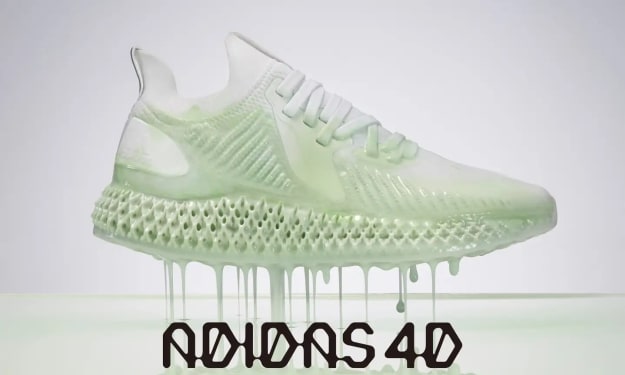
As the industry evangelist, Adidas’s 4DFWD reached its performance peak in 2026. Its unique “bow-tie” shaped lattice (FWD CELL) undergoes shear deformation under vertical pressure, physically converting vertical impact into forward propulsion. Experimental data shows it generates 3 times the forward momentum of previous generations while reducing braking force by 15%. This has truly taken 4D technology from “fashion runways” to “professional tracks.”
ARKKY: Pioneer in Mass Production Efficiency and Breathability
If Adidas proved the performance of 4D, ARKKY has proven the democratization potential of 3D printed shoes.
- Full-vent system: ARKKY utilizes its high-precision lattice technology to achieve true 360-degree air circulation. Tests show that ARKKY running shoes have 40% higher internal heat dissipation efficiency than traditional mesh running shoes.
- CozLite and AeroDash series: Tailored for daily commuting and high-intensity exercise, ARKKY offers differentiated lattice density configurations. Its extremely high cost-performance ratio has made 3D printed shoes price-competitive with high-end traditional running shoes for the first time.
Nike & Zellerfeld: Dual-Color Commercialization and Aesthetic Revolution
The Nike and Zellerfeld collaboration on the Air Max 1000 caused a sensation in 2026. This is the world’s first commercially available dual-color 3D printed shoe. This technological breakthrough has allowed 3D printed shoes to move beyond monotonous raw colors, successfully capturing the fashion market through layered visual depth and artistry.
Four Major Advantages of 3D Printed Shoes
- Geometric-level physical rebound: Unlike foamed materials that rely on chemical bubbles, 3D printing relies on the physical elasticity of geometric structures. These “physical springs” maintain nearly lossless rebound even after 1,000 kilometers, completely solving the chronic issue of rapid degradation in running shoes.
- Ultimate breathability: By eliminating traditional layered composites, air can flow directly through the midsole and upper lattices. In the hot summers of 2026, this has become the top choice for professional runners.
- Ultra-personalized health management: Through integrated orthotic design, 3D printed shoes can dynamically adjust support based on the wearer’s flat feet or high arches. This is not just an improvement in comfort but a medical-grade means of preventing chronic injuries like plantar fasciitis.
- Supply chain revolution: The shift from “mass production” to “scan-to-print” enables brands to achieve “zero inventory” and “local manufacturing,” dramatically shortening the distance from design to consumer.
Conclusion
2026 is just the beginning. With the further popularization of AIHALS technology and the declining cost of bio-based materials, we predict that by 2030, over 30% of high-performance athletic shoes will be produced through additive manufacturing. Future footwear will no longer be mass-duplicated commodities from factories but digital extensions of each runner’s biomechanical characteristics. In 2026, we are running toward a digital future at an unprecedented speed.
About the Creator
4Dshoes
Auteur Sociologist and Fashion Tech Expert, specializes in 4D printed footwear. His research focuses on how 3D printing reshapes footwear design, enhances comfort, and drives sustainability in the fashion industry.
Recommended: arkky.com
About Binding Prometheus
I want to start actively advocating on behalf of my own work, and the most valuable part of my canon is, without a doubt, Binding Prometheus, the play I have been working on since 2019 and only finished in 2023 as part of my MA. The play itself is an amalgamation of a million different inspirations. On one end, it evokes the Ancient Greek myth-play, deriving its own title from the earliest extant work of Western drama we have, Aeschylus’s Prometheus Bound. On the other end, it borrows significantly from the sci-fi bulwarks from over the years, namely Mary Shelley’s Frankenstein and Karel Capek’s Rossum’s Universal Robots. The play could be an episode of Black Mirror, I fear. I don’t know. I’ve only ever seen one episode of Black Mirror.
By Steven Christopher McKnight28 days ago in Futurism
Saudi Arabia Juvenile Products Market: Rising Birth Rates, Premiumization & Expansion
According to IMARC Group's latest research publication, Saudi Arabia Juvenile Products Market size was valued at USD 240.13 Million in 2025. The market is projected to reach USD 417.21 Million by 2034, exhibiting a growth rate (CAGR) of 6.33% during 2026-2034.
By Jeffrey Wilsonabout 24 hours ago in Futurism
The Path to Salvation
The late autumn evening air filled the monk's lungs, but it wasn't the season that chilled his bones. The heavy-handed presence of evil he had sensed upon entering the woods surrounding this mountain village had not bothered to conceal itself from him.
By Made in DNA7 days ago in Fiction



Comments
There are no comments for this story
Be the first to respond and start the conversation.